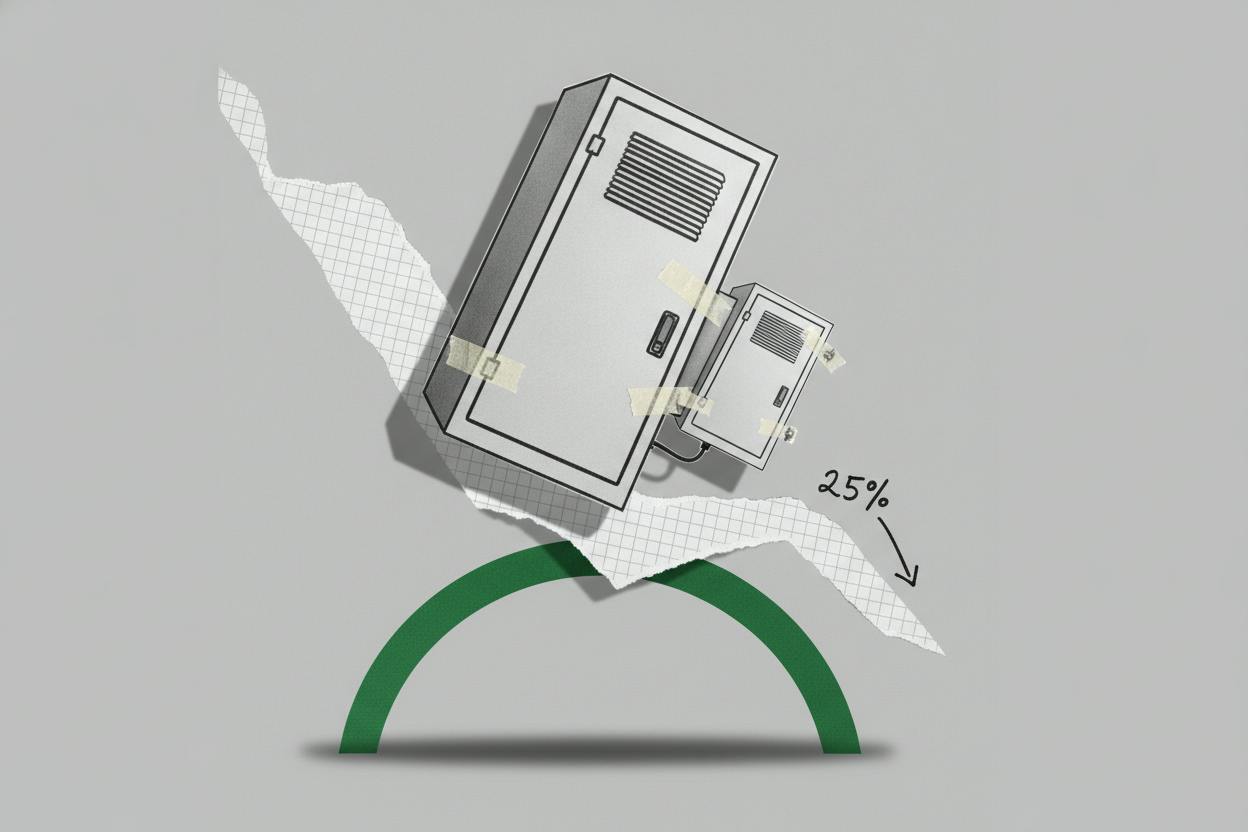
Schneider Electric, the French industrial giant, has seen its stock tumble roughly 25% since announcing plans to acquire US software firm PTC. But RBC Capital Markets is pushing back against the market's pessimism, arguing the sell-off is out of proportion to what the deal actually changes.
In a note to clients, RBC maintained its “outperform” rating on Schneider and kept its price target unchanged at 320 euros. The bank described the drop as “unjustified,” suggesting investors may be overreacting to the acquisition's risks.
What the PTC deal brings
PTC is a Massachusetts-based company that makes software for product design and lifecycle management, tools widely used in manufacturing and engineering. For Schneider, which specializes in energy management and industrial automation, adding PTC would broaden its software offerings and deepen its reach into the factories and plants where its hardware already operates.
RBC argues that the deal strengthens Schneider's industrial-automation franchise rather than exposing it to a new, riskier business. The bank specifically pushed back on the idea that the acquisition suddenly ties Schneider to the volatile “AI software” sector, a space that has seen sharp swings in investor sentiment recently.
The broader market context matters here. Tech and software stocks have been under pressure as investors worry about high valuations and the pace of AI-related spending. But RBC's view is that PTC's software is more about industrial efficiency than speculative AI hype, meaning the sell-off may reflect a misreading of the deal.
The debate over value
The bigger question investors are wrestling with is whether the acquisition will actually create value after accounting for the cost of financing it. RBC acknowledged that the deal “may be challenging” for Schneider's return on invested capital (ROIC)—a measure of how efficiently a company turns its capital into profits.
ROIC is a key metric for investors because it shows whether management is deploying money wisely. If a big acquisition drags ROIC down, it can signal that the purchase price was too high or that the expected synergies won't materialize quickly. RBC's caution on this front is a reminder that even supporters of the deal see some hurdles.
Still, the bank's overall stance is that the market has already priced in too much negativity. The 25% drop is a steep reaction, and RBC believes the long-term benefits of adding PTC—broader software capabilities, deeper customer relationships, and a stronger position in the automation market—outweigh the near-term financial drag.
What it means for investors
For everyday investors, this episode highlights how sharply markets can react to acquisition news. A deal that looks logical on paper can still trigger a big sell-off if investors worry about price, debt, or execution risk. The key is to separate the immediate market mood from the underlying business logic.
RBC's decision to hold its price target suggests it sees the current share price as a potential opportunity, but that doesn't mean the stock is a guaranteed winner. Acquisitions always carry integration risks, and the financing costs could weigh on earnings for quarters to come.
Investors should also consider the broader backdrop. European markets have been trading cautiously amid mixed economic signals, and tech stocks globally have been sensitive to profit forecasts that may be too optimistic. Schneider's sell-off is a reminder that even solid companies can see sharp moves when sentiment turns.
Looking ahead, the focus will be on how Schneider finances the deal and whether it can deliver the promised synergies. If the company shows progress on integrating PTC and protecting its returns, the stock could recover. If not, the market's skepticism may prove justified.
For now, RBC's stance offers a counterpoint to the panic, but investors should weigh the risks themselves. The deal is far from a sure thing, and the 25% drop shows that the market is not convinced—at least not yet.