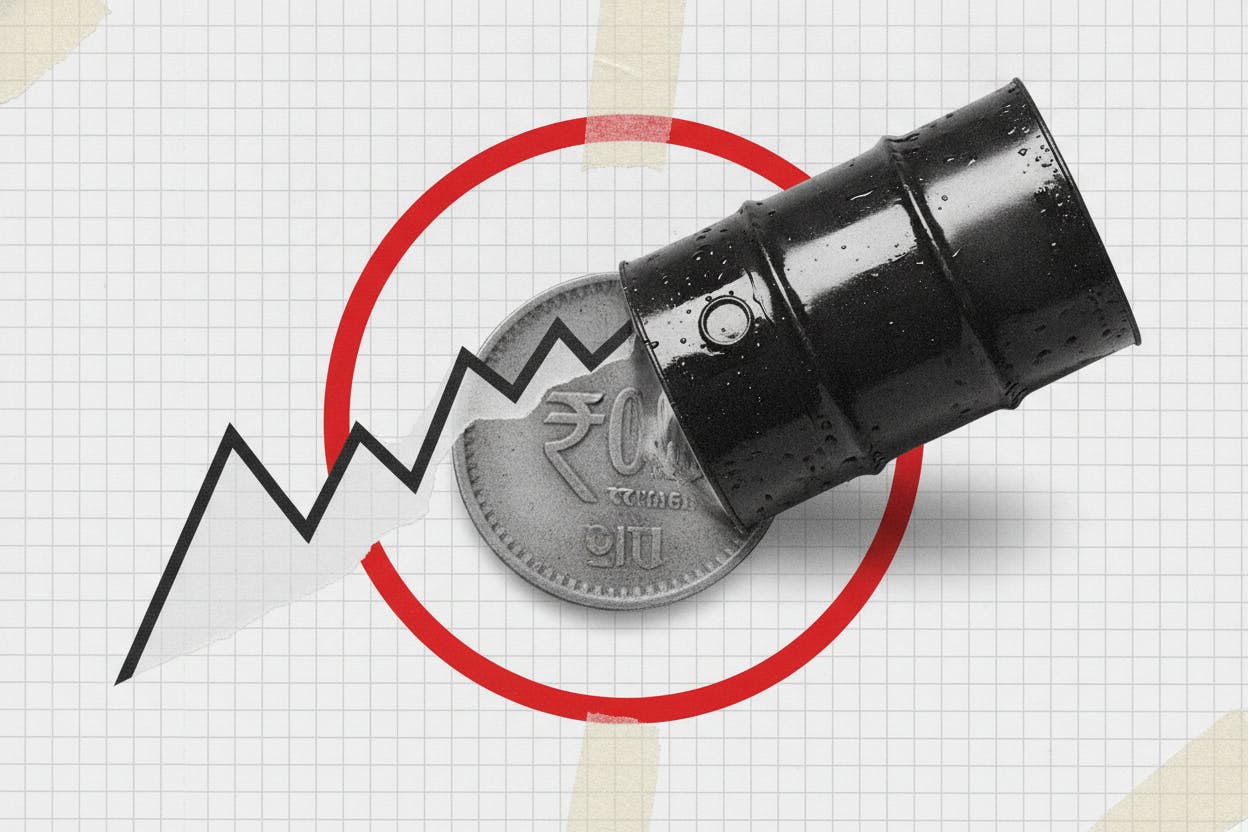
The Indian rupee is bracing for a weaker start on Monday, caught between two powerful forces: a more hawkish Federal Reserve and rising oil prices. Traders are penciling in an opening around 95.55-95.60 per dollar, after the currency closed Friday at 95.3775, according to Reuters.
The pressure comes from two directions. First, Fed Chair Kevin Warsh sounded more hawkish than expected, suggesting the central bank may need to raise interest rates further to bring inflation back to its 2% target. That pushed up expectations for a rate hike at the Fed's September 15-16 meeting, with markets now pricing in nearly a 60% chance, up from about 35% before Warsh's comments.
Second, Brent crude oil jumped toward $90 a barrel on renewed tensions in the Strait of Hormuz, a critical shipping lane for global oil supplies. Higher oil prices are a double-edged sword for India, which imports most of its crude, as they widen the trade deficit and put downward pressure on the rupee.
Why the Fed matters for the rupee
The Federal Reserve's policy stance has a direct impact on the rupee. When the Fed signals higher interest rates, US Treasury yields rise, making dollar-denominated assets more attractive to global investors. That tends to pull capital out of emerging markets like India, weakening their currencies.
Warsh's comments, which reaffirmed the Fed's commitment to price stability, have already boosted the dollar and US yields. The dollar is holding near recent highs, and this strength is directly weighing on the rupee.
For Indian investors, a weaker rupee means imported goods become more expensive, which can feed into domestic inflation. It also affects companies with foreign debt or those that rely heavily on imports, as their costs rise.
Oil's role in the rupee's slide
Oil is another major factor for the rupee. India is one of the world's largest oil importers, so when crude prices climb, the country's import bill swells. This increases demand for dollars, putting additional pressure on the rupee.
The recent jump in Brent toward $90 a barrel, driven by tensions in the Strait of Hormuz, is particularly concerning. The strait is a vital chokepoint for global oil shipments, and any disruption there can send prices spiking. For India, this means a higher import bill and a wider current account deficit, both of which are negative for the currency.
Higher oil prices also have a knock-on effect on domestic fuel prices, which can stoke inflation and potentially prompt the Reserve Bank of India (RBI) to keep interest rates higher for longer.
What to watch: the RBI's intervention line
All eyes are now on the RBI's likely intervention level. Traders have identified a range of 95.70-95.80 per dollar as a line the central bank may defend. The RBI often steps into the forex market to smooth excessive volatility, either by selling dollars to support the rupee or by buying dollars to prevent it from strengthening too much.
If the rupee approaches that level, the RBI could intervene to slow its decline. However, the central bank's ability to defend a specific level depends on its dollar reserves and the broader market sentiment. In the past, the RBI has allowed the rupee to move gradually, stepping in only to prevent sharp swings.
For investors, the key question is how far the rupee can fall before the RBI acts. A weaker rupee can be a double-edged sword for the stock market: it helps exporters but hurts importers and can trigger foreign outflows.
What it means for investors
For everyday investors, the rupee's slide has several implications. If you hold US dollar assets or have investments abroad, a weaker rupee means your returns in rupee terms could be higher. Conversely, if you're planning to travel abroad or buy imported goods, you'll find them more expensive.
For those with exposure to Indian equities, a weaker rupee can be a headwind, especially for sectors like IT and pharmaceuticals that earn in dollars but have costs in rupees. On the other hand, companies that export goods may benefit from a weaker currency.
The Fed's hawkish stance also affects global markets. As gold prices have slipped on rate hike bets, and global stocks have been steady but cautious, the ripple effects are being felt across asset classes.
In the near term, the rupee's direction will depend on the Fed's next moves, oil price trends, and the RBI's willingness to intervene. The September Fed meeting is a key date to watch, as any further hawkish signals could deepen the rupee's slide. For now, investors should brace for continued volatility in the currency markets.



