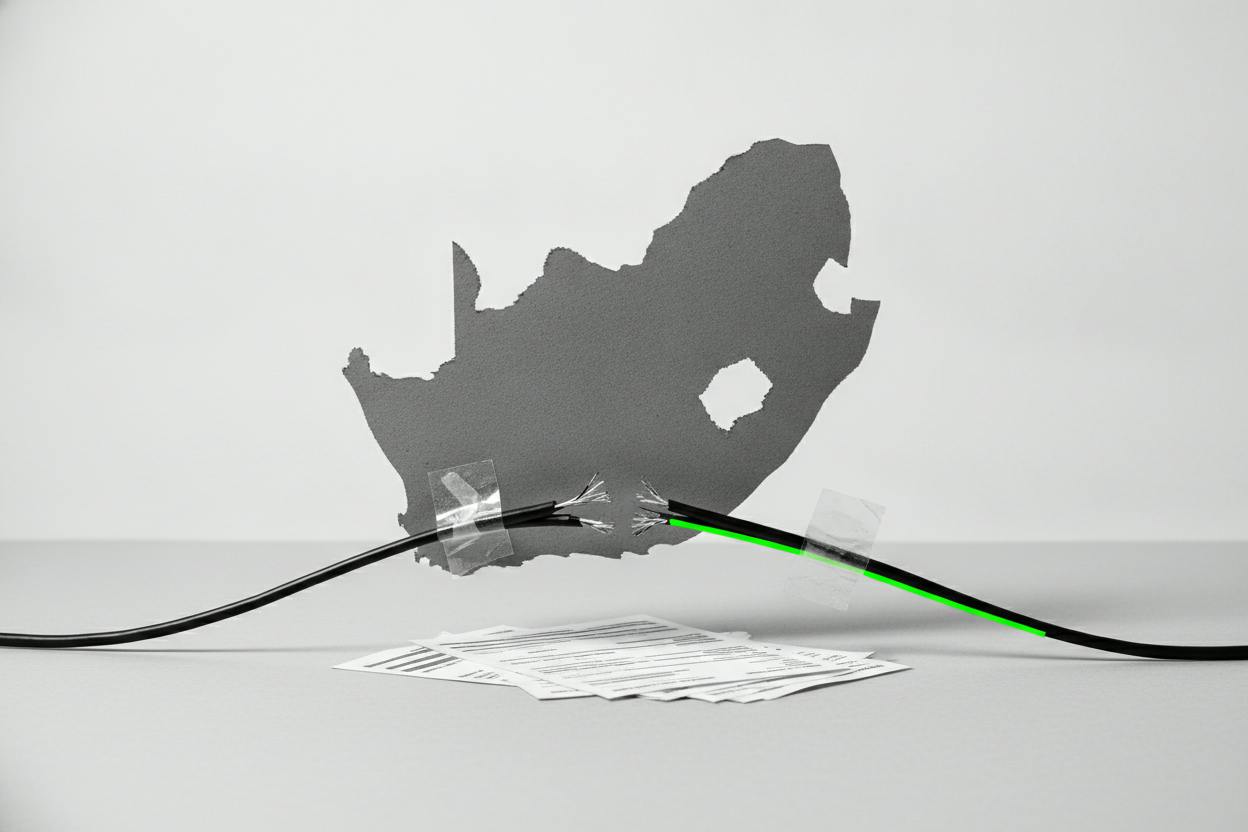
South Africa's central bank has given the country's financial system a clean bill of health, but it's keeping a close eye on two modern threats: the digital backbone that keeps money moving and the frothy valuations of AI-related assets.
In its latest Financial Stability Review, the South African Reserve Bank (SARB) said banks and other lenders remain well-capitalized and hold plenty of liquid assets, despite a mix of global and local risks. The bank's base-case outlook is that the system will function efficiently "until November 2027," assuming no major systemic event occurs.
Digital infrastructure tops the risk list
The report's highest-rated risk wasn't a wave of bad loans. Instead, it was disruption to "critical digital infrastructure and services." SARB noted that "residual vulnerability" in this area is higher than it was in June, a sign that outages, cyberattacks, and telecom failures are climbing the risk register.
This is a shift from traditional banking risks like credit defaults or market crashes. The central bank's point is that banks can look healthy on paper and still face a shock that starts with operations, not credit. If payment systems, clearing houses, or core banking platforms go down, cash and collateral can't move smoothly. That creates settlement delays and short-term cash-flow stress for companies and financial firms.
In such a squeeze, institutions tend to hoard liquidity and rely on shorter-term funding, pulling back from longer-dated lending even if their capital ratios are strong. Markets often see the first signs in pricier short-dated bank funding and wider bank credit spreads, with a higher risk premium for businesses that depend heavily on South Africa's local payment rails.
AI valuations on the watchlist
SARB also added a new item to its monitoring list: a potential correction in AI-related asset valuations. The central bank acknowledged that global market themes can still tighten financial conditions for smaller markets like South Africa.
AI-linked stocks and assets have surged globally, driven by excitement over the technology's potential. But if those valuations re-rate lower, the fallout could spill into risk sentiment worldwide. For South Africa, that could mean higher borrowing costs, a weaker rand, or reduced appetite for local assets—even if the country's own fundamentals are solid.
This isn't just a theoretical concern. UK regulators have already warned that AI agents could trigger financial rules, and the rapid build-out of AI data centers is creating new revenue streams for some companies. But the flip side is that a sudden repricing could hit markets that are less prepared for the shock.
What it means for investors
For everyday investors, the SARB's report is a reminder that financial stability isn't just about balance sheets. It's also about the plumbing that connects them. When that plumbing fails, even well-capitalized banks can face liquidity crunches, and that can ripple through to borrowing costs and investment returns.
The "until November 2027" base case is reassuring, but it's conditional. It depends on the payments system staying online and on global markets not delivering a nasty surprise. Investors should watch for any signs of stress in short-term funding markets or widening credit spreads, as those could be early warnings.
On the AI front, the central bank's caution echoes broader concerns. Big AI data center deals are making headlines, but the valuations behind them may be stretched. If a correction comes, it could tighten financial conditions in emerging markets like South Africa, even if the local economy is doing fine.
For now, the SARB's message is one of cautious optimism. The system is resilient, but the risks are shifting. Digital infrastructure and AI valuations are the new watchwords, and investors would do well to keep them in mind.