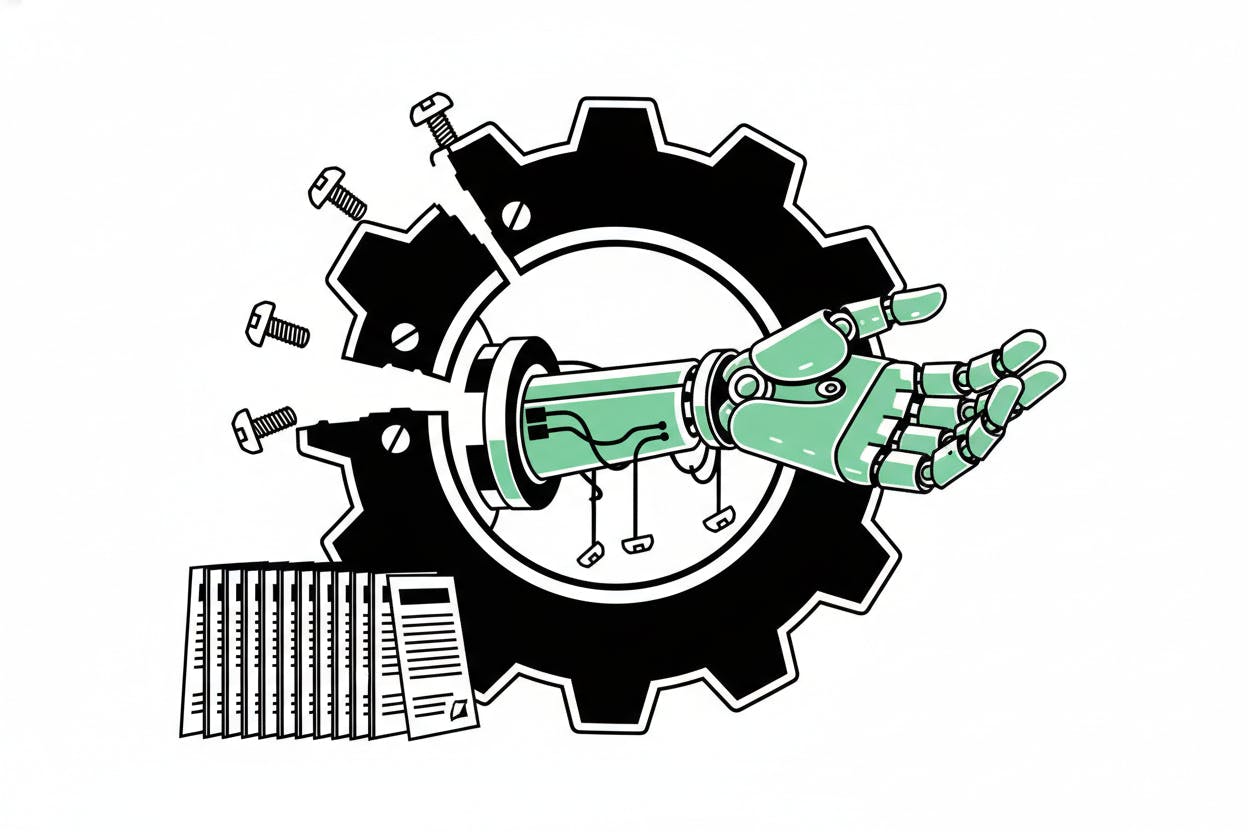
German auto and industrial supplier Schaeffler is expanding a partial-retirement scheme for roughly 1,300 workers in its home market, a cost-cutting step that will hit profits before it delivers savings. At the same time, the company is touting a growing order book for humanoid robots, a sign it is betting on future growth even as it trims its traditional workforce.
The company told employee representatives it expects a one-off charge of about €51 million in 2026 from the wider program, with the cost savings only starting to show up from 2027. That timing is typical of such restructuring moves: the expense lands first, while the benefit arrives later. CEO Klaus Rosenfeld acknowledged that the near-term payoff is hard to quantify precisely.
What is partial retirement?
Partial retirement is a German scheme that lets older employees reduce their working hours in the years before they retire, with their income topped up by the employer. It is often used as a socially acceptable way to trim headcount without outright layoffs. For Schaeffler, extending the program to more workers is part of a broader effort to cut costs in a challenging environment for European auto suppliers.
The company, which makes ball bearings, engine components, and electric-drive systems, has been under pressure as carmakers slow their transition to electric vehicles and face weaker demand in some markets. Like many suppliers, Schaeffler is trying to reduce its cost base while investing in new technologies it hopes will drive future revenue.
Robotics orders as a growth bet
Schaeffler's robotics order book reached €350 million in the first half of the year, according to the company. That figure represents confirmed orders for components used in humanoid robots—machines designed to resemble and move like humans, which are being developed for use in warehouses, factories, and other settings.
Humanoid robotics is an emerging field that has attracted heavy investment from tech companies and automakers alike. Schaeffler, with its expertise in precision engineering and motion control, is positioning itself as a supplier of key parts such as actuators, bearings, and gearboxes for these robots. The €350 million order book is still small compared with the company's overall revenue, but it signals a potential new growth area as its traditional automotive business faces headwinds.
The robotics push is part of a broader strategy to diversify beyond the cyclical auto sector. Schaeffler has also been integrating its recent merger with Vitesco, a powertrain specialist, to create a larger electrified and industrial components business.
What it means for investors
For shareholders, the key takeaway is the timing mismatch between costs and benefits. The €51 million charge in 2026 will reduce earnings and cash flow in that year, while the savings from the partial-retirement program will only begin to appear the following year. That means near-term financial results could look weaker, even if the long-term cost structure improves.
Investors should also weigh the robotics order book against the company's overall scale. While €350 million is a meaningful figure for a new product line, it is a fraction of Schaeffler's annual revenue, which runs into the tens of billions of euros. The robotics business is unlikely to move the needle in the near term, but it could become more significant if the humanoid robot market grows as quickly as some proponents expect.
Cost-cutting measures like this are common among European manufacturers facing margin pressure. The partial-retirement approach is generally seen as less disruptive than mass layoffs, but it still signals that management sees a need to reduce the workforce to stay competitive.
Looking ahead, investors will likely watch for more details on the robotics pipeline and how quickly Schaeffler can convert orders into revenue. They will also monitor the company's overall cost-reduction progress and whether the 2027 savings materialize as planned.
Schaeffler's dual strategy—cutting costs in its traditional business while investing in future technologies—mirrors moves by other industrial firms. For example, Pfizer has expanded its own cost-cutting plan while focusing on new growth areas. Similarly, CoreWeave is investing heavily in AI infrastructure to capture future demand.
In the broader market, investors are increasingly rewarding companies that show both cost discipline and a clear path to future growth. Schaeffler's move is a bet that the robotics boom will eventually pay off, but the near-term pain is real.