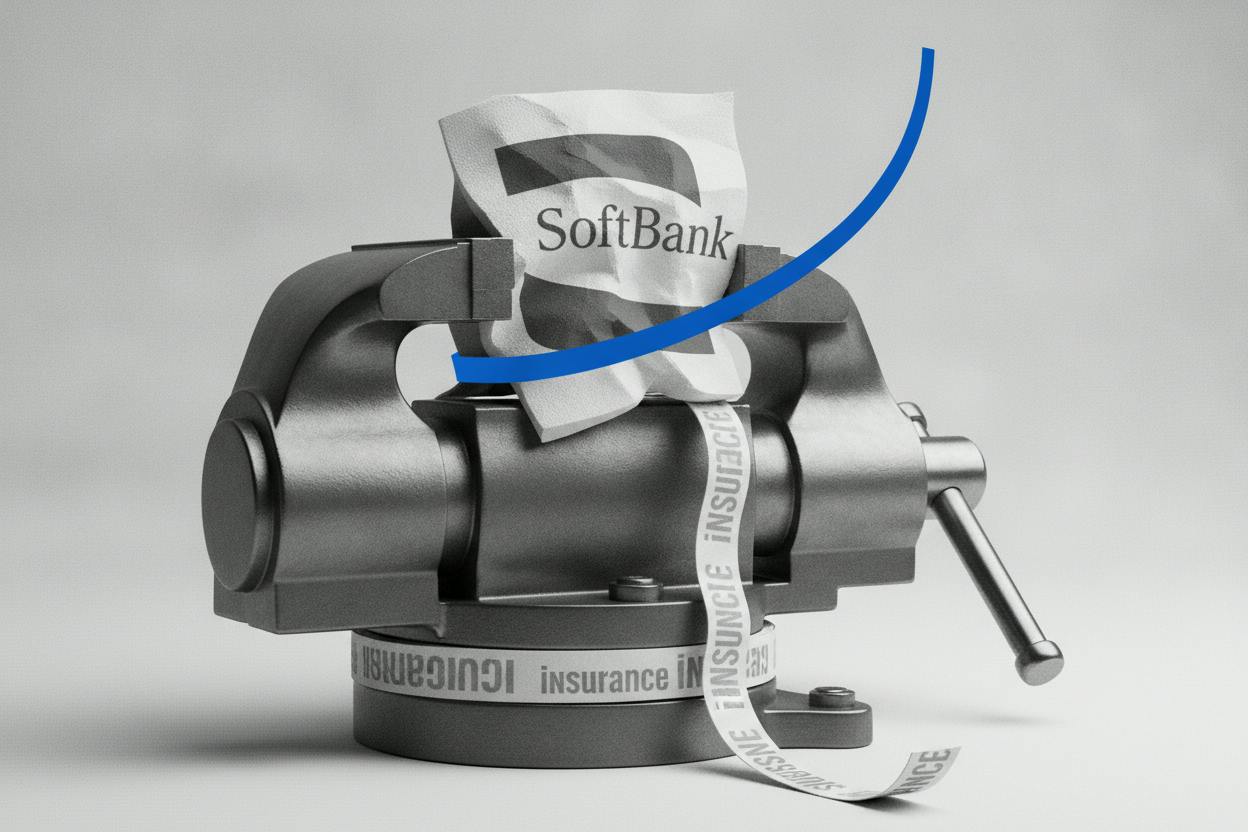
SoftBank Group, the Japanese investment giant, saw the cost of insuring against its default jump to a four-year high on Friday. The company's five-year credit default swap (CDS) spread widened by 22 basis points to 466 basis points, according to Reuters. That means investors now pay more for protection against the possibility that SoftBank fails to repay its debts.
A CDS works like an insurance policy: the buyer pays a premium, and if the borrower defaults, the seller compensates the buyer. When the spread widens, it signals that the market perceives higher risk. For SoftBank, the move reflects growing unease about its massive bets on artificial intelligence and the timeline for those investments to pay off.
Why SoftBank's AI exposure matters
SoftBank has become a bellwether for the AI trade. It has invested $64.6 billion in OpenAI, the company behind ChatGPT, and holds roughly a 90% stake in Arm, the chip designer whose technology powers many AI applications. These stakes tie SoftBank's fortunes directly to the AI boom, for better or worse.
Investors are questioning whether the huge sums poured into AI will generate returns quickly enough. The recent US midterm election results have added fresh doubts about the pace of data center buildouts, which are essential for training and running AI models. If those projects slow down, companies like Arm and OpenAI could see weaker demand, and SoftBank's investments would suffer.
This isn't the first time SoftBank's AI strategy has faced scrutiny. Earlier this year, Arm's AI data center push failed to win over investors, highlighting the gap between AI hype and near-term earnings. Similarly, Anthropic's IPO roadshow hit valuation pushback, suggesting that even high-profile AI names are meeting resistance from cautious investors.
The borrowing angle
Reuters also reported that SoftBank has been borrowing at unusually high interest rates. That's a red flag for credit investors, because higher borrowing costs eat into profits and increase the risk of financial distress. When a company already carries significant debt, a rise in its CDS spread can become a self-reinforcing problem: lenders demand higher yields, which raises the cost of new debt, which in turn makes default more likely.
SoftBank's situation is compounded by its history of volatile investments. The company's Vision Fund, which backs tech startups, has swung between huge gains and steep losses. That volatility makes it harder for investors to predict cash flows, which is exactly what credit markets dislike.
In a separate development, China blocked SoftBank's $5.4 billion ABB robotics deal over data fears, adding to the company's regulatory headaches. While that deal was not directly related to AI, it underscores the geopolitical risks that can affect SoftBank's portfolio.
What it means for investors
For everyday investors, the widening CDS spread is a signal to pay attention to the risks in the AI trade. SoftBank is not just a single company; it's a proxy for the entire AI ecosystem. When its default insurance gets pricier, it suggests that the market is becoming more skeptical about the speed and scale of AI returns.
That skepticism can spill over into other AI-related stocks. If investors worry that data center buildouts will slow, companies that supply chips, servers, and cooling systems could see their valuations pressured. On the other hand, if AI adoption continues to grow, the current pessimism might be overdone.
For bondholders, the rising CDS spread means that holding SoftBank debt is riskier than it was a year ago. For equity investors, it's a reminder that high-growth bets come with high uncertainty. As always, diversification is key: putting all your money into any single theme, whether AI or anything else, can be dangerous.
Looking ahead, investors will be watching SoftBank's next earnings report and any updates on its OpenAI and Arm stakes. They'll also keep an eye on interest rates and the broader economy, since higher rates make it more expensive for companies like SoftBank to service their debt. The CDS market will continue to reflect those concerns in real time.
In the meantime, the AI trade remains a double-edged sword: enormous potential, but also enormous risk. SoftBank's rising default insurance cost is just the latest reminder that the market is starting to price in that risk more carefully.