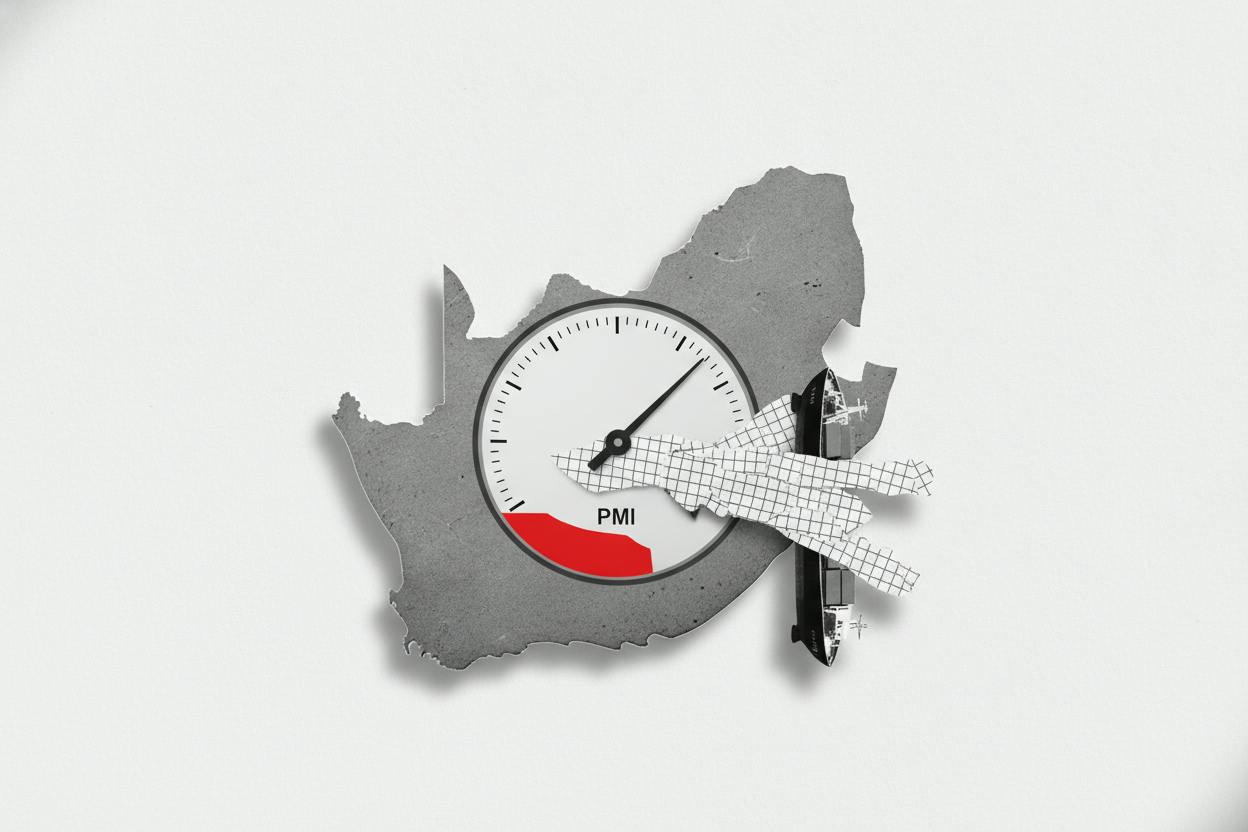
South Africa's private sector continued to shrink in October, according to the latest S&P Global purchasing managers' index (PMI). The headline reading held at 49.0, unchanged from September and still below the 50 mark that separates expansion from contraction. The data points to an economy that is still struggling to find momentum, with weaker demand, rising fuel costs, and ongoing disruptions at the Port of Durban all taking a toll on business activity and sentiment.
What the PMI tells us
The PMI is a widely watched gauge of business conditions, based on surveys of purchasing managers across manufacturing, services, and other sectors. A reading above 50 signals that activity is expanding, while a reading below 50 indicates contraction. October's 49.0 suggests that companies are still seeing a decline in business, even though the pace of decline in new orders eased compared with September.
That slight improvement in new orders may offer a glimmer of hope, but the broader picture remains subdued. Output fell for a second consecutive month, and export orders declined for the first time since May. That drop in overseas demand is a concern for a country that relies heavily on exports of commodities, manufactured goods, and agricultural products. It also hints that the slowdown is not just a domestic issue—demand from key trading partners appears to be cooling as well.
On the cost side, firms reported that input expenses rose at the fastest pace in recent months, driven largely by higher fuel prices. For businesses already grappling with weak sales, rising costs squeeze profit margins and can force tough decisions about hiring, investment, and pricing.
Port of Durban delays add to the strain
One of the most visible drags on activity has been the ongoing congestion at the Port of Durban, one of Africa's busiest shipping hubs. Delays at the port have disrupted supply chains, making it harder for companies to get goods in and out of the country. For exporters, that means missed deadlines and lost orders; for importers, it means higher costs and slower restocking.
These logistical bottlenecks are not new, but they continue to weigh on business confidence. When companies cannot rely on timely shipments, they become more cautious about taking on new orders or expanding operations. That caution shows up in the PMI's confidence component, which slipped further in October.
The broader economic backdrop remains challenging. South Africa has been dealing with slow growth, high unemployment, and persistent infrastructure problems, including electricity shortages. While the PMI does not capture every aspect of the economy, it is a useful barometer of how businesses are feeling—and right now, they are feeling cautious.
What it means for investors
For everyday investors, the PMI is a reminder that South Africa's economic recovery is still fragile. A reading below 50 means that the companies listed on the Johannesburg Stock Exchange (JSE) are likely facing headwinds in their domestic operations. That can translate into weaker earnings, lower share prices, and reduced dividends.
However, it is important to keep the news in perspective. The PMI is just one data point, and it does not necessarily signal a deep recession. The easing in new orders suggests that the worst of the decline may be behind us, and some sectors—particularly those tied to global commodity prices—could benefit from external factors. For instance, cheaper oil prices could help ease input cost pressures in the months ahead, even if fuel costs rose in October.
Investors should also watch how the local political and economic environment evolves. South African markets have been weighing local elections against global risk sentiment, and the outcome of those elections could influence policy direction and investor confidence. Meanwhile, global factors—such as the US election and shifts in commodity prices—are likely to play a role in how South African assets perform. As African markets waver on these external forces, South Africa's domestic challenges remain front and center.
For those with exposure to South African equities or bonds, the key takeaway is to stay diversified and focus on the long term. The PMI is a snapshot of current conditions, not a forecast of the future. While the contraction is concerning, it also sets a low bar for improvement—any uptick in demand or easing of port bottlenecks could quickly lift sentiment.
In the meantime, investors should keep an eye on upcoming economic data, including inflation figures and the central bank's interest rate decisions. These will provide more clues about the trajectory of the economy and whether the contraction is likely to persist or fade.