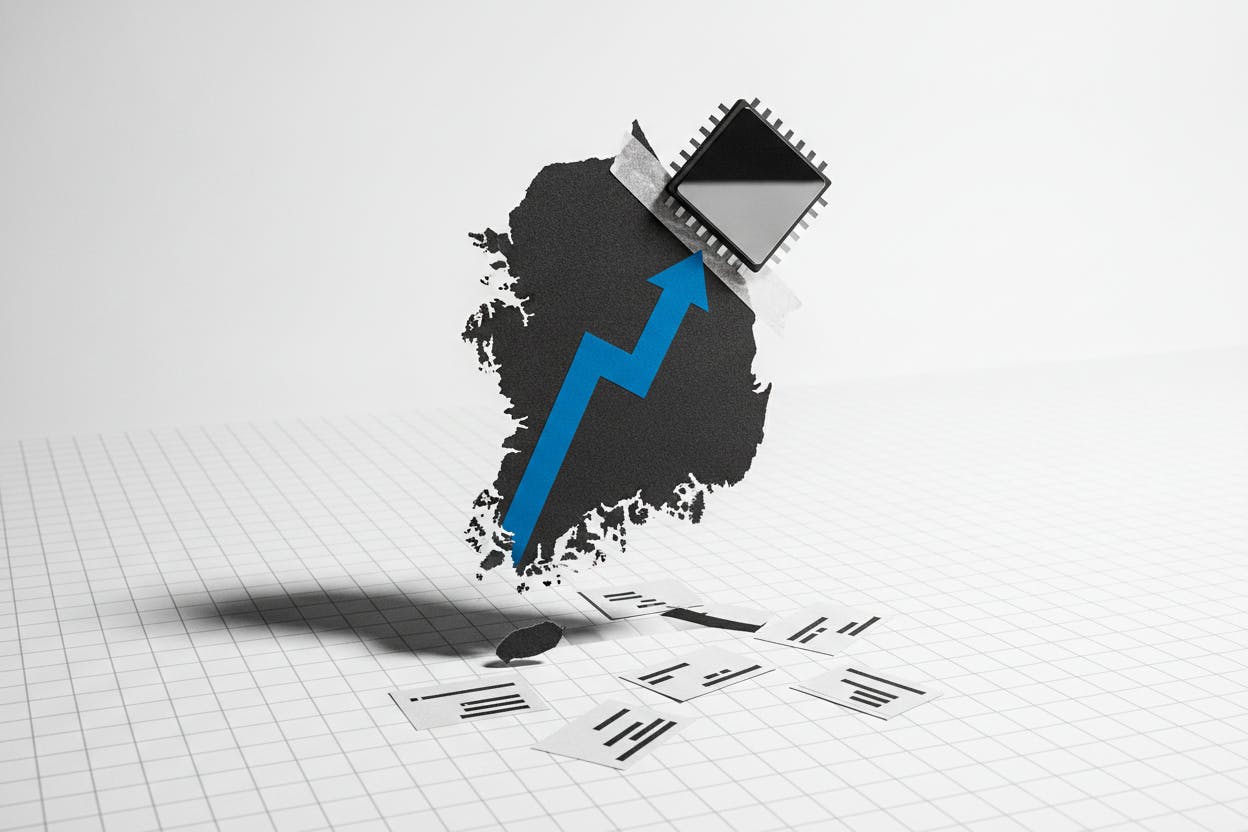
South Korean stocks just delivered their strongest quarterly performance in over two decades, with the benchmark KOSPI index surging 68% in the latest quarter — its best showing since the Asian financial crisis era of 1998. The rally was almost entirely powered by a handful of semiconductor heavyweights riding the artificial intelligence boom.
What drove the surge?
The headline move came from two of South Korea's largest companies: Samsung Electronics and SK Hynix. Samsung, the world's largest memory chipmaker, rose more than 90% over the quarter. SK Hynix, a key supplier of high-bandwidth memory (HBM) chips used in AI data centers, jumped over 220%. Together, they account for a massive share of the KOSPI's market capitalization, meaning their moves can swing the entire index.
This kind of concentration is a double-edged sword. When sentiment around the AI chip cycle is positive, as it has been this quarter, the index can soar. But it also means the KOSPI is vulnerable to sharp reversals if the outlook for chip demand shifts. As Reuters noted, the rally came with elevated volatility, reflecting the market's sensitivity to any news about AI spending or chip orders.
The broader context: South Korea's stock market has been a major beneficiary of the global AI infrastructure buildout. Companies like Nvidia rely heavily on SK Hynix and Samsung for memory chips, and the explosion in demand for AI computing power has supercharged their earnings and stock prices. This mirrors a wider trend across emerging Asian markets, where AI chip stocks have driven the best quarterly performance since 2009.
Foreign investors were net sellers — why?
One surprising detail: foreign investors were net sellers of South Korean stocks during the quarter, offloading 3.8 trillion won (roughly $2.8 billion). That might seem counterintuitive given the index's explosive gains. But it highlights a key dynamic: the rally was largely driven by domestic retail and institutional investors piling into chip stocks, while foreign funds rotated out of South Korea amid a stronger U.S. dollar and higher interest rates elsewhere.
This pattern is not unique to South Korea. Across emerging Asia, foreign cash has been fleeing even as chip stocks rally, as a strong dollar makes dollar-denominated assets more attractive and emerging-market currencies less so. For everyday investors, this is a reminder that market moves are not always driven by foreign money — local sentiment and sector concentration can be just as powerful.
What it means for investors
For ordinary investors, the KOSPI's surge is a case study in how a few dominant stocks can shape an entire market's returns. The index's 68% gain is eye-catching, but it masks a narrow base: most of the rally came from just two companies. If you owned a diversified KOSPI tracker, you benefited from that concentration. But if the AI chip cycle turns — due to oversupply, weaker demand, or geopolitical tensions — those same stocks could drag the index down just as fast.
Investors should also watch the foreign selling trend. If the dollar weakens or global risk appetite returns, foreign inflows could provide an additional tailwind. Conversely, if the dollar stays strong, foreign selling may continue, capping further upside. The broader backdrop for South Korean equities also includes geopolitical risks (North Korea tensions) and the health of the global economy, which drives demand for memory chips.
Looking ahead, the next catalyst for the KOSPI will likely be earnings reports from Samsung and SK Hynix, as well as any updates on AI chip orders from major tech companies. The market will also be watching for signs that the chip cycle is peaking — a key risk for such a concentrated rally. For context, similar dynamics have played out in other markets: European stocks also saw a strong quarter led by AI tech names, underscoring how global the AI trade has become.
Ultimately, the KOSPI's record quarter is a powerful reminder that in today's markets, a handful of companies can drive outsized returns — and outsized risks. For everyday investors, understanding what's under the hood of an index is just as important as the headline number.