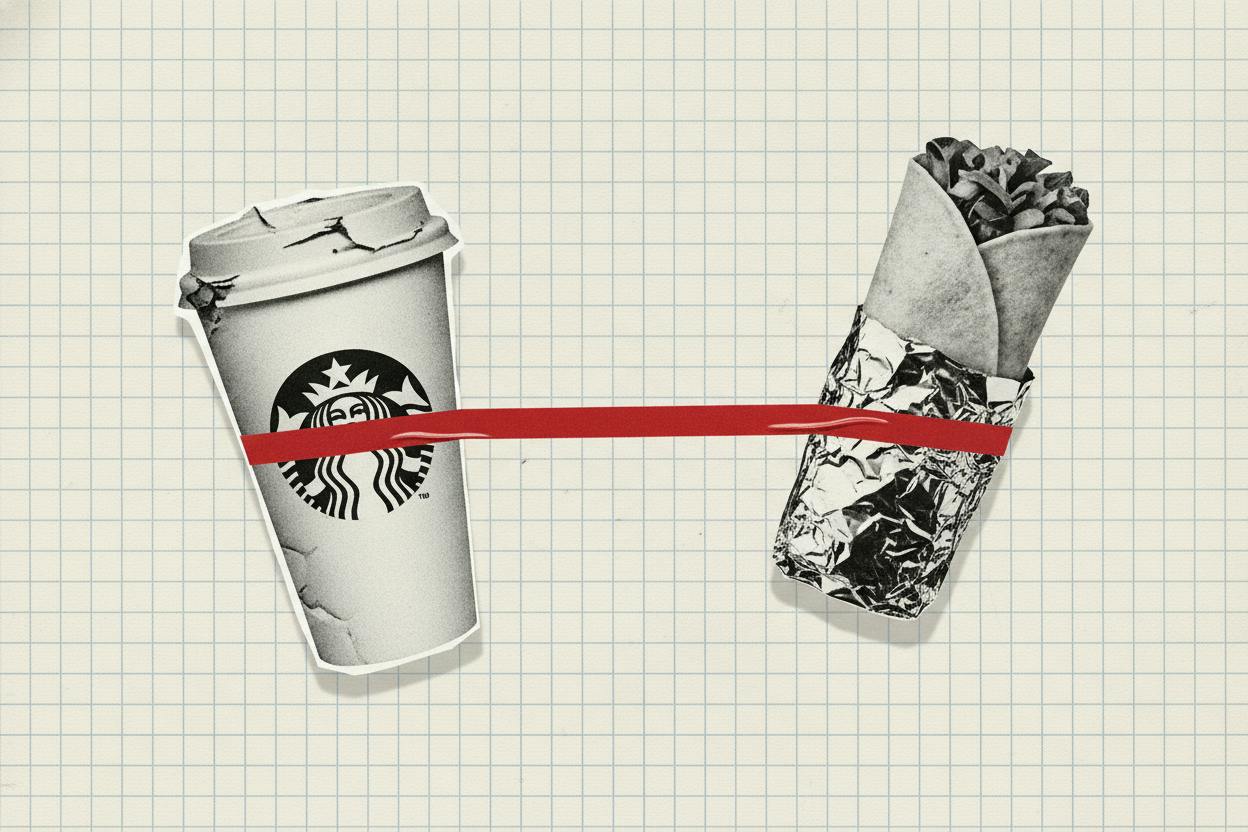
Consumer stocks were in the spotlight on Tuesday as a report of a potential blockbuster restaurant deal collided with mixed signals from some of the sector's biggest names. Shares of Starbucks and Chipotle swung after the Financial Times reported that Starbucks had explored acquiring Chipotle, while packaged-food giant PepsiCo and apparel maker Levi Strauss delivered contrasting updates.
The news underscores a key point for everyday investors: “consumer stocks” are not a single, uniform group. The label covers everything from snack makers and soda companies to fast-food chains and jeans manufacturers, and each responds differently to the economic environment.
Starbucks and Chipotle: a possible mega-deal
According to the Financial Times, Starbucks—the world's largest coffee chain—has at some point explored buying Chipotle, the fast-casual burrito chain. Neither company has confirmed the report, and there is no guarantee that any deal will materialize. But the mere possibility was enough to move both stocks, with shares whipping around as investors weighed the implications.
A tie-up between the two would be enormous. Starbucks has a market value of roughly $100 billion, while Chipotle is worth around $60 billion, so any acquisition would likely rank among the largest restaurant deals in history. The report also comes at a time when Starbucks has been under pressure from activist investors and a slowing U.S. consumer, while Chipotle has been a relative outperformer in the fast-casual space.
For investors, the news is a reminder that even the biggest companies are constantly evaluating strategic options, and that deal speculation can create short-term volatility. But it's important to remember that talks may not lead to a transaction, and even if they do, regulatory hurdles could be significant.
PepsiCo trims outlook, but shares climb
Elsewhere, PepsiCo—the global snacks and beverages giant behind brands like Lay's, Gatorade, and Mountain Dew—reported quarterly results that beat analyst expectations. However, the company also trimmed its full-year earnings growth outlook, citing margin pressure in its North American business.
That combination—beating on the quarter but cutting the forward view—sent a mixed message. On one hand, the company is still performing well in the near term. On the other, it's signaling that higher costs or softer demand could weigh on profits ahead. Investors initially pushed the stock higher, suggesting they were relieved that the beat was strong enough to offset the guidance cut.
PepsiCo's situation is a classic example of why it's important to look beyond headline numbers. A company can beat expectations and still disappoint if its outlook weakens, or vice versa. For investors, the key is to focus on the underlying trends—like margin pressure—that may persist.
Levi Strauss misses on sales
Levi Strauss, the iconic jeans maker, provided the downbeat note among the trio. The company missed on sales, sending its shares lower. Levi has been grappling with a tough retail environment, particularly in its wholesale channel, and the miss suggests that consumer demand for apparel remains uneven.
Apparel companies like Levi are often seen as more sensitive to the economic cycle than packaged-food makers. When shoppers feel confident, they're more willing to spend on discretionary items like new jeans. When they're not, they trade down or delay purchases. That makes Levi's sales miss a potential warning sign for the broader consumer spending picture.
What it means for investors
The divergent moves in these three stocks highlight the importance of not treating “consumer” as a single trade. Instead, investors should consider the different sub-sectors: packaged food, restaurants, and apparel each face their own dynamics.
Packaged-food companies like PepsiCo tend to be more defensive, with steady demand regardless of the economy. Restaurants, especially fast-casual chains like Chipotle, can be more growth-oriented but also more volatile. Apparel makers like Levi are often the most cyclical, with sales closely tied to consumer confidence and discretionary spending.
For everyday investors, the takeaway is to look at the specific drivers behind each company's performance rather than assuming all consumer stocks move together. It's also a reminder that merger speculation can create short-term noise, but the underlying fundamentals—like margins, sales growth, and consumer trends—are what matter over the long run.
As the market digests these updates, investors will be watching for further signs of how the American consumer is holding up. With inflation still elevated and interest rates high, the resilience of consumer spending remains a key question for the broader economy. The mixed signals from PepsiCo and Levi suggest that the picture is far from uniform.
In the meantime, the Starbucks-Chipotle story is likely to keep generating headlines, even if a deal never comes to fruition. For now, investors should focus on what they can control: understanding the businesses they own and the risks they carry.