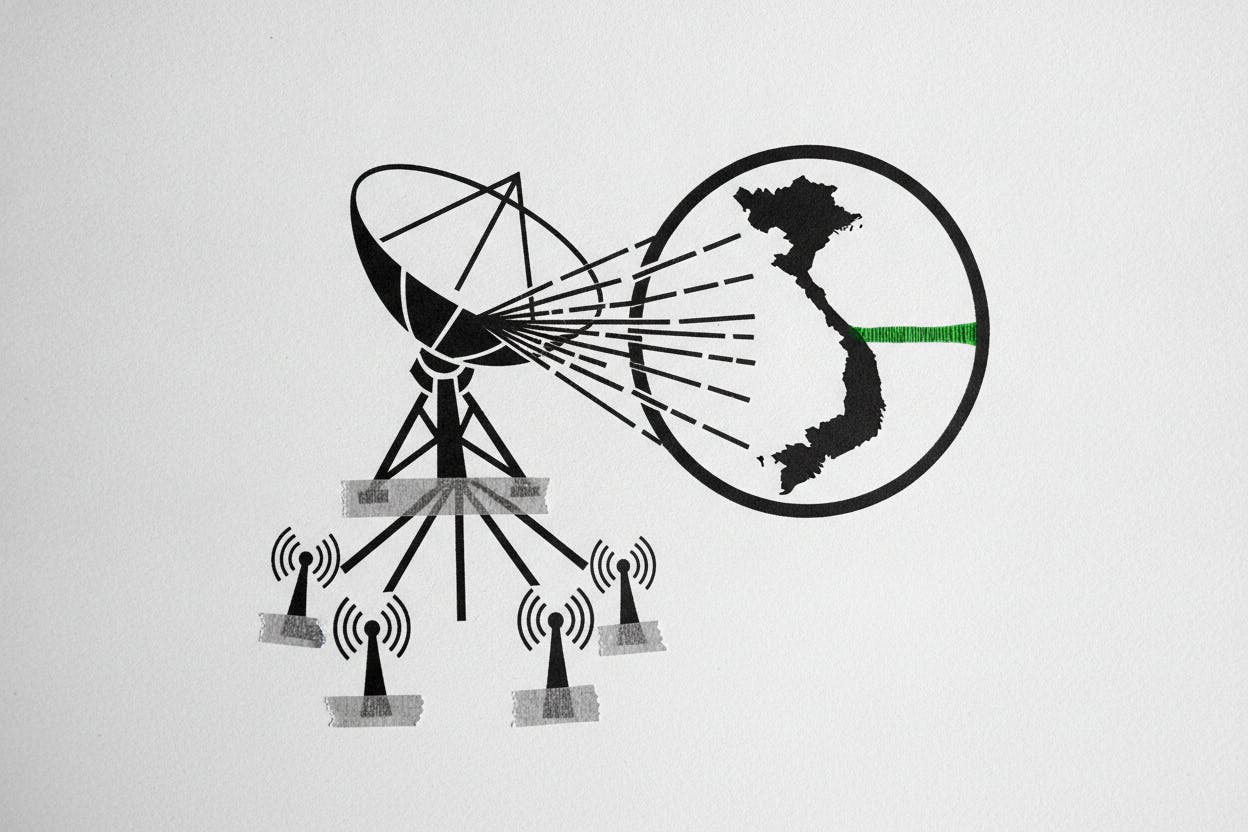
SpaceX's satellite internet service Starlink has begun taking orders in Vietnam, marking a significant step into one of the region's most strategically sensitive telecom markets. Customers can now place deposits on Starlink's local website for a residential plan priced at 1.13 million dong (about $43) per month, plus a one-time 8.66 million dong fee for the dish and router. Business plans start at 1.48 million dong a month.
The launch is a trial, and the Vietnamese government has capped the number of subscribers at 600,000 through the end of 2030. That limit is a clear sign of caution from Hanoi, which has long been wary of foreign control over telecom infrastructure.
Why Vietnam is opening the door
Vietnam has historically restricted foreign ownership in its telecom sector, viewing it as critical national infrastructure. But the government has now said it will waive those ownership limits for Starlink, a notable policy shift. The move appears designed to bring high-speed internet to rural and remote areas where traditional fiber and mobile networks are costly to build.
For SpaceX, Vietnam represents a large and relatively underserved market. The country has a population of around 100 million, and while urban centers are well-connected, many rural regions still lack reliable broadband. Starlink's low-Earth-orbit satellite network can deliver internet to virtually any location with a clear view of the sky, making it an attractive option for those areas.
The 600,000-subscriber cap is a compromise: it lets the government test the service and its implications without fully opening the market. That number is small relative to Vietnam's population, but it's enough to make a meaningful revenue contribution to Starlink's global subscriber base, which has been growing rapidly.
What this means for investors
For everyday investors, the key takeaway is that Starlink is expanding its addressable market. Vietnam is just the latest in a series of countries where Starlink has launched or expanded service, following similar moves in other parts of Asia and Africa. Each new market adds potential subscribers and revenue, which matters for SpaceX's valuation.
SpaceX is not publicly listed, but its shares trade on secondary markets, and the company has attracted significant retail investor interest. In fact, recent reports show that retail investors have turned net sellers of SpaceX stock for the first time since its IPO, even as the company continues to post strong growth. The Vietnam launch could be a positive catalyst, but it's important to remember that the subscriber cap limits the immediate financial impact.
Investors should also consider the broader competitive landscape. Starlink faces competition from other satellite internet providers, as well as from terrestrial networks. In Vietnam, the government's cap suggests it wants to protect local telecom companies, which could limit Starlink's long-term growth in the country.
What to watch next
The trial period will be closely watched. If Starlink meets demand and the government sees benefits, the cap could be raised or removed after 2030. That would open the door to a much larger market. For now, the 600,000 limit is a clear ceiling, and investors should monitor subscriber growth in Vietnam as a sign of how the trial is progressing.
Another factor to watch is pricing. At $43 a month, Starlink's residential plan is competitive with local broadband in Vietnam, but the upfront cost of the dish and router may be a barrier for some households. The business plans, starting at $56 a month, could appeal to small enterprises and tourism operators in remote areas.
For SpaceX, the Vietnam launch is part of a broader strategy to expand globally. The company has also been investing heavily in AI infrastructure, including a $16.8 billion AI chip facility in Texas with Tesla, which could eventually benefit from the same satellite network that powers Starlink.
In the near term, the Vietnam trial is a modest but positive development. It shows that Starlink can navigate complex regulatory environments, and it gives the company a foothold in a fast-growing Southeast Asian economy. For investors, the key is to watch how the trial unfolds and whether the government eventually lifts the cap.
As always, it's worth remembering that SpaceX is a private company, and its stock is not available on major exchanges. Investors who hold shares through secondary markets should be prepared for volatility and limited liquidity. The Vietnam news is a reminder that SpaceX's growth story is intact, but it's not a reason to make any hasty moves.