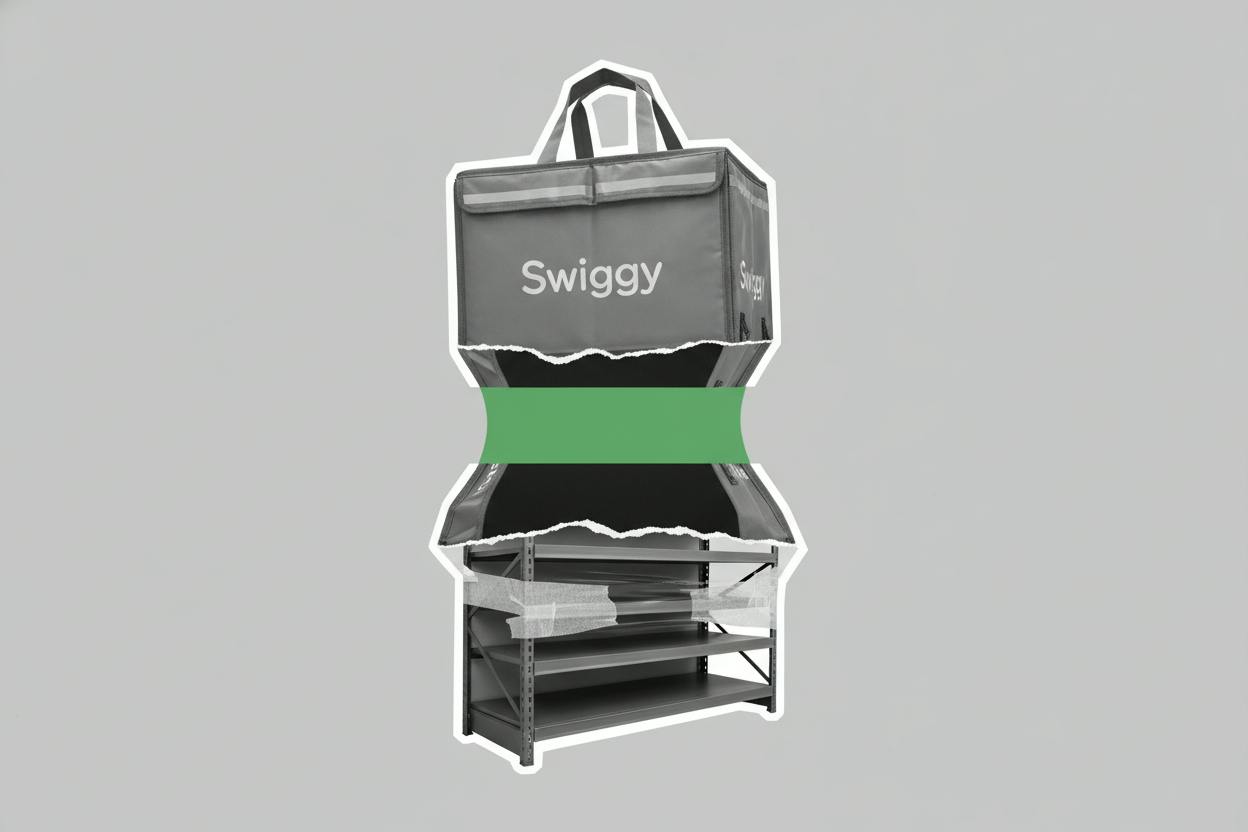
Swiggy, one of India's largest food-delivery and quick-commerce platforms, is cutting 340 roles at Instamart, its rapid-delivery unit, as it reshapes the business amid intensifying competition in the country's fast-growing quick-commerce sector. The move, reported by Reuters, comes as Instamart battles rivals like Blinkit and Zepto in a race that rewards dense networks of dark stores and lightning-fast delivery.
What's driving the cuts?
Quick commerce — the business of delivering groceries and everyday items in minutes — looks like a simple app-based service, but it operates more like a logistics network with heavy fixed costs. Dark stores, the small warehouses that stock goods for rapid delivery, require rent, staff, and equipment, and those costs don't shrink much when demand dips. That means growth can widen losses before it improves margins.
That pressure is evident in Swiggy's latest results. Instamart's adjusted core loss widened to 8.95 billion rupees (about $107 million) in the September quarter, up from 8.49 billion rupees a year earlier, even as gross order value rose. The company has said it believes losses have peaked and has guided to about a 100 basis-point sequential improvement in adjusted core margin for the December quarter, helped by better warehouse efficiency and a focus on "deepening" existing markets rather than rapidly opening new stores.
For the 340 employees affected by the cuts, Swiggy is offering severance and statutory payouts, plus extended health coverage through May 2027, according to Reuters.
Why efficiency matters now
The quick-commerce model rewards scale, but only if that scale is used efficiently. When a dark store is already running, the fastest way to improve economics is usually to push more orders through the same footprint, spreading overhead across more deliveries. That's why Swiggy's shift from rapid store rollout to building depth in existing neighborhoods is significant.
If order density rises and duplicated management layers are trimmed, small margin gains can compound without needing constant expansion. The key question for investors is whether the promised 100 basis-point step-up shows up soon enough to offset the 8.95 billion-rupee quarterly loss, especially while Blinkit and Zepto keep spending to win speed and coverage.
Blinkit, owned by Indian retailer Eternal, and Zepto have been aggressive in expanding their dark-store networks and marketing budgets, making the competitive landscape brutal. Swiggy's decision to trim Instamart suggests it is prioritizing profitability over growth, a shift that could resonate with investors who have grown wary of cash-burning businesses.
What it means for investors
For everyday investors, this news is a reminder that quick commerce is not just a tech story — it's a logistics story with real-world costs. Companies in this space often face a trade-off between growth and profitability, and Swiggy's move signals that it is choosing to focus on the latter.
The 100 basis-point margin improvement guidance is a key metric to watch. If Swiggy delivers on that, it could reassure investors that the business is turning a corner. If it falls short, the pressure on the stock could intensify, especially with competitors still spending heavily.
Swiggy's shares have been volatile since its listing, and this restructuring could be seen as a positive step toward sustainable profitability. However, the quick-commerce race is far from over, and the company will need to keep innovating to stay competitive.
For those following the broader Indian market, this story also highlights the intense competition in the country's digital economy. As HSBC trims its India finance hubs and other companies adjust to changing conditions, the pressure to cut costs and improve efficiency is a recurring theme.
Investors should also keep an eye on how Swiggy's rivals respond. If Blinkit and Zepto continue to expand aggressively, Swiggy may need to balance its efficiency drive with the need to defend market share. The next few quarters will be crucial in determining whether Swiggy's strategy pays off.
In the meantime, the severance and health coverage offered to affected employees is a positive note, showing that the company is trying to handle the layoffs responsibly. But for investors, the real test is whether the margin improvements materialize as promised.