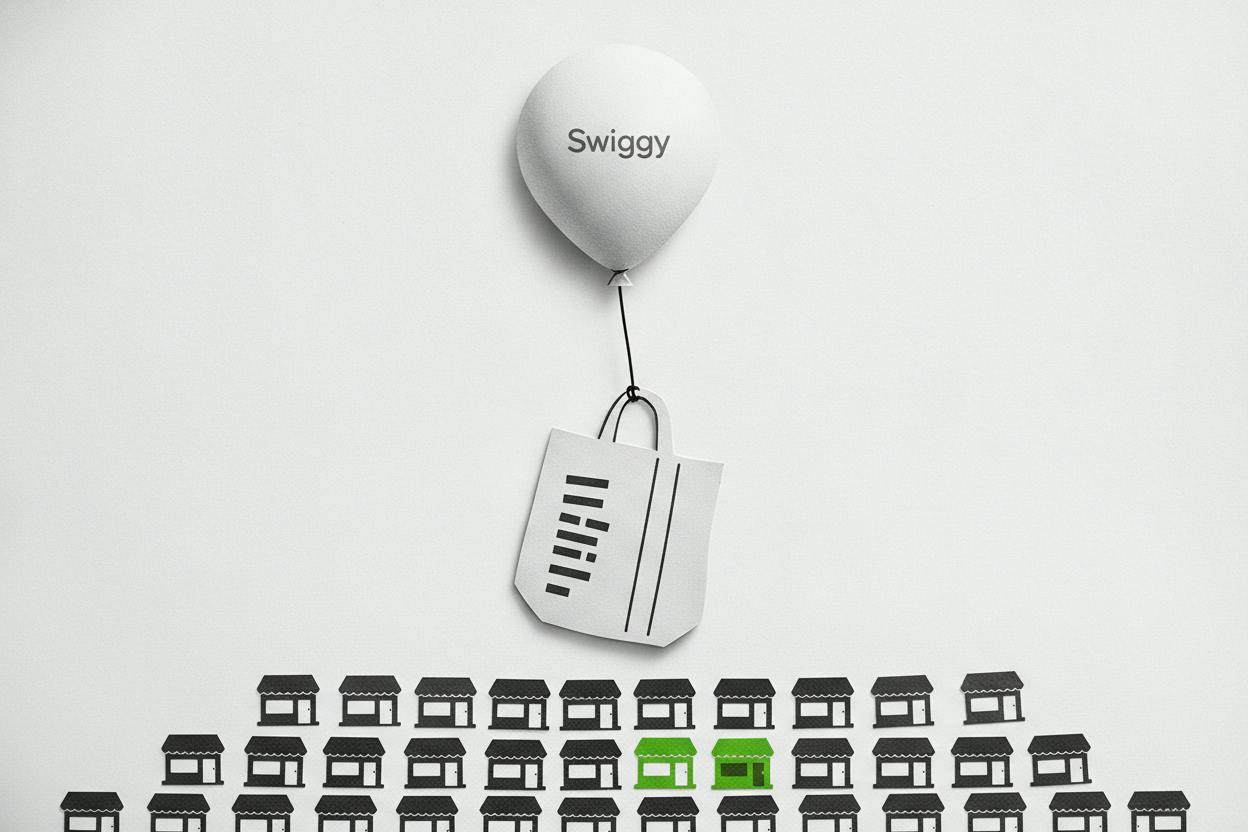
Swiggy, one of India's largest food delivery and quick-commerce platforms, reported a narrower quarterly loss for the three months ended September 30, even as its fast-delivery business Instamart sank deeper into the red. The split result shows a company where the core food delivery engine is humming, but the newer, faster-growing arm is burning cash as it races to expand.
The Bengaluru-based company posted a consolidated net loss of 9.22 billion rupees ($97.24 million), smaller than the loss a year earlier but wider than analysts had expected, according to LSEG data cited by Reuters. Revenue from operations jumped 36.1% from a year earlier to 75.71 billion rupees, helped by stronger food delivery economics.
Food delivery shines, Instamart spends
Swiggy's core food delivery business delivered a record adjusted core profit of 3.41 billion rupees, thanks to higher advertising revenue and better delivery efficiency. That means the company is making more money on each order after covering the costs of getting food from restaurants to customers.
Instamart, Swiggy's quick-commerce unit that promises grocery and household items in minutes, moved in the opposite direction. Its adjusted core loss widened to 8.95 billion rupees, even though net order value grew 34.8% to 65.94 billion rupees. The reason: Swiggy spent more on pricing, customer acquisition, and warehouse expansion.
That spending shows up in a key metric called “contribution margin” – essentially what's left after variable costs like delivery and promotions. Instamart's contribution margin slipped to negative 1% of gross order value, down from negative 0.2% in the previous quarter. In plain terms, for every 100 rupees of orders, Instamart lost 1 rupee after covering variable costs, before fixed costs like rent and salaries.
The dark store race
Instamart now operates 1,240 dark stores across 133 cities, after adding 69 net stores in the quarter. Dark stores are small warehouses set up in residential areas to enable quick deliveries. Each new store brings fixed costs – rent, staff, and equipment – before it can generate enough orders to become profitable.
Swiggy isn't alone in this push. Rival Eternal, a consumer internet company, said its Blinkit unit added 308 net stores in the same quarter and won't prioritize near-term margin improvement. That signals the “footprint race” in India's quick-commerce market is far from over, with both players willing to sacrifice profits for reach.
For context, quick commerce is a relatively new business model that has exploded in India, with companies promising deliveries in 10 to 20 minutes. The model relies on having many small warehouses close to customers, which means heavy upfront investment. The hope is that once a store reaches a certain order volume, it becomes profitable, but that point can take time to reach.
What it means for investors
For investors, the key takeaway is that Swiggy's overall profitability is now heavily tied to Instamart's expansion. Food delivery can look healthy while the group still bleeds cash, because quick commerce is currently the bigger source of losses.
The math is tough: each new dark store brings fixed costs, and then price cuts and sign-up deals squeeze what Swiggy earns per order. Until each site gets enough repeat customers to lift order density, adding locations can mechanically pull margins further below zero.
With Instamart adding 69 net stores to reach 1,240, and Blinkit adding 308 while signaling it's willing to wait on profits, the competition could keep discounting intense. That makes Swiggy's path to narrower losses depend heavily on whether Instamart can raise throughput per store quickly.
For everyday investors, this is a classic growth-versus-profitability story. Swiggy is choosing to invest heavily in a fast-growing market, hoping that the quick-commerce bet pays off in the long run. But until those stores start generating enough orders, the losses will continue to weigh on the company's bottom line.
Investors will likely watch Instamart's contribution margin and store-level economics closely in coming quarters. If the company can show that new stores are ramping up quickly, the market may be more forgiving of the current losses. If not, the pressure to slow expansion could mount.
For more on how delivery businesses are navigating similar tradeoffs, see our coverage of Domino's reliance on delivery apps and Walmart's drone delivery plans.