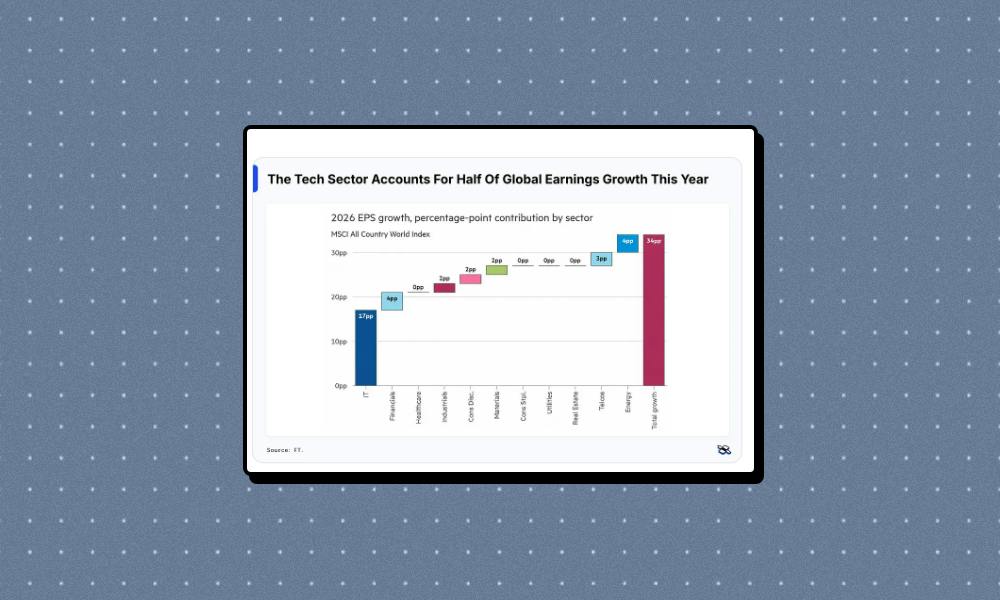
The world's stock markets have become increasingly dependent on a handful of technology giants to deliver the earnings growth that investors expect. According to Citigroup, the IT sector now accounts for roughly half of all global earnings growth this year. And the bank expects that reliance to deepen: by 2027, tech's contribution is projected to rise to 68%, even as overall earnings growth slows from 35% to 16%.
That kind of concentration is unusual. Historically, the top-performing sector has contributed about 40% of global earnings growth on average. Next year's forecast would mark the second-highest concentration in three decades, surpassed only by the energy sector's dominance during the 2022 energy crisis.
Why tech's earnings dominance matters
When a single sector drives that much of the market's profit growth, the entire market's fate becomes tied to that sector's fortunes. If tech companies continue to beat expectations, the broader market can keep climbing. But if tech stumbles—whether due to slowing demand, regulatory pressure, or a shift in investor sentiment—the impact could ripple far beyond the sector itself.
This dynamic is already visible in recent market moves. AI stocks have been steady as yields ease, but earnings season remains the next big test. Investors are watching closely to see whether the artificial intelligence boom translates into sustained profit growth, or whether the lofty expectations baked into tech valuations prove too high.
A historical perspective
The last time a sector held this much sway was during the 2022 energy crisis, when surging oil and gas prices made energy companies the dominant profit engine. That period was marked by extreme volatility in energy prices and a sharp slowdown in the rest of the economy. The current situation is different in that tech's strength is driven by innovation and productivity gains, not a supply shock. But the concentration risk is similar.
For everyday investors, this means diversification is more important than ever. If your portfolio is heavily weighted toward tech—whether through individual stocks or index funds—you may be taking on more risk than you realize. A broad market index like the S&P 500, for example, has a significant tech weighting, so its performance is increasingly tied to a few mega-cap names.
What it means for investors
For investors, the key takeaway is that the market's health is increasingly dependent on a narrow group of companies. That doesn't mean tech stocks are a bad investment—far from it. But it does mean that the margin for error is thinner. If tech earnings disappoint, the market has fewer other sectors to fall back on.
It's also worth noting that overall earnings growth is expected to slow from 35% to 16% by 2027. That's still a healthy pace, but it's a significant deceleration. Investors who have become accustomed to double-digit growth may need to adjust their expectations.
Some analysts are already revising their outlooks. For instance, Oppenheimer recently raised its S&P 500 earnings view for 2026, but held its price target, suggesting that while earnings are strong, valuations may already reflect much of the good news.
Beyond tech: other earnings stories
While tech dominates the earnings landscape, other sectors are also reporting. Bajaj Finance saw profit jump 29% on strong loan growth, and Europe's EV sales surged 70% in September, showing that growth isn't confined to Silicon Valley. But these stories are the exception rather than the rule.
For investors, the message is clear: keep an eye on tech earnings, but don't ignore the rest of the market. A balanced portfolio that includes exposure to different sectors and geographies can help cushion the blow if tech's dominance fades.
As Citigroup's data shows, the current concentration is unusual but not unprecedented. The energy sector's dominance in 2022 eventually faded as oil prices normalized. Whether tech's reign will be similarly temporary remains to be seen, but investors should be prepared for both scenarios.



