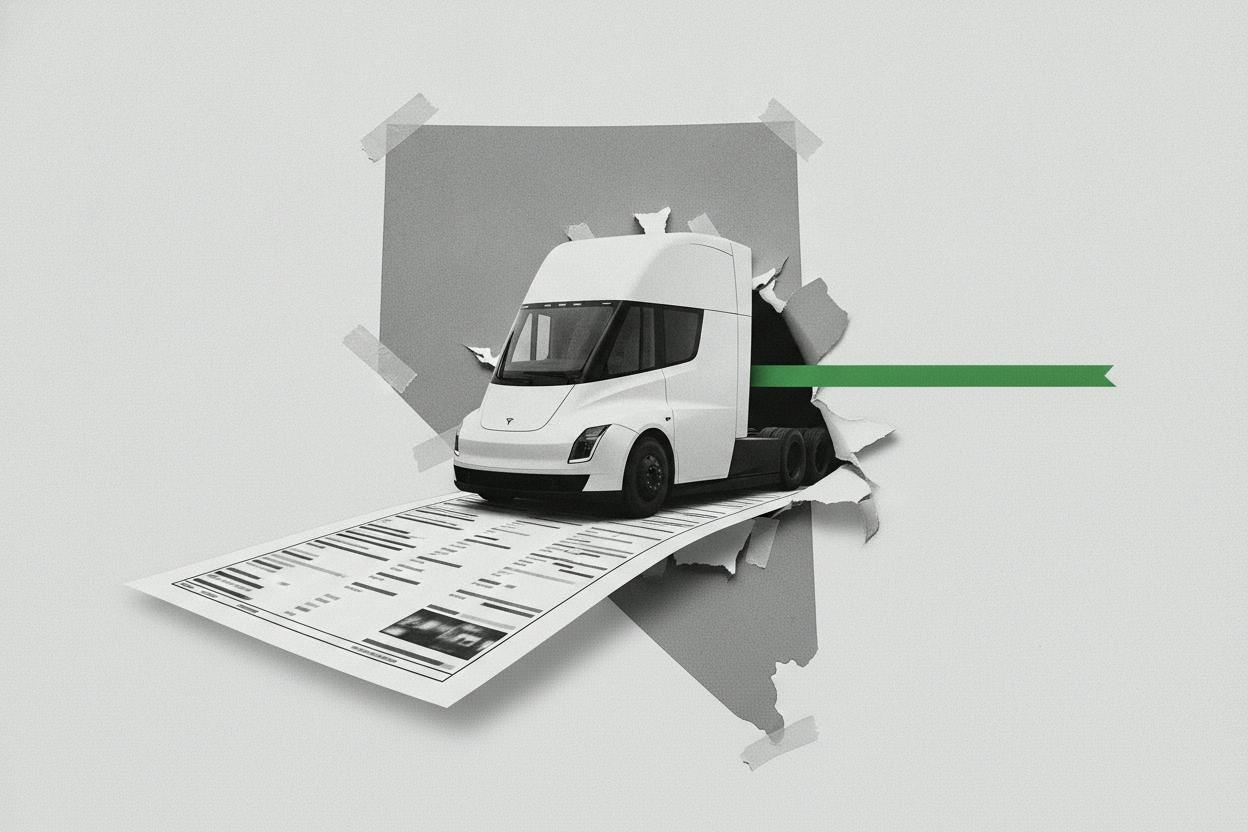
Tesla is taking a significant step toward mass-producing its electric big rig, the Semi, with the inauguration of its production facility in Sparks, Nevada. The move signals a shift from the small-batch deliveries that began in late 2022 to a genuine manufacturing operation for a vehicle the company first unveiled back in 2017.
The Semi is Tesla's entry into the heavy-duty trucking market: a battery-powered Class 8 truck designed to replace diesel-powered freight haulers. Class 8 is the heaviest class of commercial truck in the United States, the kind used for long-haul freight. Tesla has long pitched the Semi as a way to cut fuel costs and emissions, but the vehicle's journey to market has been marked by repeated delays and shifting timelines.
A long road to production
When Tesla unveiled the Semi in 2017, it promised production within a couple of years. That didn't happen. The company finally started limited deliveries in late 2022, with a handful of units going to early customers like PepsiCo. But volume production remained elusive, and the company's July shareholder letter pushed back expectations, saying Semi production would begin in 2026—a later start than many had hoped for higher-volume output.
Now, with the Nevada plant coming online, Tesla appears to be moving from pilot mode to something closer to scale. The facility is expected to handle the assembly of the Semi, though Tesla has not disclosed specific production capacity or output targets. The company has said it is lining up large fleet orders, which suggests that commercial interest is building, but it has also fielded questions about pricing and how quickly it can ramp up production.
The Semi's pricing has been a point of speculation. Tesla has not published a final price for the truck, and fleet operators are keen to know how it compares with diesel trucks, which typically cost around $150,000 or more. Electric trucks carry a higher upfront cost, but lower fuel and maintenance expenses over time. That total-cost-of-ownership math is critical for trucking companies, which operate on thin margins.
Why the Semi matters
The Semi is more than just another Tesla product. It represents the company's push into a new market—commercial freight—where it faces established players like Daimler Truck, Volvo, and Paccar, all of which are also developing electric or hydrogen-powered trucks. For Tesla, the Semi is a chance to diversify beyond passenger cars and energy products, and to apply its battery and software expertise to a sector that is under pressure to decarbonize.
For investors, the Semi's progress is a signal about Tesla's ability to execute on ambitious projects. The company has a history of missing deadlines, but it has also shown it can eventually scale production, as it did with the Model 3 and Model Y. The Semi's ramp-up will be watched closely as a test of whether Tesla can replicate that success in heavy-duty vehicles.
The broader context is also important. The trucking industry is a major source of greenhouse gas emissions, and regulators in the U.S. and Europe are tightening emissions standards. That is pushing fleet operators to consider electric options, even if the upfront costs are higher. Tesla's Semi, if it can be produced at scale and at a competitive price, could capture a slice of that market.
What it means for investors
For everyday investors, the Semi's launch is a development to watch, but not necessarily a reason to rush into Tesla stock. The company's core business remains passenger vehicles, and the Semi is unlikely to move the needle on Tesla's overall financials in the near term. However, it could become a meaningful revenue stream over time if production ramps up as planned.
Investors should also consider the competitive landscape. Tesla is not the only company chasing electric trucks, and the market is still young. The success of the Semi will depend on factors like battery costs, charging infrastructure, and fleet adoption rates—all of which are uncertain.
For those interested in the broader shift toward electric vehicles, the Semi's progress is a useful barometer. It shows how far EV technology has come, but also how challenging it is to move from prototypes to profitable mass production. As Tesla works through the ramp-up, expect more headlines about production numbers, delivery timelines, and pricing—all of which will offer clues about the Semi's viability.
In the meantime, investors can keep an eye on Tesla's quarterly updates, which will likely provide more details on Semi production and orders. The company's ability to meet its own targets will be a key test of its operational discipline.