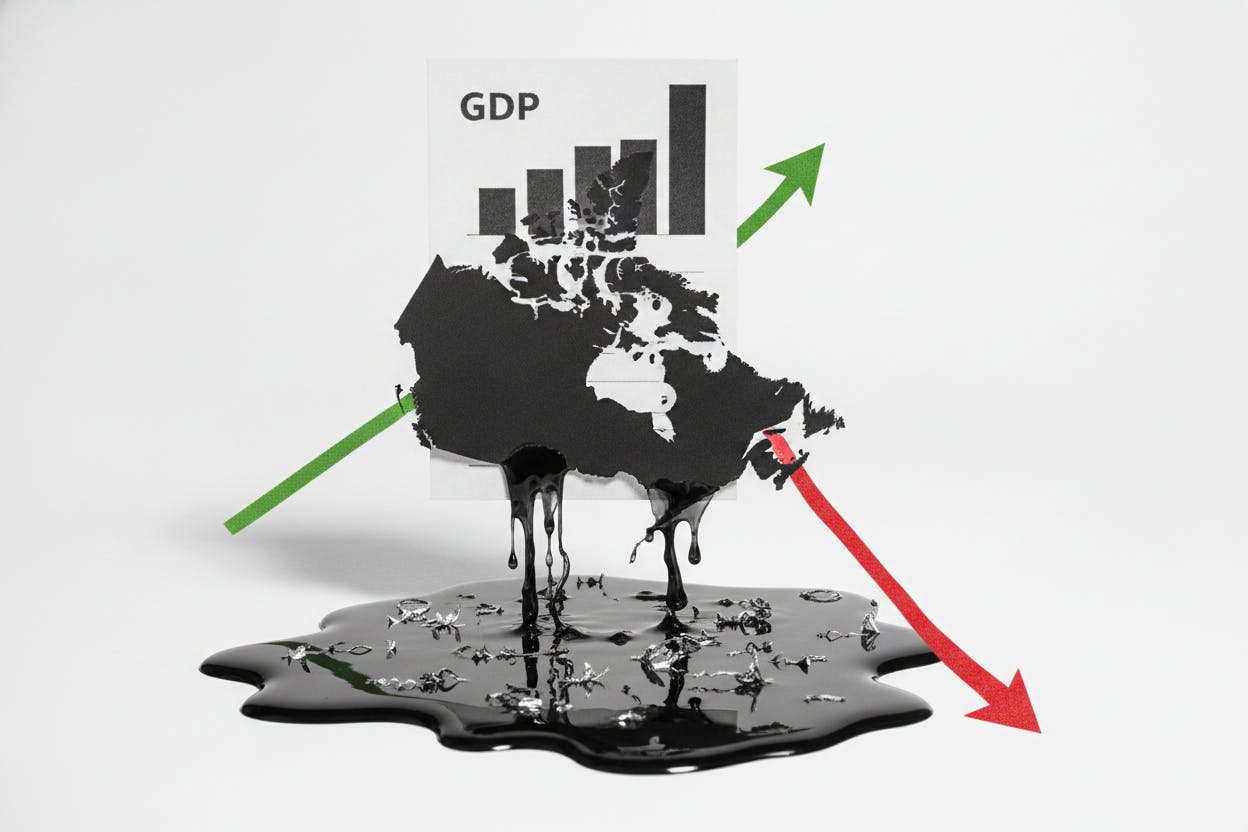
Canada's main stock index ended the day lower on Friday, erasing an early gain even as the country's economy posted a solid expansion in the second quarter. The S&P/TSX Composite Index fell 120 points, a reversal from an initial 70-point advance, as weakness in commodity-linked sectors outweighed the upbeat economic data.
What happened
Statistics Canada reported that real gross domestic product (GDP) grew 0.8% in the second quarter, helped by stronger exports, household spending, and business investment. That translates to a 3.3% annualized pace, according to BMO, one of Canada's largest banks.
But the market's reaction was muted, and the index turned negative as the day wore on. The move was mostly a commodity story: energy shares fell 1.3% and base-metals stocks dropped 1.2%, as oil and gold prices moved lower. In contrast, steadier corners of the market like utilities and telecoms managed small gains of 0.2% each.
This divergence highlights a familiar tension for Canadian investors: the TSX is heavily weighted toward resource companies, so even good economic news can be overshadowed by swings in commodity prices.
Why the disconnect?
For many investors, the GDP report was a positive sign. A 0.8% quarterly gain, with a 3.3% annualized pace, suggests the Canadian economy is growing at a healthy clip. Exports, consumer spending, and business investment all contributed, pointing to broad-based strength.
Yet the stock market often looks forward, not backward. While the GDP data reflects the past quarter, traders are more focused on what comes next—and that includes the path of interest rates, inflation, and global demand for commodities.
Oil and gold prices slipped on the day, which weighed on the energy and materials sectors that dominate the TSX. When those heavyweights stumble, they can drag the entire index down, even if other parts of the economy are doing well.
This is a pattern that Canadian investors have seen before. The TSX's heavy reliance on natural resources means it can sometimes move in the opposite direction of the broader economy. A strong GDP report might be good for the currency or for interest-rate expectations, but it doesn't automatically translate into higher stock prices if commodity prices are falling.
What it means for investors
For everyday investors, the key takeaway is that the TSX is not a pure reflection of Canada's economic health. It's a collection of companies, many of which are tied to global commodity markets. So while the GDP number was encouraging, the index's decline shows that other forces are at play.
Investors should also keep an eye on the Bank of Canada. A stronger economy could give the central bank more room to keep interest rates higher for longer, which can affect everything from mortgage rates to corporate borrowing costs. That's a topic we've explored in our look at how the Bank of Canada might handle tariff-driven inflation.
For those who want to diversify beyond the commodity-heavy TSX, index options can offer a way to gain exposure to broader market moves without picking individual stocks. Our guide on index options for everyday investors explains how they work, and we've also broken down the key differences between stocks, stock options, and index options.
Meanwhile, the Canadian dollar has been under pressure recently due to trade tensions, as we noted in our piece on the loonie hitting a one-week low. A weaker currency can help exporters but can also push up the cost of imported goods, adding to inflation concerns.
Looking ahead
The coming weeks will likely bring more clarity on whether the GDP strength is sustainable. Investors will be watching for updates on commodity prices, trade negotiations, and any signals from the Bank of Canada about its next policy move.
For now, the message is mixed: the economy is growing, but the stock market is being pulled by different currents. That's a reminder that diversification and a long-term perspective are more important than reacting to any single day's move.



