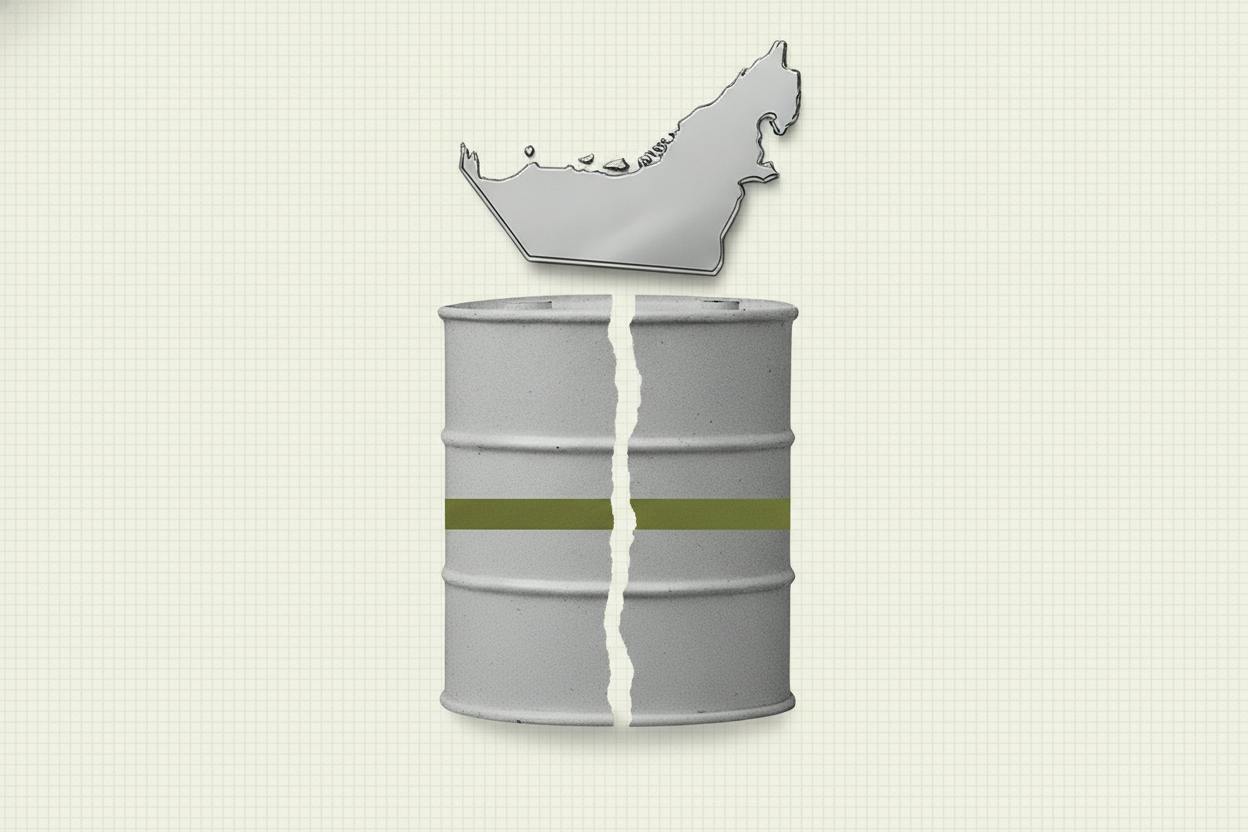
UAE stock markets moved in opposite directions on Tuesday as oil prices eased following news that the United States and Iran held what President Donald Trump called “productive discussions.” Abu Dhabi’s ADX index slipped 0.055%, while Dubai’s DFM index rose 0.332%.
The divergence highlights how differently the two emirates’ markets respond to crude oil movements. Abu Dhabi’s economy is closely tied to hydrocarbon revenue, so its stocks often react quickly to changes in oil prices. Dubai, by contrast, has a more diversified economy, with a larger focus on real estate, tourism, and trade, making it less sensitive to oil swings.
Oil cools on diplomatic signals
Brent crude futures fell 1.45% to about $102.77 a barrel at 3:08 pm UAE time, according to the source brief. The drop came after Trump flagged the talks with Iran, and Iran’s foreign minister said Tehran would respond to a US proposal “in the next few days,” as reported by Tasnim. Washington has kept its blockade of Iranian ports in place, but the mere acknowledgment of dialogue was enough to ease some of the geopolitical risk premium that had been built into oil prices.
Deutsche Bank noted that the acknowledgment of talks “took some of the pressure off oil prices into the close.” For investors, this is a reminder that crude prices are not just about supply and demand—they also carry a premium for geopolitical uncertainty. When tensions appear to cool, that premium shrinks, and oil prices can fall even without a change in actual supply.
Abu Dhabi feels the oil pinch
In Abu Dhabi, the oil price dip hit stocks that are most exposed to government and government-linked spending. Much of that spending is funded by hydrocarbon revenue, so when oil prices fall, investors often mark down expected cash flows into the system. That can cool expectations for big-ticket projects and the liquidity that contractors and suppliers rely on.
One clear example was NMDC Group, an Abu Dhabi marine engineering and dredging firm, which fell 2.23% even though the broader ADX barely moved. NMDC is a cyclical name with visible project exposure, so it tends to be among the first to react to oil price changes.
This pattern is common in oil-dependent markets. When crude drops, even modestly, investors may start to question the pace of future infrastructure spending and the health of companies that depend on that spending. It’s not that a 1.45% decline in Brent is catastrophic—it’s that the market is constantly repricing expectations based on the latest headlines.
Dubai’s relative resilience
Dubai’s market, on the other hand, is less directly tied to oil-funded capital spending. Its economy is more diversified, with a strong focus on trade, tourism, and real estate. That means stock-specific factors can play a bigger role in driving the DFM index, which is why it managed to eke out a gain even as oil prices fell.
For investors, this divergence is a useful reminder that not all Gulf markets move in lockstep with oil. While crude is a major driver for the region, the degree of sensitivity varies. Abu Dhabi’s market is more oil-linked, while Dubai’s is more diversified.
What it means for investors
For everyday investors, the key takeaway is that geopolitical headlines can move oil prices, and those moves can ripple through stock markets—especially in oil-dependent regions. When tensions ease, oil prices can fall, which may weigh on energy stocks and companies tied to government spending in oil-rich states.
But it’s also important to remember that not all markets react the same way. A diversified market like Dubai may be less affected by oil swings than a more oil-centric market like Abu Dhabi. Investors should consider the composition of their holdings and how sensitive they are to commodity prices.
Looking ahead, markets will be watching for further developments in US-Iran talks. If the discussions progress, oil prices could stay under pressure, which might continue to weigh on Abu Dhabi stocks. Conversely, if talks stall, the risk premium could return, pushing oil prices back up.
For now, the split between Abu Dhabi and Dubai shows that even within a single country, markets can tell different stories. Understanding those differences is key to making informed investment decisions.