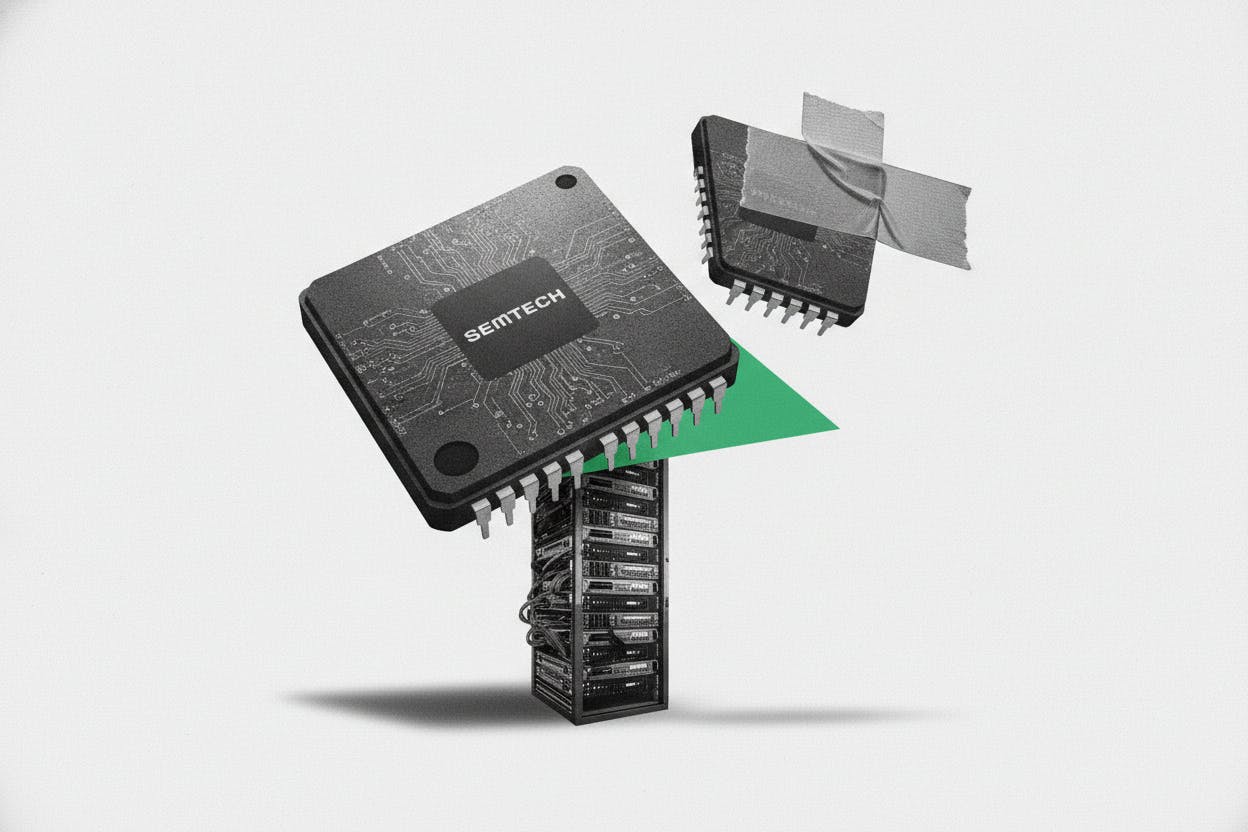
Investment bank UBS is betting that Semtech's data center business can carry the company after it sells off its cellular module unit. The bank's analysts expect data center revenue to keep climbing, and they see the divestiture boosting gross margins by roughly 500 basis points—a significant jump in profitability.
What's behind the move?
Semtech, a chipmaker that supplies components for a range of electronics, has been reshaping its portfolio. The sale of its cellular module business is part of that strategy, but it also means the company will lose a chunk of its current revenue. UBS's view is that the data center segment—which makes chips used in servers and networking gear—can fill that gap over time.
The bank's basic story is a handoff: selling the cellular module business shrinks Semtech's revenue base, but expanding data center sales could offset that decline. UBS expects the data center segment to build toward a roughly $200 million quarterly run rate by fiscal Q1 2028, and it says Semtech's latest guidance already points to a sharp near-term ramp.
Why margins matter
Gross margin is the share of sales left after subtracting the direct costs of making a product. A 500-basis-point improvement is substantial—it means for every dollar of revenue, Semtech would keep five cents more. That can translate into bigger profits even if overall sales don't grow much.
For investors, margin expansion is often just as important as revenue growth. It shows a company is becoming more efficient or shifting toward higher-margin products. In Semtech's case, the cellular module business likely carried lower margins, so shedding it should automatically improve the blended figure.
Data center demand remains hot
The data center market has been one of the strongest areas in tech, driven by the boom in artificial intelligence and cloud computing. Companies are pouring billions into building out infrastructure to handle AI workloads, and chipmakers that supply those systems are seeing robust demand. This trend has been a key theme across the sector, with AI spending plans ballooning to $750 billion and companies like nVent acquiring power equipment makers to meet that demand.
Semtech's data center business is well-positioned to ride that wave, according to UBS. The bank's confidence suggests that the company's chips are finding their way into systems that are in high demand. That's a positive sign for the stock, which has been volatile as investors weigh the impact of the divestiture.
What it means for investors
For everyday investors, the key takeaway is that Semtech is undergoing a strategic shift. Selling a lower-margin business to focus on a higher-growth, higher-margin one can be a smart move, but it also carries execution risk. The company needs to deliver on its data center growth targets to make the trade-off worthwhile.
UBS's analysis suggests the market should focus on the data center segment's trajectory rather than the temporary dip in revenue from the sale. If the ramp goes as planned, Semtech could emerge as a leaner, more profitable company. But if data center sales stumble, the loss of the cellular module revenue could hurt.
Investors should also keep an eye on the broader chip sector. Chip stocks have been sensitive to AI-related news, and any slowdown in data center spending could affect Semtech and its peers. Conversely, continued strength in AI infrastructure spending would likely support the company's growth story.
The bottom line
UBS's bullish stance on Semtech's data center business is a vote of confidence in the company's strategic direction. The margin boost from the cellular module sale provides a near-term tailwind, while the data center ramp offers longer-term upside. However, investors should weigh the risks of execution and market conditions before making any decisions.
As always, it's wise to consider how this fits into your overall portfolio and risk tolerance. Semtech's story is one of transformation, and that can be both an opportunity and a challenge.