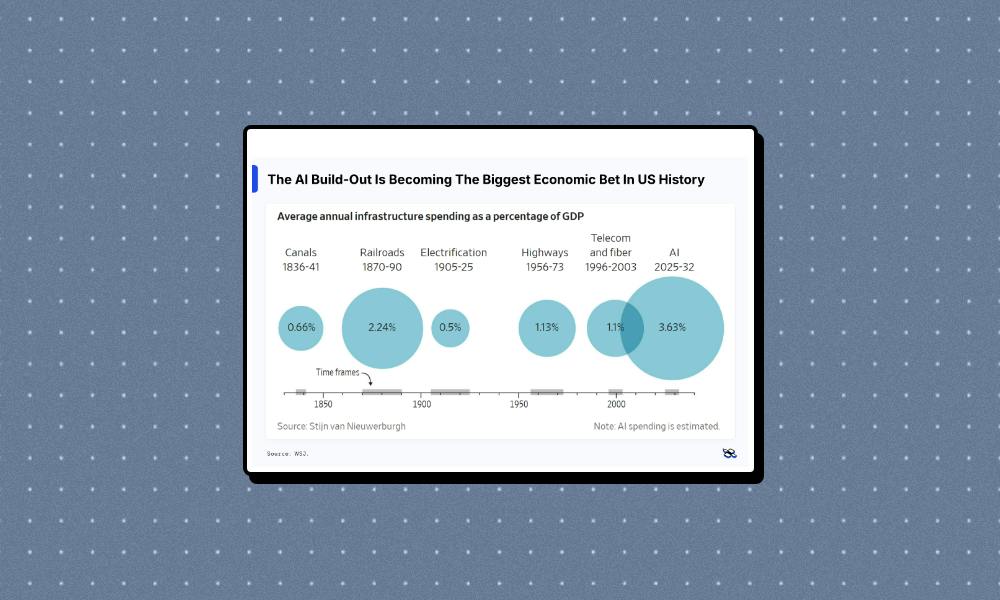
The United States is embarking on an economic experiment of historic proportions. Investment in data centers and related artificial-intelligence infrastructure could reach $10.3 trillion between 2025 and 2032, according to recent projections. That figure is equivalent to an average of 3.6% of GDP each year—a scale that outpaces the country's previous infrastructure booms, including railroads, highways, and telecoms.
This isn't just a tech story. The spending is already rippling through the broader economy, reshaping construction, labor markets, and the investment landscape. But with such a massive bet comes significant risk, and investors need to understand both the upside and the potential downsides.
What's driving the boom?
The surge in AI infrastructure spending is fueled by the rapid adoption of generative AI and machine-learning tools across industries. Companies are racing to build data centers that can handle the enormous computing power required to train and run AI models. This has led to a construction boom that stands in stark contrast to the rest of the private sector.
While most private construction has been shrinking, data-center construction is booming. This is creating demand for a wide range of workers, from electricians and engineers to project managers and IT specialists. The labor market is feeling the effects: AI has helped generate more than 750,000 US jobs since 2023, with AI-related job listings commanding particularly high salaries.
This is not just a coastal phenomenon. Data centers are being built across the country, from rural Texas to the suburbs of Ohio, bringing employment and economic activity to regions that have often been left behind by tech booms.
How does this compare to past booms?
To put the scale in perspective, consider the railroad boom of the 19th century, the interstate highway system of the 1950s, and the telecom build-out of the 1990s. Each of those transformed the American economy, but none matched the projected scale of the AI build-out relative to GDP.
Railroads opened up the West and created national markets. Highways connected suburbs and enabled the rise of the automobile. Telecoms laid the fiber-optic cables that made the internet possible. AI infrastructure is being built to support a technology that could, in theory, transform every sector of the economy—from healthcare and finance to manufacturing and logistics.
But the comparison also highlights the risks. Past booms often ended in overcapacity and busts. The railroad boom led to bankruptcies and consolidation. The telecom boom ended with the dot-com crash, leaving behind a glut of fiber-optic capacity that took years to fill. The question is whether AI infrastructure will follow a similar pattern.
What it means for investors
For everyday investors, the AI build-out presents both opportunities and pitfalls. On the one hand, the spending is a tailwind for companies that build, equip, and operate data centers—from semiconductor makers to construction firms to power utilities. The job growth and construction activity are also positive for the broader economy, at least in the near term.
On the other hand, the concentration of investment in a single sector creates vulnerability. If AI adoption slows, or if the technology fails to deliver on its promise, the billions poured into data centers could become stranded assets. That risk is amplified by the sheer scale of the spending, which could crowd out other types of investment and leave the economy overexposed to a downturn in tech.
Investors should also consider the ripple effects. The demand for electricity from data centers is already straining power grids in some regions, which could lead to higher energy costs for consumers and businesses. This is one reason why energy markets are closely watching AI-related demand.
Moreover, the AI boom is not happening in isolation. It intersects with other global trends, such as divergent growth in Asia and China's own AI experiments. These dynamics could shape the competitive landscape and affect which companies ultimately benefit.
What to watch next
Investors should keep an eye on several indicators. First, the pace of data-center construction and any signs of overbuilding. Second, corporate earnings from major tech companies, which will reveal whether AI investments are translating into revenue growth. Third, the labor market—if AI-related hiring continues to surge, it could support consumer spending and the broader economy.
It's also worth watching how regulators and policymakers respond. The scale of the build-out may prompt questions about energy use, environmental impact, and market concentration. Any new rules could affect the economics of AI infrastructure.
Finally, remember that this is a long-term story. The $10.3 trillion figure spans nearly a decade, and the path will likely be uneven. There will be quarters of strong growth and possibly periods of correction. For investors, the key is to stay informed and diversified, rather than betting everything on a single trend.
The AI build-out is a defining economic event of our time. It has the potential to supercharge growth and create new industries, but it also concentrates risk in ways that could have lasting consequences. Understanding the balance is essential for anyone with money in the market.