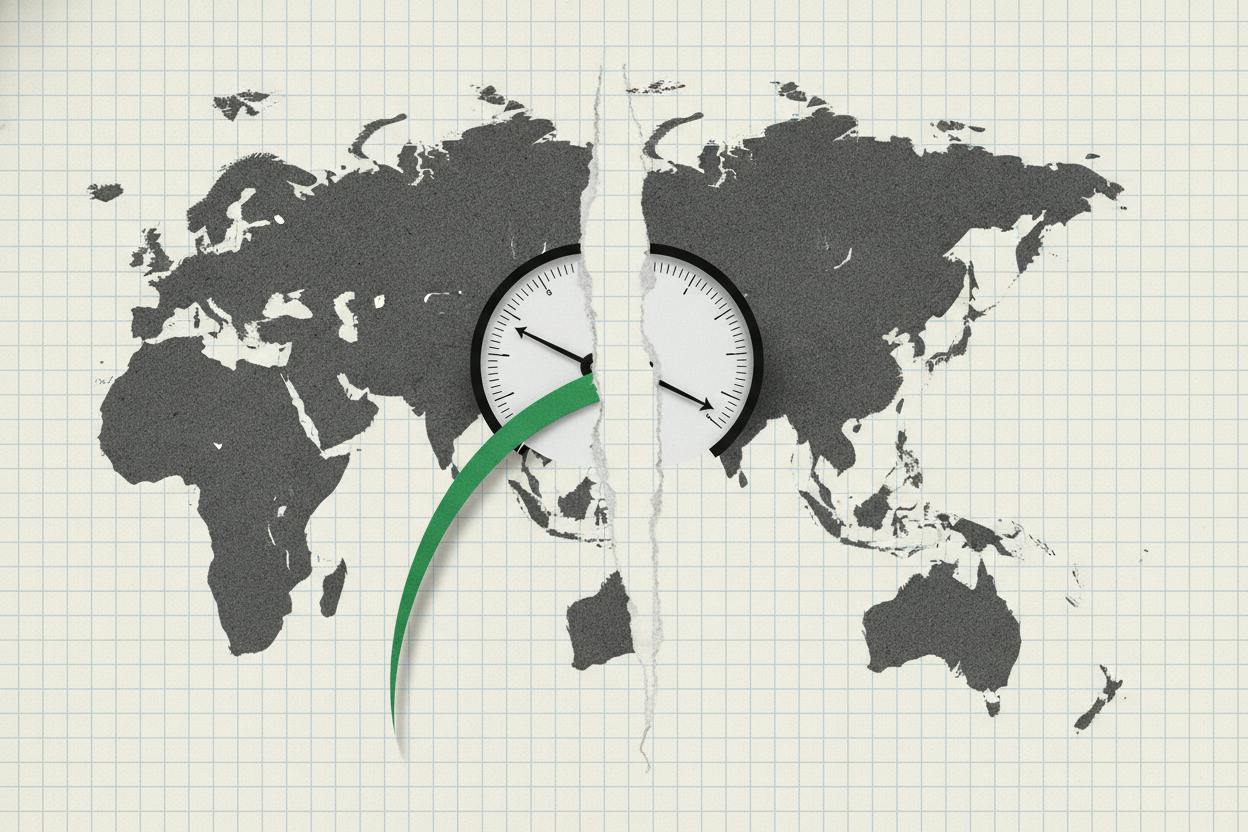
The Organisation for Economic Co-operation and Development (OECD) is painting a picture of an Asia that is no longer moving in lockstep. In its September 2026 Interim Economic Outlook, the Paris-based body forecasts that India will lead the region's growth, while China slows, Japan remains subdued, and South Korea comes off an export-led surge. The result is a region where both growth rates and policy paths are diverging sharply.
India: still sprinting, but with a stumble
India is the standout performer in the OECD's projections. The economy is forecast to grow 7.1% in fiscal 2026-27, down from 7.8% in the previous fiscal year, before easing further to 6.5% in fiscal 2027-28. That's still a remarkably strong pace for a major economy, but the OECD warns that the path won't be perfectly smooth.
Weaker purchasing power is expected to weigh on activity in late 2026, with a gradual recovery only taking hold in 2027. That suggests Indian consumers may feel a pinch in the coming months, even as the broader economy continues to expand at a healthy clip. The OECD's forecast aligns with its earlier upgrade to India's 2026 growth forecast, though it also flagged rising inflation as a risk.
China: cooling as consumption weakens
China's slowdown is more pronounced. The OECD projects growth will slip from 5.0% in 2025 to 4.5% in 2026 and 4.2% in 2027. The key culprit: inflation is biting into consumption, and efforts to curb excess capacity in some industries are also weighing on activity. For a country that has long been the engine of global growth, a gradual deceleration is a significant shift.
Chinese consumers, who have been cautious with spending, are facing higher prices that erode their purchasing power. The government's attempts to address overcapacity in sectors like manufacturing and property have added to the headwinds. As a result, the OECD sees China's growth trajectory flattening, even as it remains one of the world's largest economies.
Japan and South Korea: subdued and slowing
Japan's outlook is subdued, with the OECD expecting continued modest growth. The country has struggled with weak domestic demand and an aging population, and the latest projections suggest little change. Japan's private sector has recently shown signs of slowing growth, which fits with the OECD's cautious view.
South Korea, meanwhile, is coming off an export-led pop that has boosted its economy in recent quarters. But the OECD expects that momentum to fade, as global demand for semiconductors and other key exports cools. The country's heavy reliance on trade makes it vulnerable to shifts in the global cycle.
What's driving the divergence?
The OECD's outlook highlights how different factors are shaping each economy. India benefits from a large domestic market, a young population, and ongoing structural reforms that are attracting investment. China, by contrast, is grappling with the aftermath of a property downturn and a shift away from export-led growth toward domestic consumption, a transition that has proven bumpy.
Japan faces its own challenges, including a shrinking workforce and persistent deflationary pressures. South Korea's fortunes are tied to the global tech cycle, which is showing signs of softening. These differences mean that policymakers in each country are likely to take very different paths in the coming years.
What it means for investors
For everyday investors, the key takeaway is that Asia is no longer a single story. The region's growth is splitting, and that has implications for where you put your money.
India's strong growth could continue to support its stock market, though investors should be aware of the risks. The OECD's warning about weaker purchasing power suggests that consumer-focused companies might face headwinds in the near term. Additionally, India's markets have already shown sensitivity to oil prices and regulatory changes, such as proposed caps on insurance commissions.
China's slowdown could weigh on companies that rely heavily on Chinese demand, from luxury goods makers to industrial firms. Investors with exposure to Chinese equities or funds should be prepared for a more muted growth environment.
Japan's subdued outlook means that its market may continue to be a laggard, though some exporters could benefit from a weaker yen. South Korea's export-driven economy could see its stock market lose some steam as global demand cools.
The OECD's report also ties into broader global themes. The organization has noted that AI investment is propping up growth in some economies, while energy costs keep inflation sticky. These factors could influence how central banks in the region set policy, which in turn affects interest rates and bond yields.
The bottom line
Asia's growth story is no longer a single narrative. India is sprinting ahead, China is cooling, Japan is subdued, and South Korea is coming off a high. For investors, that means diversification across the region is more important than ever. Rather than treating Asia as a monolith, it's worth looking at each country's unique drivers and risks.
The OECD's outlook is a reminder that economic forecasts are not set in stone. But by understanding the forces at play, investors can make more informed decisions about where to allocate their money.