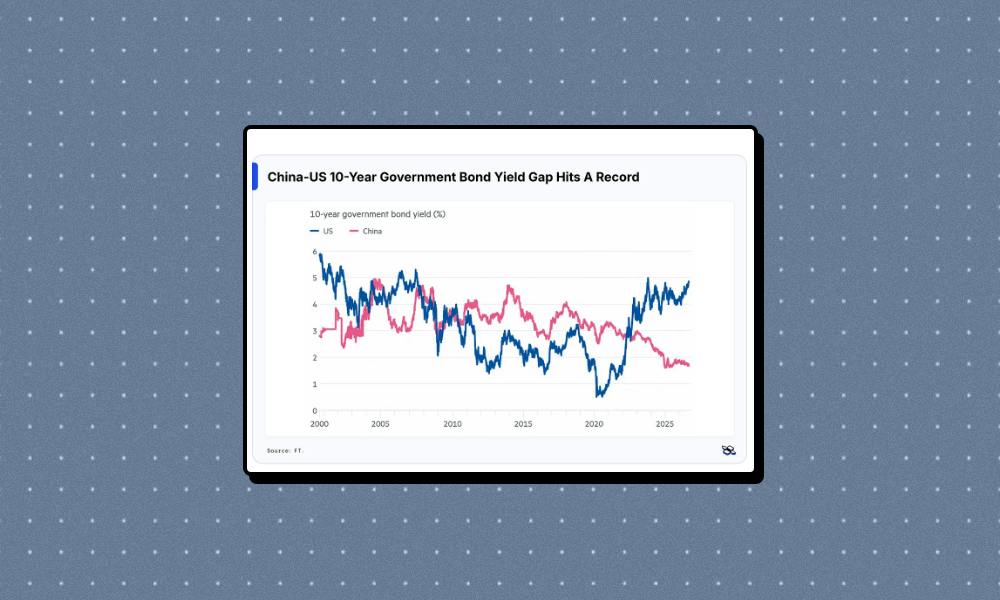
The gap between what it costs the US and Chinese governments to borrow has never been wider. This week, the difference between 10-year US Treasury yields and 10-year Chinese government bond yields hit a record 3.17 percentage points. US yields rose to 4.85%, while China's slipped to just 1.68%.
That spread is more than a curiosity for bond traders. It's a powerful magnet for global capital, and it's reshaping where money flows.
Two economies, two very different stories
The yawning gap reflects two economies moving in opposite directions. In the US, stubborn inflation and a growing mountain of government debt have pushed long-term borrowing costs higher. Investors are demanding more compensation to hold US debt, worried about persistent price pressures and the fiscal outlook.
In China, the picture is almost the reverse. The world's second-largest economy is wrestling with deflationary pressures and sluggish credit demand. Weak consumer spending and a property sector that's still struggling have kept prices flat or falling. That environment pulls bond yields down and pushes bond prices up.
Ironically, that dynamic has made China's bond market one of the world's best performers recently—though for reasons Beijing is probably not thrilled about. A rally driven by economic weakness is not the kind of success most governments hope for.
What the record spread means for investors
For everyday investors, the most immediate effect is on where global money flows. When US bonds offer yields that are three percentage points higher than Chinese bonds, investors around the world have a strong incentive to move capital into US assets. That can strengthen the US dollar and support US markets, but it also puts pressure on China's currency and financial system.
There's also a knock-on effect for other markets. As money flows West, emerging markets and other economies that compete for capital may feel the squeeze. Higher US yields can also make borrowing more expensive for companies and governments elsewhere.
For US investors, the high yields on Treasuries are a double-edged sword. On one hand, they offer attractive income—especially compared to the paltry returns available in many other developed markets. On the other, they reflect an economy that's still dealing with inflation and a government that's borrowing heavily.
It's worth noting that the gap could narrow if either economy shifts course. If US inflation cools and the Federal Reserve cuts rates, US yields could fall. If China's economy stabilizes and credit demand picks up, its yields could rise. But for now, the two are heading in opposite directions.
Investors should also keep an eye on how this affects corporate borrowers. Companies in the US face higher financing costs, which can eat into profits. Meanwhile, Chinese companies may benefit from cheaper borrowing, but only if there's enough demand to justify new investment.
The record spread is a reminder that global markets are interconnected. What happens in Beijing and Washington doesn't stay there—it ripples through portfolios everywhere.
What to watch next
Bond markets will be watching for any signs of a shift in either economy. In the US, that means inflation data and Federal Reserve policy signals. In China, it's about whether stimulus measures can revive credit demand and stop the deflationary slide.
For now, the message is clear: the world's two biggest economies are on very different paths, and that divergence is showing up in the most basic price of all—the cost of borrowing.