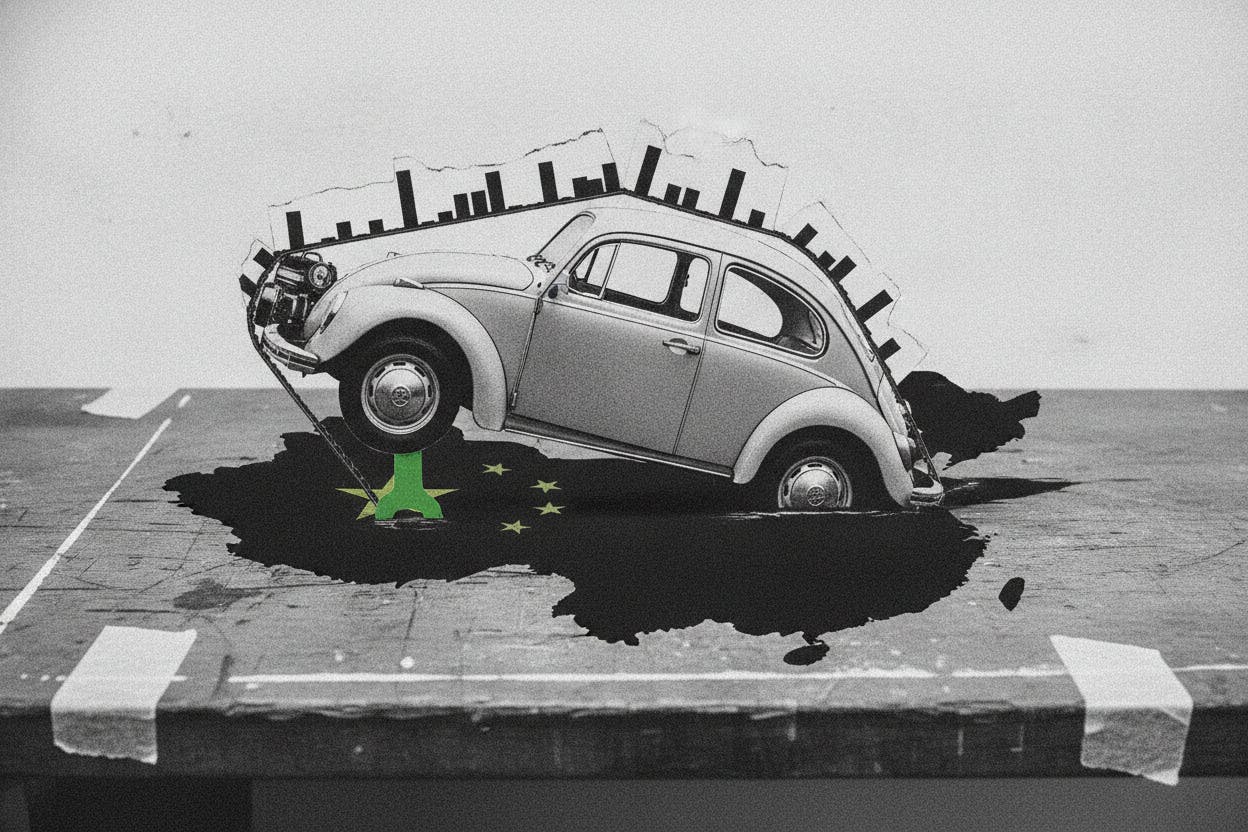
Volkswagen, Europe's largest automaker, is grappling with a sharp decline in its once-dominant China business. Profits from the region have dropped more than 80% over the past decade, and the company's shares have fallen to their lowest level since July 2010, according to Reuters. The struggles highlight how quickly the competitive landscape in the world's largest auto market has shifted.
The China Engine Stalls
For years, Volkswagen built much of its success on selling cars in China through joint ventures with local partners. The strategy made VW the top foreign automaker in the country, with strong sales of models like the Santana and Jetta. But that position has eroded as Chinese consumers increasingly turn to domestic brands that offer better software, more advanced electric vehicles, and aggressive pricing.
Local competitors such as BYD, NIO, and XPeng have gained significant market share, pushing Volkswagen from first place to third in the market. The shift has squeezed profit margins, as VW has had to cut prices and invest heavily in new EV models to stay relevant. Meanwhile, the broader Chinese auto market has seen a price war, further pressuring profitability.
The decline in China profits is a major blow for Volkswagen, which has long relied on the region to offset weaker margins in Europe and North America. With China now contributing far less to the bottom line, the company's overall financial health has come under scrutiny.
CEO Blume's Historic Overhaul
CEO Oliver Blume, who took the helm in 2022, is pushing what Reuters described as a "historic overhaul" to address the challenges. The plan includes cost-cutting measures, a renewed focus on electric vehicles, and efforts to streamline the company's sprawling operations. However, the task is daunting.
Volkswagen is an 89-year-old conglomerate with more than 657,000 employees, multiple brands including Audi, Porsche, and Skoda, and a complex ownership structure. Labor representatives hold significant power on the supervisory board, and the Porsche and Piech families control most of the voting rights through a special class of shares, even though they do not own a majority of the stock. This governance setup can make decisions like closing plants, cutting jobs, or shifting investment priorities slower and more contentious than at a typical public company.
Adding to the pressure, European car demand is expected to remain below pre-COVID levels, and trade barriers are adding costs in key markets. Volkswagen's group profit margins have more than halved between 2021 and 2025, squeezed by higher labor and energy bills and weaker sales volumes.
What It Means for Investors
For investors, the key question is whether Volkswagen can restructure quickly enough to revive its fortunes. Turnarounds typically depend on speed: the faster costs are cut and the product lineup improves, the sooner profits can recover. But VW's governance structure suggests more friction than you would see at a leaner company.
When investors expect that kind of negotiation to slow plant closures, brand simplification, or investment shifts, they often assume any margin recovery will take longer and carry more execution risk. The result is frequently a persistent "conglomerate discount," where the market values the whole group less generously than the sum of its parts. That helps explain why VW's shares have struggled even as management signals big changes.
The broader market context also matters. Recent volatility in global stocks, including a tech selloff that revived US stock market bubble fears, has made investors more cautious about cyclical companies like automakers. Meanwhile, rising interest rate bets and geopolitical tensions have added uncertainty to emerging markets like China, where Volkswagen generates a significant portion of its sales.
Some investors are watching for signs that Volkswagen can adapt more nimbly. The company has announced partnerships with Chinese tech firms to improve its software and EV offerings, and it is exploring ways to reduce costs in its home market. But the scale of the challenge is immense, and the stock's slide to 15-year lows suggests the market is skeptical.
For everyday investors, the Volkswagen story is a reminder that even established global giants can face existential threats when they fail to keep pace with technological shifts and changing consumer preferences. The company's fate in China will be a key test of whether it can reinvent itself for the electric age.