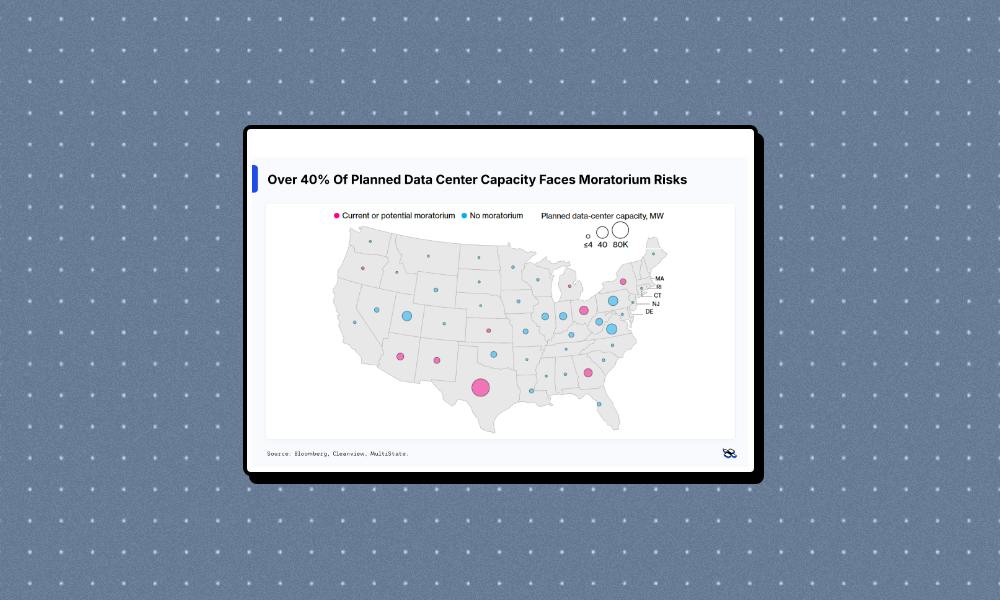
The artificial intelligence boom has hit an unexpected obstacle: the ballot box. Across the United States, newly elected state and local officials are promising to pause or restrict data center construction, and voters are weighing in directly through local measures. The result is that roughly 40% of planned US data center capacity is now at risk, according to industry analysts.
The backlash is a sharp turn for an industry that has been racing to build the massive computing facilities that power AI models, cloud services, and streaming. Data centers are energy-hungry, noisy, and often require significant water for cooling, which has made them unpopular neighbors in many communities. Now, that local discontent is translating into political action.
What's driving the pushback?
Data centers are not like typical office buildings. They house thousands of servers that run around the clock, consuming enormous amounts of electricity. In some regions, their arrival has raised concerns about grid reliability, higher utility bills for residents, and environmental impacts. Noise from cooling fans and backup generators has also drawn complaints.
As a result, a growing number of elected officials are campaigning on promises to slow down or stop new projects. The brief notes that 46 local ballot measures could further slow development, including 17 outright bans. These measures range from zoning restrictions to moratoriums on new construction, and they reflect a broader skepticism about whether the benefits of data centers—such as jobs and tax revenue—outweigh the costs.
This is not just a rural phenomenon. Even in tech-friendly states, communities are pushing back. Some towns have complained that data centers create few permanent jobs while straining local infrastructure. Others worry about the visual impact of sprawling facilities and the noise they generate.
The financial stakes
The stakes are enormous. Bloomberg Intelligence estimates that the backlash could shave 5% to 7% off the $1.4 trillion expected to be spent on AI infrastructure in 2027. That translates to tens of billions of dollars in potential delays or cancellations. As much as ten gigawatts of capacity—enough to power several million homes—could be delayed.
For investors, this is a reminder that the AI boom is not just a technological story but also a political and regulatory one. Companies like Legrand, which makes electrical equipment for data centers, have seen sales surge on the back of AI demand. Similarly, Solstice has raised its outlook citing AI data centers and nuclear demand. But if construction slows, those tailwinds could weaken.
The political risk is not entirely new. Earlier this year, OpenAI dropped non-disclosure agreements with towns as part of an effort to address community concerns. That move signaled that even major AI players are aware of the reputational and political challenges.
What it means for investors
For everyday investors, this story matters on several levels. First, it highlights the importance of regulatory and political risk when evaluating AI-related stocks. A company may have stellar earnings, but if its growth depends on building new data centers, local opposition can be a real headwind.
Second, it underscores the fragility of supply chains. Data centers are not just about the servers inside them; they require transformers, cooling systems, backup generators, and a stable power supply. Delays in construction ripple through the entire ecosystem, affecting equipment makers, utilities, and even construction firms.
Third, the backlash could have broader economic implications. Data centers are a major driver of electricity demand, and utilities have been planning new power plants and grid upgrades to serve them. If projects are delayed, those plans may be postponed, affecting energy markets and potentially keeping electricity prices lower than expected.
That said, it's important to keep perspective. The AI boom is still in its early stages, and many companies are exploring ways to address community concerns, such as using more efficient cooling technologies or locating facilities in less populated areas. Some are even looking at nuclear power to provide clean, reliable energy, as Solstice has noted.
Still, the fact that 40% of planned capacity is at risk is a significant number. It suggests that the industry may need to adapt its approach—engaging with communities earlier, offering more benefits, or finding ways to reduce the footprint of data centers. For investors, this is a signal to watch how companies navigate these challenges, as those that do well may emerge stronger, while those that ignore local concerns could face costly delays.
In the meantime, the ballot measures will be closely watched. If they pass, they could set a precedent for other communities, potentially slowing the pace of AI infrastructure buildout across the country. For now, the industry is learning that in a democracy, even the most powerful technology can be stopped at the local level.