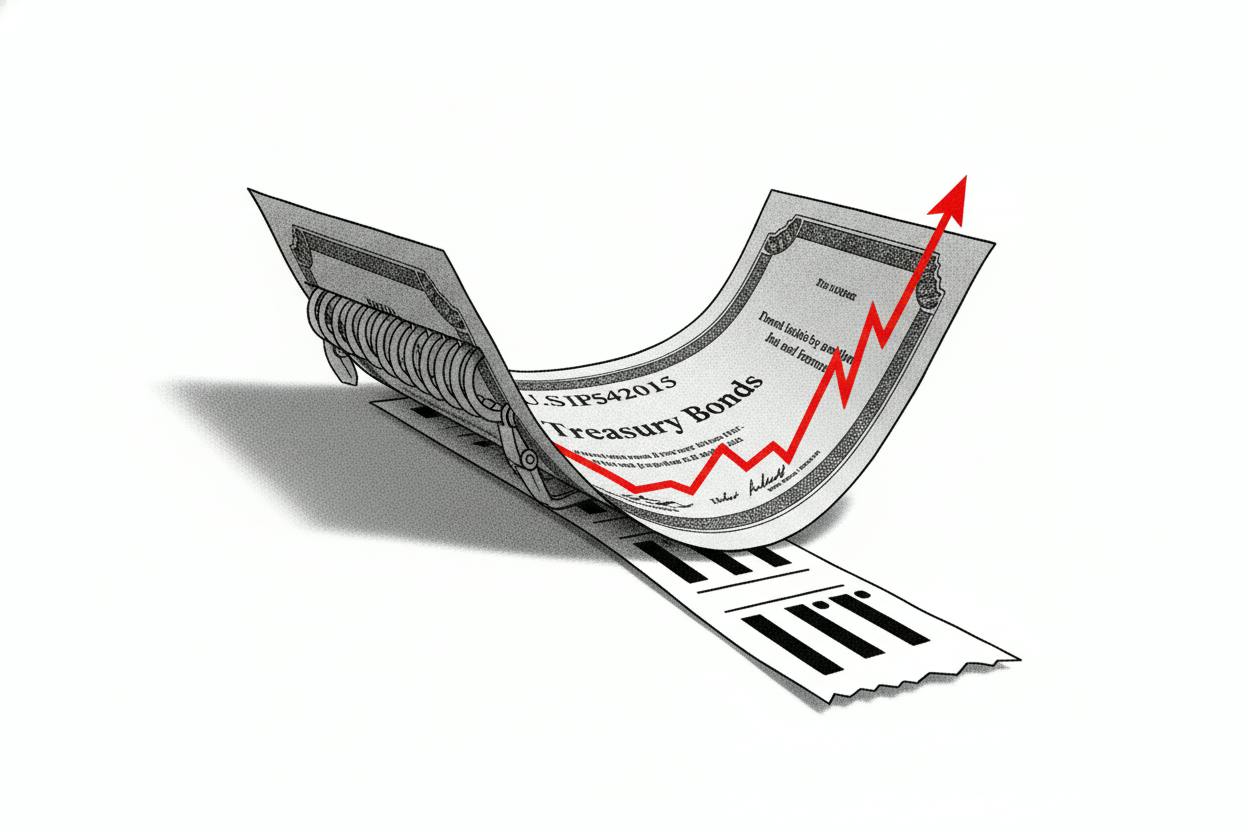
US bond investors had a rough Wednesday as a surprisingly strong economic reading and a poorly received government debt auction sent Treasury yields soaring. The 10-year Treasury yield briefly touched 5.135%, a level not seen since 2007, before settling around 5.108%.
The move was driven by two factors. First, the S&P Global flash PMI for October came in hotter than expected, suggesting that demand in the US economy is still holding up and that price pressures may be building again. That combination can make investors think inflation will cool more slowly than hoped, which is bad news for bond prices.
Second, the US Treasury's $70 billion auction of five-year notes landed with a thud. Investors demanded a higher yield than the market was indicating just before the auction, and overall demand was the weakest in about four years. Weak auctions are a sign that investors are reluctant to buy government debt at current prices, often because they expect yields to rise further.
Why bond yields matter
Bond prices and yields move in opposite directions. When yields rise, it means bond prices are falling. For everyday investors, this matters because Treasury yields are the benchmark for borrowing costs across the economy. They influence mortgage rates, car loans, and corporate borrowing costs, and they also affect the valuation of stocks.
Higher yields make bonds more attractive relative to stocks, which can pull money out of equities. They also raise the discount rate used to value future company earnings, which can pressure stock prices, especially for growth companies that promise big profits years down the road.
The 10-year yield has been climbing for months, and the recent surge to multi-decade highs has been a key driver of market volatility. As we noted earlier, oil and Treasury yields have been moving in lockstep, adding to the pressure on risk assets.
What this means for the Fed
The bond market's reaction has also shifted expectations for the Federal Reserve. Traders are now pricing in a higher probability of another rate hike in October, a move that seemed unlikely just a few weeks ago. The Fed has been trying to bring inflation down to its 2% target, and a hot PMI reading suggests that the economy may still be too strong for inflation to ease quickly.
However, the weak auction also signals that investors are worried about the growing supply of government debt. The US is running large budget deficits, and the Treasury has been increasing the size of its auctions to fund them. When demand for that debt is weak, yields have to rise to attract buyers, which can feed into higher borrowing costs across the economy.
What it means for your portfolio
For ordinary investors, the takeaway is that the era of ultra-low interest rates is firmly in the rearview mirror. If you hold bonds or bond funds, rising yields mean your existing bonds are losing value on paper. But for new money, higher yields are actually a positive, as you can lock in better returns.
For stock investors, the environment is more challenging. Higher yields tend to hurt high-valuation growth stocks more than value stocks or companies with strong cash flows. Diversification across asset classes and sectors becomes more important when yields are rising.
It's also worth noting that European stocks dipped as oil topped $100 and US yields hit 2007 highs, showing that this is a global phenomenon. The rise in yields is not just a US story; it's affecting markets worldwide.
As always, it's important to keep a long-term perspective. Market moves like this can be unsettling, but they are part of the normal cycle. If you have a well-diversified portfolio and a time horizon of several years, short-term yield spikes are unlikely to derail your long-term goals.
Investors will be watching the next round of economic data and the Fed's comments for clues about the path of rates. The bond market is clearly telling us that the path is uncertain, and that uncertainty is showing up in higher yields.