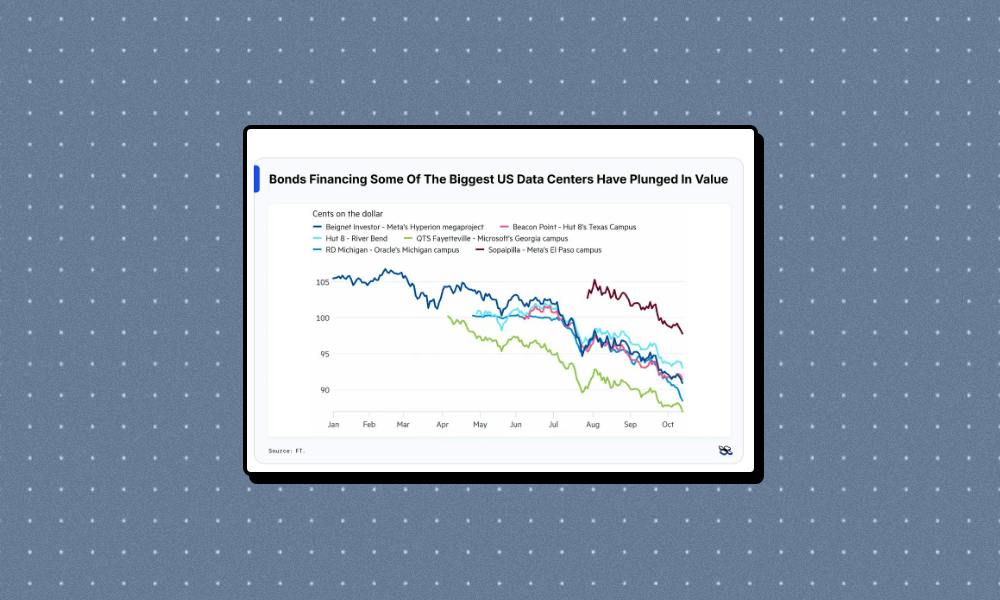
The artificial intelligence boom has been built on grand ambitions and even grander borrowing. But now, the debt that powers those ambitions is starting to crack.
Bond investors are selling off debt tied to massive US data centers, worried that AI revenues won't come close to covering the industry's eye-watering borrowing costs. The selloff is a warning sign that the market's enthusiasm for AI may be cooling, at least when it comes to the companies that build and operate the physical infrastructure behind the technology.
What's happening in the bond market
Bonds financing projects backed by tech giants like Meta, Microsoft, and Nvidia have fallen below their original value. That means investors who bought these bonds at issuance are now seeing losses on paper. The decline reflects growing skepticism about whether the AI boom will generate enough cash flow to service the debt taken on to build data centers.
The pain is even sharper for a group of companies known as “neoclouds”—firms that rent out AI computing power to other businesses. These companies have borrowed heavily to build out their data center capacity, betting that demand for AI processing will soar. But with revenue still uncertain, bond investors are demanding higher returns to compensate for the risk.
Take CoreWeave, a major neocloud provider. Its bonds have slumped below 80 cents on the dollar, pushing yields toward 15%. Bond yields rise when prices fall, reflecting the bigger returns investors demand for taking on more risk. A yield of 15% is a red flag, signaling that the market sees a meaningful chance of default.
Why this matters for everyday investors
For most people, the immediate impact is indirect. If you own a bond fund or an ETF that holds corporate debt, you might see some of these data center bonds in your portfolio. The selloff could drag down the fund's performance, even if you never directly bought a single bond.
But the bigger picture is about the health of the AI trade. Stocks like Nvidia and Microsoft have soared on the promise of AI-driven growth. If the debt that funds AI infrastructure starts to sour, it could ripple through the entire sector. As Asian chip stocks steady after a recent selloff, investors are clearly weighing AI spending against rising bond yields.
The bond market is often seen as a smarter, more cautious cousin to the stock market. Bond investors are the ones who get paid first, and they tend to be more conservative. When they start to worry, it's worth paying attention.
The bigger picture: AI's debt-fueled growth
The AI boom has been unusual in its scale of borrowing. Companies have taken on massive debt to build data centers, often before they have a clear picture of future revenue. This is a bet that AI demand will grow fast enough to justify the spending. But as the bond selloff shows, not everyone is convinced.
Some analysts have compared the situation to the dot-com bubble, where companies borrowed heavily to build internet infrastructure, only to see revenues fall short. Others argue that AI is different because the technology is already generating real revenue, even if it's concentrated among a few big players.
For now, the bond market is sending a clear message: the risk is rising. As Fitch keeps Tencent at an A rating despite heavy AI spending, it's clear that even well-rated companies are being watched closely for their AI-related debt loads.
What investors should watch next
The key question is whether AI revenues will eventually catch up with the spending. If they do, the bonds could recover. If not, the selloff could deepen, and the pain could spread to other parts of the market.
Investors should keep an eye on earnings reports from major AI players, as well as any signs that data center utilization is rising. Also watch for any downgrades from credit rating agencies, which could trigger further selling.
For those who own bond funds, it might be worth checking how much exposure they have to data center debt. For stock investors, the bond market's jitters are a reminder that the AI boom is not without risk. As investors pull money from cash and rotate into stocks and bonds, the shift in sentiment could have broader implications.
The selloff in data center bonds is a classic sign of a market that's getting ahead of itself. It doesn't mean the AI story is over, but it does mean that the easy money phase might be ending. For now, the bond market is telling us to be careful.