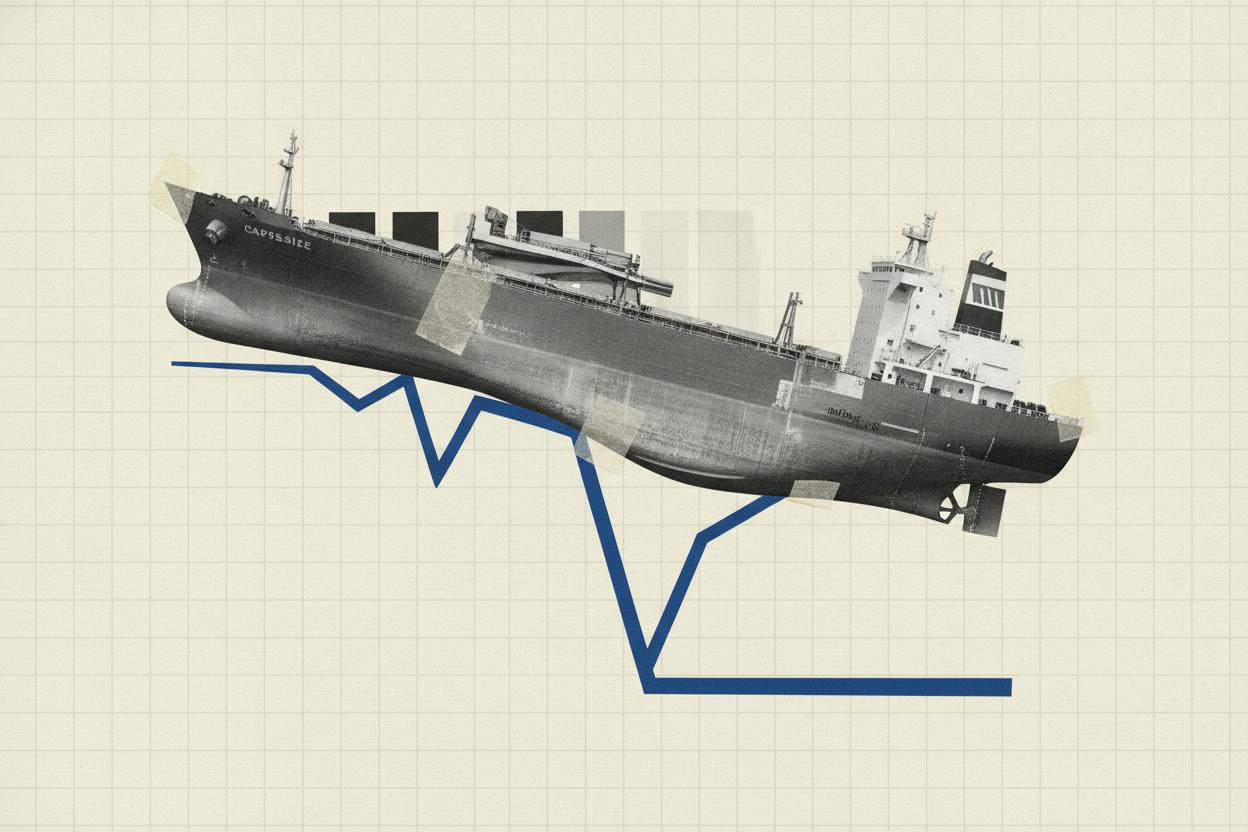
The Baltic Dry Index, a key barometer for global shipping costs, fell 14% this week to 2,511, its lowest level since June 30. The decline was driven by weaker capesize rates, the largest category of dry-bulk carriers, which typically haul iron ore and coal across long distances.
According to Reuters, the index has now fallen for three consecutive weeks. The capesize sub-index dropped 25% over the week to 3,249, pushing estimated daily earnings down to about $26,000. Panamax rates also slipped, while smaller supramax routes held up somewhat better.
What is the Baltic Dry Index?
The Baltic Dry Index is a daily snapshot of how much it costs to move raw materials like iron ore, coal, and grain by sea. It is compiled by the Baltic Exchange and is widely watched as an early indicator of global economic activity. When shipping rates rise, it often signals strong demand for commodities; when they fall, it can suggest weakening trade or an oversupply of ships.
Capesize vessels are the giants of the dry-bulk fleet, with capacities of around 150,000 to 400,000 deadweight tonnes. They are primarily used on routes from Brazil and Australia to China, carrying iron ore and coal. Because they are so large, their rates are especially sensitive to changes in demand from major industrial economies, particularly China.
The recent drop in capesize earnings to about $26,000 a day is notable, though still above the break-even levels for many operators. For context, capesize rates have been volatile in recent years, swinging from multi-year highs to lows below operating costs.
Why are rates falling?
The brief points to weaker capesize routes as the main culprit. Several factors are likely at play. Seasonal patterns often see a slowdown in shipping activity after the summer peak, and this year is no exception. Additionally, iron ore and coal demand from China, the world's largest buyer, has been uneven as the country's property sector struggles and steel output fluctuates.
There is also the question of fleet supply. New vessels ordered during the shipping boom of the early 2020s are now entering the water, adding capacity and putting downward pressure on rates. At the same time, some older ships are being scrapped, but not fast enough to offset the new supply.
Geopolitical tensions, such as the Houthi threats in the Red Sea, have occasionally disrupted shipping routes and pushed rates higher, but those effects have faded in recent weeks. As Gulf stocks slid on similar fears earlier, any renewed disruption could quickly change the picture.
What it means for investors
For everyday investors, the Baltic Dry Index is not a direct investment, but it has ripple effects. Shipping companies, such as dry-bulk operators, see their earnings directly tied to these rates. A sustained decline could pressure their stock prices and profit margins. Conversely, a rebound in rates could boost them.
Commodity producers also feel the impact. When shipping costs fall, it becomes cheaper to move iron ore and coal, which can slightly lower the landed cost for buyers. However, as Vale warned earlier, higher shipping costs can squeeze supply, so the reverse may also hold true.
For the broader economy, falling dry-bulk rates are often seen as a sign of cooling global trade. That can be a double-edged sword: it may ease inflationary pressures, but it can also signal weaker industrial demand. Investors in sectors like mining, construction, and manufacturing should keep an eye on these trends.
It's also worth noting that the Baltic Dry Index is notoriously volatile. A single week's move, or even a three-week slide, does not necessarily indicate a long-term trend. Shipping markets are influenced by everything from weather to port congestion to macroeconomic policy.
Looking ahead, market participants will be watching for any signs of a rebound in Chinese demand, as well as the pace of new vessel deliveries. The upcoming winter months often see a pickup in coal shipments for heating, which could provide some support to rates.
For now, the decline in capesize earnings is a reminder that the global economy is still navigating an uneven recovery. As stocks have remained steady amid central bank signals, the shipping market offers a more granular view of real-world trade flows.
Investors should treat the Baltic Dry Index as one of many indicators, not a standalone signal. It is best used in conjunction with other data, such as manufacturing PMIs and commodity prices, to gauge the health of global trade.