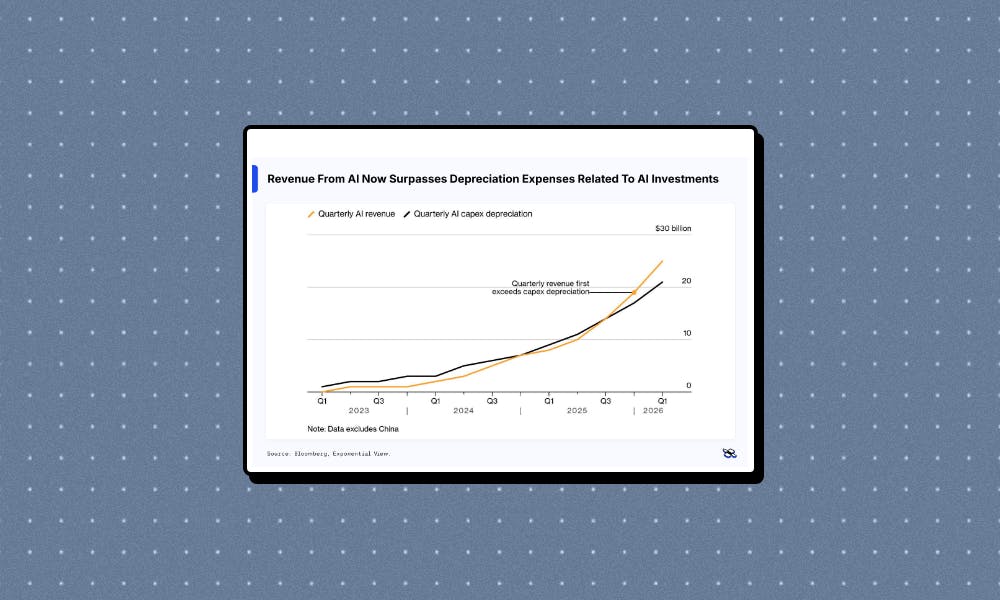
For the first time in the AI boom, revenue is starting to catch up with the enormous spending on data centers and chips. Global AI revenue, excluding China, reached $25 billion in the first quarter of 2026, according to research firm Exponential View. That topped the industry's estimated $21 billion in depreciation costs from data center and chip investments for the second quarter in a row.
Depreciation is the accounting method that spreads the cost of a big asset—like a $100 million data center—over its useful life, typically several years. For AI companies, depreciation is a major expense because they've poured hundreds of billions into building out infrastructure. Covering that cost with revenue is a milestone, but it's not the same as generating a profit.
What the Numbers Mean
The $25 billion in revenue includes sales from cloud services, AI software, and chip sales to businesses and governments. The $21 billion in depreciation reflects the wear and tear on all those servers, GPUs, and networking gear. The fact that revenue now exceeds depreciation for two straight quarters suggests the industry might be approaching a sustainable economic model.
But the stakes are enormous. Meta, Alphabet, Microsoft, and Amazon alone are expected to spend as much as $725 billion on capital expenditure this year. That's more than the entire GDP of many countries. Investors have been watching closely, with some questioning whether the AI spending spree will ever pay off. Recent AI chip stocks slid as healthcare surged, reflecting growing doubts about the return on those investments.
Why Depreciation Matters
Covering depreciation is a necessary step, but it's not the finish line. Think of it like buying a rental property: if your rental income covers the mortgage and property taxes, you're breaking even on cash flow. But you still haven't made a profit until you've also covered maintenance, insurance, and your own time. Similarly, AI companies need to generate enough revenue to cover not just depreciation, but also operating costs like electricity, staff, and software development.
The broader market is also watching. South Korean stocks plunged 5.8% earlier this year as AI spending doubts hammered chip giants like Samsung and SK Hynix. That shows how sensitive the market is to any sign that the AI boom might be overhyped.
What It Means for Investors
For everyday investors, this data point is a mixed signal. On the positive side, it suggests that the AI industry is generating real revenue, not just burning cash. That's a big improvement from a year ago, when many analysts worried that AI was a bubble with no revenue to show for it.
On the cautious side, covering depreciation is a low bar. The real test will be whether AI companies can generate enough profit to justify their sky-high valuations. If revenue growth slows or costs keep rising, the market could reassess the entire sector. The US economy grew at a revised 2.1% in Q1, but consumer spending slumped to just 0.5%, which could weigh on corporate spending on AI tools.
Investors should also watch for signs that AI spending is translating into higher earnings for the biggest players. If Meta, Alphabet, Microsoft, and Amazon can show that their AI investments are boosting profits, that would be a much stronger signal than simply covering depreciation.
The Bottom Line
The AI revenue milestone is real and worth noting, but it's not a victory lap. The industry still has a long way to go before the boom truly pays off. For now, investors should keep an eye on earnings reports and capital expenditure plans from the big tech companies. The next few quarters will be crucial in determining whether AI is a sustainable growth story or just another tech bubble.