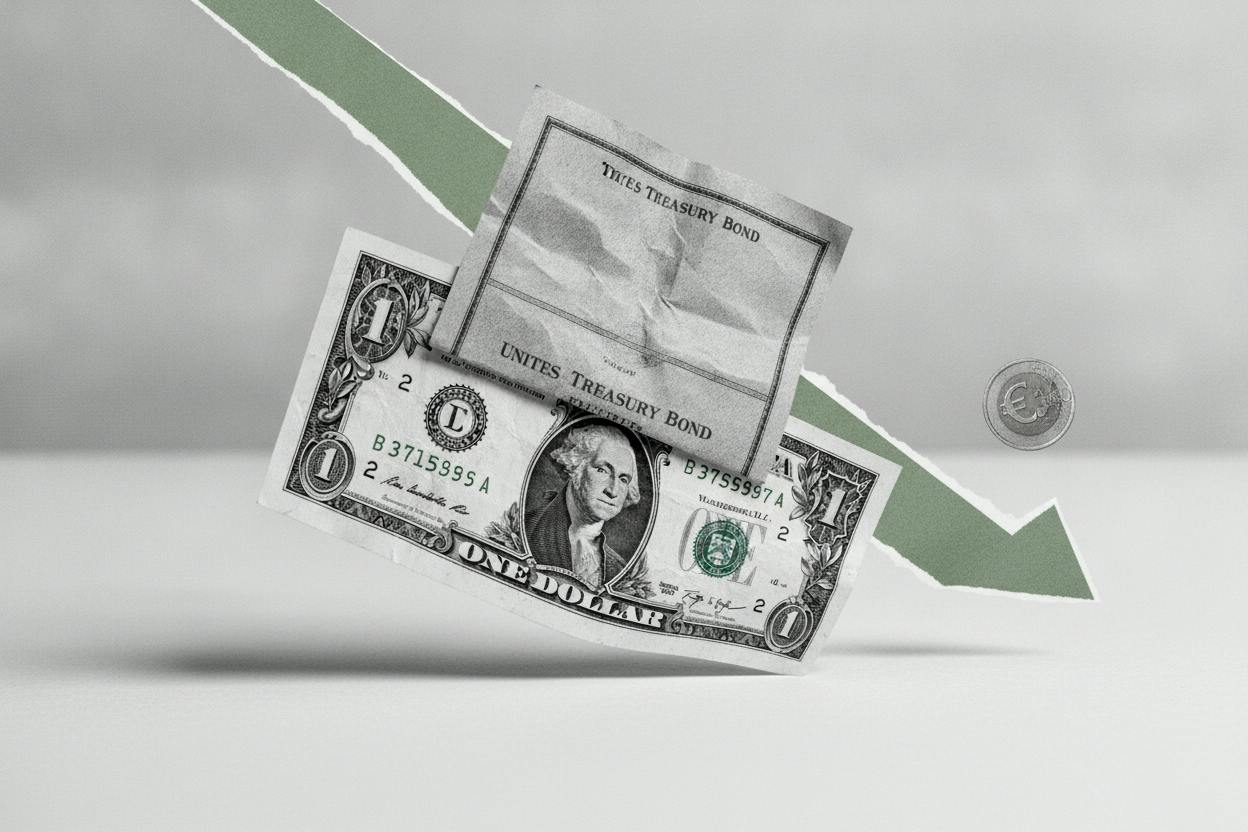
The US dollar is heading for its first weekly drop in five weeks, as a pullback in the artificial-intelligence trade nudges investors into the safety of US government bonds and drags down interest rates. The shift has given the euro room to recover from a 17-month low, and it highlights how quickly sentiment can turn when a popular market theme starts to wobble.
What's driving the move?
This week's slide in AI-related stocks is no longer just an equity story. According to Reuters, some of the stress has spilled into the credit market, where investors are questioning whether heavily indebted data-center operators can become profitable fast enough to comfortably make their interest payments. Data centers are the physical backbone of the AI boom, but building them requires enormous upfront spending, often funded with borrowed money.
When doubts like that surface, money often flows into US Treasuries—the government bonds that are considered among the safest investments in the world. More buying pushes bond prices up and yields down. The US 10-year Treasury yield is on pace for its biggest weekly fall in more than a year.
That matters for currencies because lower yields shrink the extra return investors can earn from holding dollar assets versus, say, euro or yen assets. With many traders already positioned for a stronger dollar, a narrowing rate gap can trigger a faster-than-usual unwind. That helps explain why the dollar index is down 0.14% on the week at 102.07, while the euro has recovered to about $1.1210 after touching a 17-month low.
Why the AI trade matters beyond tech stocks
The AI trade has been a major driver of US stock market gains over the past couple of years, with investors pouring money into companies that build AI models, make the chips that power them, and operate the data centers that house the servers. But as with any hot theme, when expectations get stretched, a pullback can be sharp.
This week's wobble is a reminder that the AI boom is not just about stock prices. It has also fueled a wave of borrowing by data-center operators, who need to finance massive construction projects. If those companies struggle to generate profits quickly enough to service their debt, the risk can ripple through credit markets, affecting bond prices and, ultimately, interest rates.
For everyday investors, the key takeaway is that a single theme can have broad market effects. A slowdown in AI-related stocks can influence everything from your bond fund's returns to the value of your international investments, simply because it changes the flow of money across asset classes.
What it means for investors
The falling 10-year yield is chipping away at the dollar's edge. When a popular US-led theme like AI starts to look shakier and even credit investors get nervous, the knock-on effect is often on rates. As demand for Treasuries rises, yields fall, and that reduces the dollar's advantage over other major currencies.
That's why relatively small weekly moves in the dollar index can still matter for pairs like EUR/USD and USD/JPY: they're reacting to the direction of US yields and expectations for the Federal Reserve. With markets pricing a 72% chance the Fed leaves rates unchanged at its coming meeting, traders are likely to stay sensitive to Fed-related messaging, including comments from Kevin Warsh, because any shift in the expected rate path quickly feeds into bond yields and, by extension, the dollar.
For investors, this means keeping an eye on both the AI trade and the Fed. If AI-related stress continues, it could keep downward pressure on yields and the dollar. On the other hand, if the Fed signals a more hawkish stance—perhaps by suggesting rate cuts are further away—the dollar could regain its footing.
Also worth watching: how this plays out in other markets. A softer dollar often provides some relief to emerging-market currencies and commodities priced in dollars, as seen in Latin American markets steadying as the dollar retreats. And if Treasury yields keep falling, that could support bond prices, a trend that has been helping stocks even when inflation data runs hot.
But there's also a cautionary note. The AI trade has been a powerful force, and a sustained pullback could have wider implications. As AI data center IPOs stall when Treasury yields climb, the current drop in yields might actually ease some of that pressure. Still, the credit market's concerns about data-center debt are a reminder that not every part of the AI boom is on solid financial footing.
For now, the dollar's weekly dip is a signal that investors are reassessing risk. Whether that reassessment deepens or fades will depend on how the AI trade evolves and what the Fed says in the coming weeks. For ordinary investors, the lesson is simple: even a story as big as AI can have ripple effects far beyond the stocks you see in your portfolio.