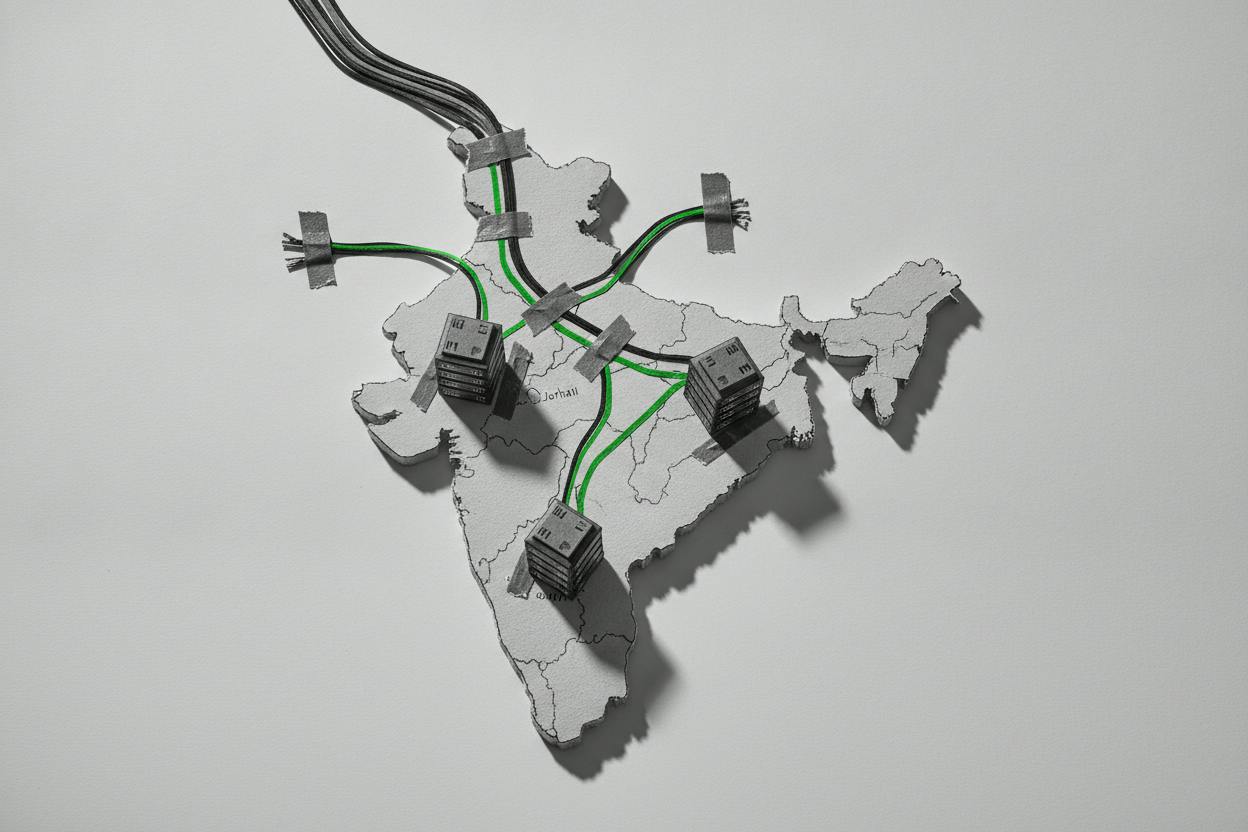
Bharti Airtel has signed a deal with the Assam state government to invest roughly 12 billion rupees (about $140 million) in three new data centers, marking one of the region's largest digital infrastructure commitments to date. The facilities, planned for Guwahati, Jorhat, and Silchar, are expected to be completed by 2028.
The investment will be channeled through Nxtra, Airtel's data-center subsidiary. Nxtra operates a network of facilities that rent out secure space, power, and high-speed connectivity to businesses needing to store data and run cloud or artificial intelligence workloads. The Assam sites add to Nxtra's push toward 1 gigawatt of “AI-ready” capacity across India, a goal that reflects the surging demand for computing power driven by AI adoption.
What the numbers show
Two of the three projects come with unusually clear cost and capacity details. Jorhat is planned for 10 megawatts of IT load, backed by an investment of 2 billion rupees, while Silchar is set for 15 megawatts with 2.55 billion rupees. Guwahati, the state capital, will receive the remaining roughly 7 billion rupees, though its capacity was not specified in the announcement.
Those figures work out to roughly 200 million rupees per megawatt for Jorhat and about 170 million rupees per megawatt for Silchar. That is a useful benchmark for investors because data centers are capital-intensive, long-term infrastructure bets. The upfront cost of land, cooling systems, backup power, and security is high, and revenue only starts flowing once customers sign on.
The 25 megawatts across the two disclosed sites represents just 2.5% of Nxtra's 1 gigawatt target. That underscores a key point: scaling to that level is not about a single announcement but about repeating a build-and-fill cycle many times over. Each new facility must attract tenants, generate cash flow, and then help fund the next project.
Why financing matters
Because cash goes out long before customers move in, data-center expansion typically requires a multi-year pipeline of equity and project loans. Nxtra has already lined up significant backing: earlier this year, it secured a $1 billion funding commitment from Alpha Wave Global, Carlyle, and Anchorage Capital. That capital helps bankroll projects that take years to build and ramp.
The speed of Nxtra's rollout will likely hinge on how easily it can keep funding new sites without squeezing Bharti Airtel's wider budget for telecom network upgrades. Airtel, like other Indian telecom operators, is investing heavily in 5G and fiber infrastructure, so any large capital outlay in data centers competes with those priorities.
For Assam, the deal is a high-profile win. The state has been trying to attract technology infrastructure to diversify its economy and create jobs. Data centers are seen as anchors for broader digital ecosystems, potentially drawing cloud providers, startups, and IT services firms to the region.
What it means for investors
For everyday investors, this announcement is a reminder that the AI boom is not just about software companies. The physical infrastructure that powers AI—data centers, power grids, and connectivity—is a growing area of capital spending. Companies like Airtel are betting that demand for data storage and computing will keep rising, and they are willing to commit billions of rupees to that bet.
But the economics are not instant. Data centers take years to build and even longer to fill with paying customers. Investors should watch how quickly Nxtra can sign up tenants and whether the projects hit their completion deadlines. They should also monitor how the expansion is funded, as heavy borrowing could strain Airtel's balance sheet.
The Assam investment also fits into a broader trend of data-center construction across India, driven by government incentives and the rapid adoption of digital services. Similar projects are underway in other states, and the competition for power, land, and skilled workers is intensifying. As governments worldwide grapple with AI infrastructure rules, the pace of such investments could be shaped by policy as much as by market demand.
For now, the Assam deal is a modest but concrete step toward Nxtra's 1 gigawatt goal. It shows that the company is willing to invest in less obvious locations, not just the major metros. Whether that strategy pays off will depend on execution and on the broader demand for AI-ready capacity in the years ahead.