Advanced Micro Devices gave investors a lot to digest on Tuesday, and the market's initial verdict was positive. The chipmaker told Wall Street it expects roughly $17 billion in revenue for the fourth quarter, and it confirmed that early versions of its Helios AI rack systems are already being tested at Meta. The stock rose more than 6% in after-hours trading following the update.
For a company that spent years as the perennial second choice in data-center chips, the numbers tell a story of a business that is increasingly defined by artificial intelligence — and increasingly by the systems it sells around its chips, not just the chips themselves.
The data-center engine is doing the heavy lifting
AMD's data-center unit posted record revenue of $8.55 billion in the third quarter, a 97% jump from a year earlier. That is the clearest signal of where the company's growth now comes from. The broader industry backdrop helps explain the surge: AI workloads are shifting from "training" — the expensive process of teaching a model — toward "inference," which is running those models inside everyday apps and services. Inference tends to happen constantly and at scale, which means more demand for the kind of hardware AMD sells.
The company still beat overall expectations for the quarter, but the strength was not uniform. Its client and gaming business slipped, a reminder that the AI buildout is now the main event and that other parts of AMD's portfolio are no longer the headline. Investors who own the stock are effectively betting on data centers, whether they think of it that way or not.
From chips to full racks — and a new rival
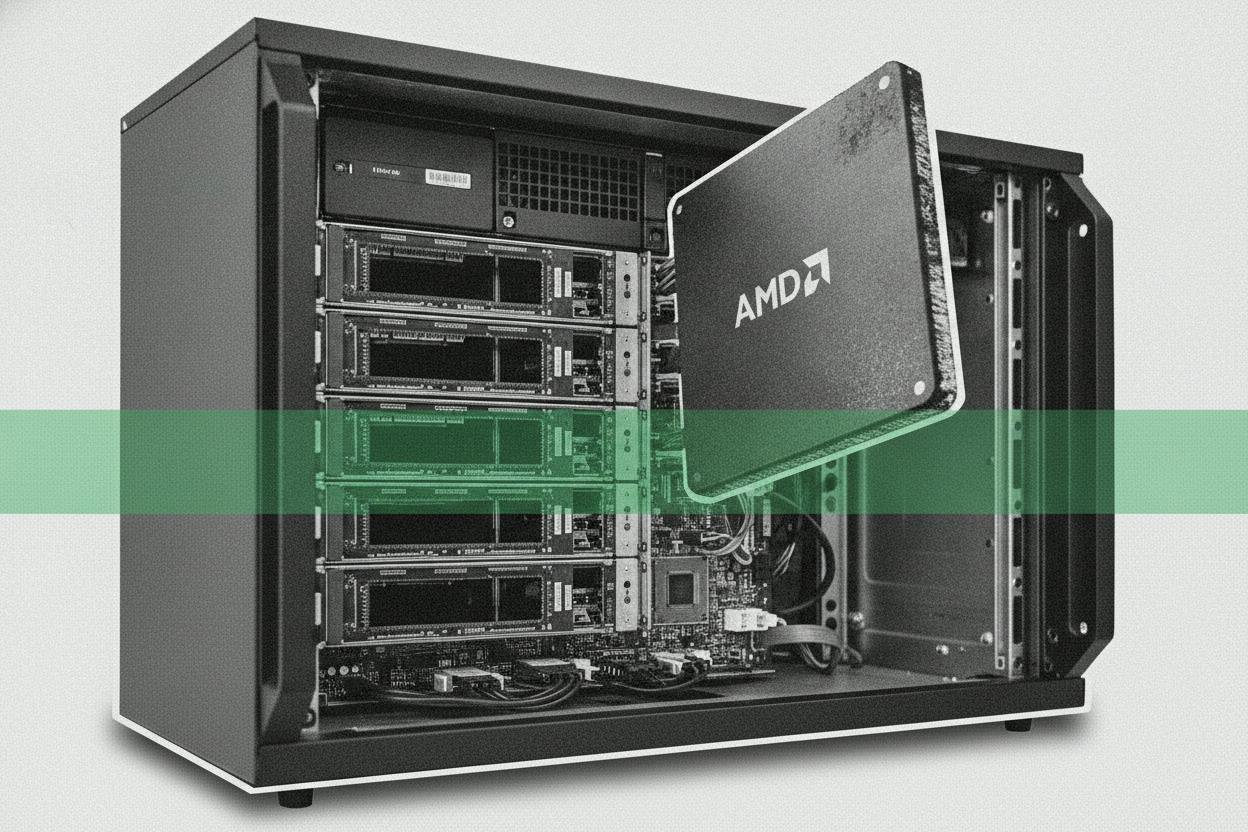
The strategic shift is arguably the most important part of the update. AMD is no longer just selling standalone processors. It is pushing rack-scale systems like Helios, which bundle its MI455X accelerator with new "Venice" server chips. A rack is essentially a complete, pre-integrated unit of computing power that customers can slot into a data center, rather than a pile of parts they have to assemble themselves.
That puts AMD in more direct competition with Nvidia, the leading designer of AI chips and the company that has dominated this market. Selling entire racks is a way to capture more of a customer's spending and to make AMD's hardware easier to deploy. It is also a well-worn playbook in enterprise technology: move up the stack, own more of the system, and become harder to replace.
But the economics change with the strategy. A full rack requires a lot of third-party components, including high-bandwidth memory — a specialized type of chip memory that is in tight supply across the industry. When you sell a bigger, more complex bill of materials, you also take on more exposure to parts you do not fully control.
Why the margin guide may matter more than the sales target
AMD guided to an adjusted gross margin of about 55% for the fourth quarter, down from 56% in the third. That single percentage point is worth watching closely. Gross margin is the share of revenue left after the direct cost of producing what you sell, and it is one of the clearest windows into pricing power and cost control.
As Helios ramps up and Meta tests early units, more of AMD's revenue will come from assembling and shipping entire racks rather than selling individual chips. That means supply squeezes — like the current tightness in high-bandwidth memory — often show up first in profit margins rather than in revenue. A company can hit its sales target and still disappoint if the profit on those sales is thinner than expected.
If gross margin can hold around the mid-50s while Helios volumes rise, investors may see evidence that AMD is winning AI share without paying for it through profitability.
If margins slip instead, the market may start treating strong sales as lower quality — especially with Nvidia and Intel as constant points of comparison. That is the tension baked into this quarter's guidance.
What it means for investors
For everyday investors, the takeaway is less about any single number and more about what AMD is trying to become. The company is asking the market to judge it as a systems provider in the AI data-center buildout, not just a chip supplier. That is a bigger opportunity, but it comes with different risks: more complex supply chains, more dependence on third-party components, and margins that can move for reasons outside the company's control.
The Meta testing news matters because it is a form of validation. Large cloud and platform companies are the customers that matter most in this market, and having early Helios units in a major buyer's hands is a step toward real orders. It is not the same as a signed, large-scale deployment, and investors should be careful not to treat it as one.
What to watch next: whether Helios moves from testing to volume shipments, how high-bandwidth memory supply evolves, and whether AMD can keep gross margin near the mid-50s as rack sales grow. The AI boom's profits have flowed heavily to chipmakers so far, and AMD is trying to make sure it captures a larger share of that spending. The $17 billion revenue target is the eye-catching figure, but the margin line may be the one that tells investors whether the strategy is actually working.