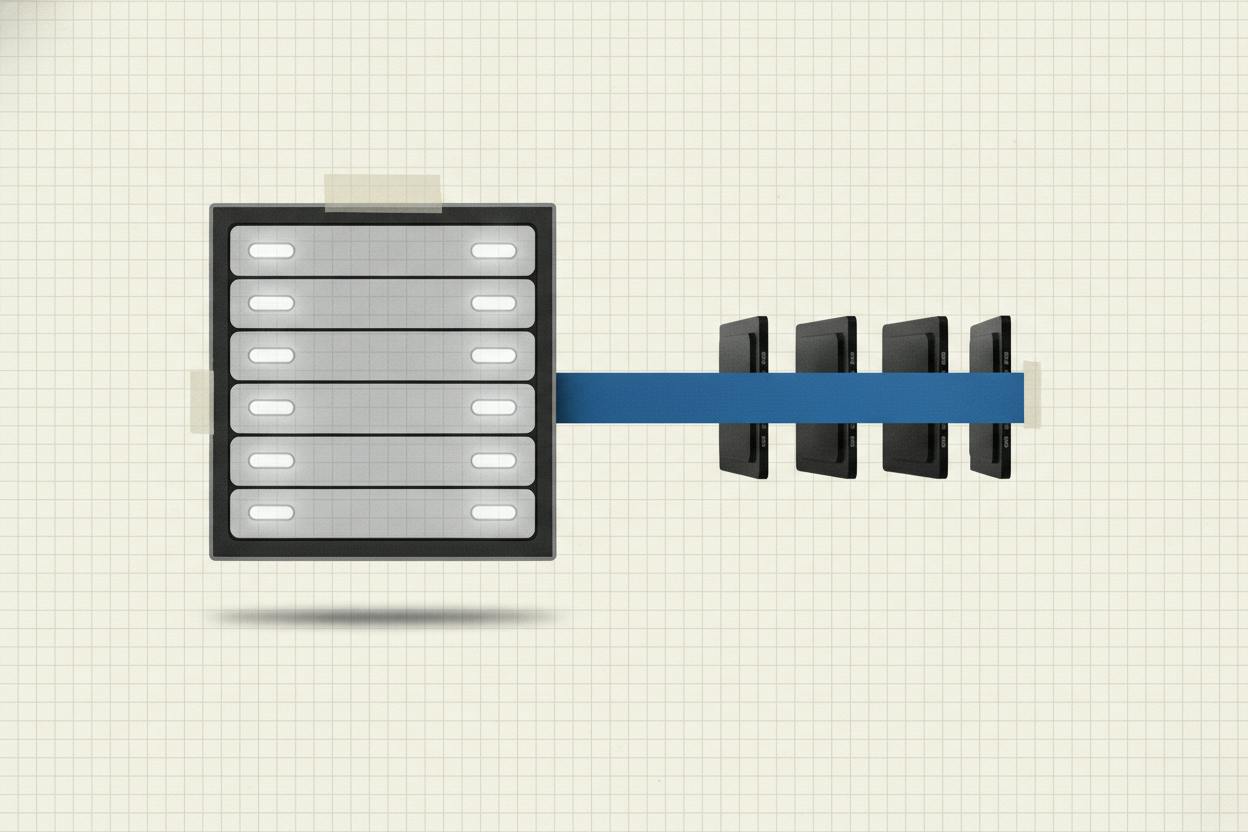
Apple is quietly exploring a return to the server market with a machine built around its own silicon, according to a report from The Information. The company has discussed using Nvidia's NVLink Fusion technology to connect its chips in an enterprise AI inference server, though the product may not arrive before 2029.
The report, citing people familiar with the discussions, says Apple has considered a server aimed at AI developers, businesses, and governments. It could use two or four of Apple's planned M8 Ultra chips, which are expected to be powerful processors designed for demanding workloads.
What is AI inference and why does it matter?
To understand the significance, it helps to break down what an AI inference server does. When an AI model is trained, it learns patterns from vast amounts of data. But the stage where the model actually answers a question or generates text is called inference. In large-scale settings, inference often runs across multiple chips at once to handle the workload quickly.
That's where the plumbing becomes critical. Chip-to-chip connections need extremely fast data transfer and low delay, or adding more chips doesn't translate into proportional speed gains. Nvidia's NVLink is a high-speed interconnect that allows GPUs to communicate with each other at speeds far beyond traditional PCIe connections. NVLink Fusion, presumably an evolution of that technology, would be the glue that lets Apple's chips work together efficiently.
Apple has been developing its own processors for years, starting with the M1 chip in 2020, and has since expanded into high-end Macs and even data center projects. But the company has largely stayed out of the server business, focusing instead on consumer devices and cloud services. A return to servers would mark a significant shift, potentially positioning Apple as a player in the AI infrastructure race.
Why Nvidia's involvement is notable
Nvidia dominates the AI chip market, with its GPUs powering most large-scale AI training and inference workloads. Its NVLink technology is already widely used in data centers to link multiple GPUs. If Apple were to use NVLink Fusion, it would be a notable partnership, even if Apple's own chips are at the heart of the server.
For investors, this raises questions about Apple's strategy. The company has been investing heavily in AI, with plans to integrate more intelligence into its devices and services. A server product could help Apple offer AI capabilities to businesses and governments, potentially opening a new revenue stream. But the timeline is long—2029 is several years away—and the project may never come to market.
What it means for investors
For everyday investors, this report is a reminder that Apple is not resting on its laurels. The company is exploring new frontiers, but it's also a sign of how competitive the AI infrastructure space has become. Nvidia's dominance is so strong that even Apple, with its own chip expertise, might need to rely on Nvidia's interconnect technology.
That said, the news is unlikely to move Apple's stock much in the near term. The server, if it ever ships, is years away, and Apple's core business—iPhones, Macs, and services—remains the primary driver of its financial performance. Investors should view this as a long-term strategic possibility rather than a near-term catalyst.
For those watching the broader AI infrastructure trend, this report adds to a growing list of companies trying to challenge Nvidia's grip on the market. Startups like Delos Data are raising funds to improve chip utilization, while others like Axelera AI are pushing into AI factories. The race is far from over, and Apple's potential entry could shake things up—if it happens.
In the meantime, investors should keep an eye on Apple's AI developments, including its plans for a foldable iPhone and smarter Siri, which could drive growth through 2027. The server project is just one piece of a larger puzzle.
As with any speculative report, it's wise to treat this as unconfirmed. Apple has not commented, and the company often explores projects that never see the light of day. But the fact that Apple is even considering such a move underscores the importance of AI infrastructure in the tech landscape.