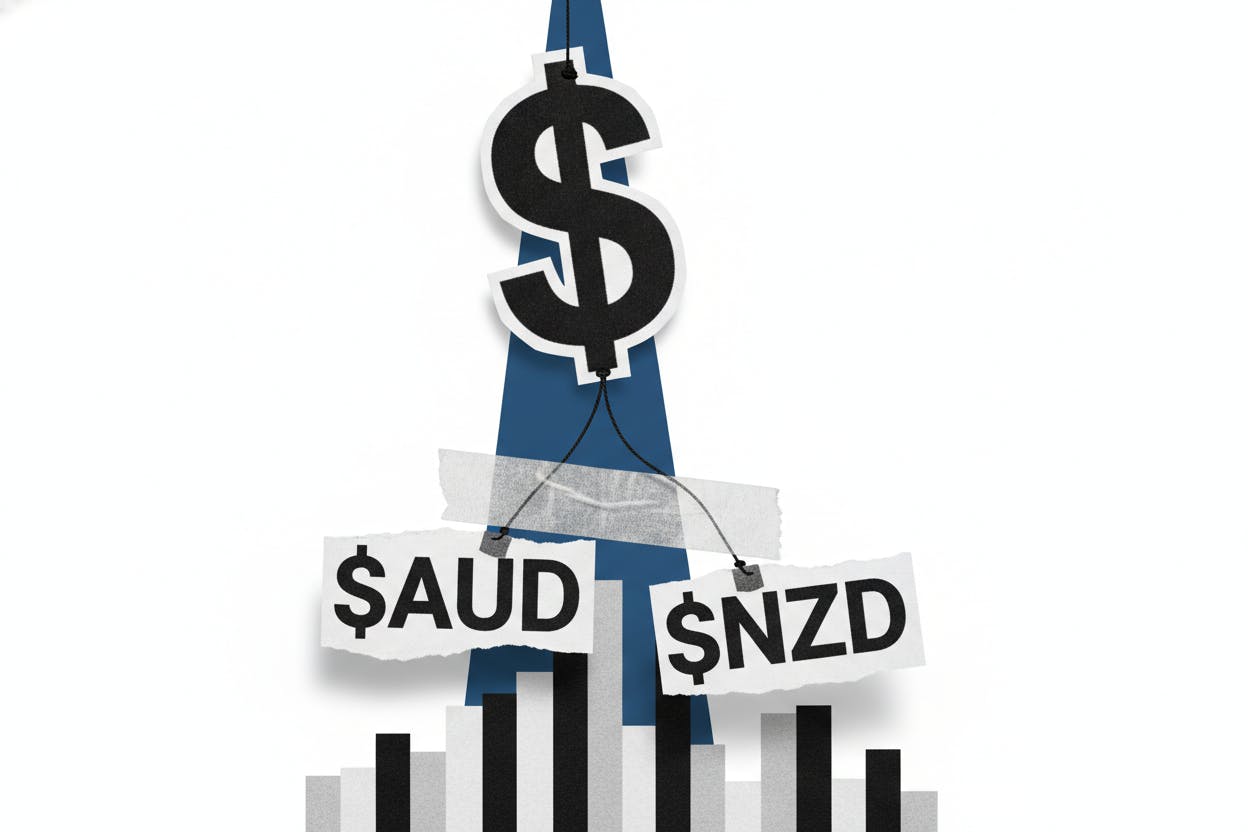
The Australian and New Zealand dollars both lost ground on Tuesday as currency markets increasingly priced in a more hawkish Federal Reserve while dialing back expectations for rate hikes from the Reserve Bank of Australia and the Reserve Bank of New Zealand.
The Aussie fell 0.4% to $0.6892, while the kiwi dropped 0.2% to $0.5665. The moves reflect a classic dynamic in foreign exchange markets: when the US central bank looks set to keep interest rates higher for longer, the US dollar becomes more attractive relative to currencies from countries where rate hikes seem less certain.
What's Driving the Moves
Currency markets mostly trade on relative interest rate expectations. If investors believe US rates will rise sooner or stay higher, holding US dollars tends to pay more. That's what pushed the Aussie and kiwi lower, with markets close to fully pricing in a September rate hike from the Fed.
Back in Australia, the picture looks softer. Traders now see only about a 15% chance of an RBA rate hike at its next meeting. That's a sharp contrast to earlier this year when markets were pricing in multiple increases. The shift comes as recent data has shown mixed signals on the Australian economy, including a deepening industry slump as measured by the Ai Group index and ongoing weakness in new orders despite a slight uptick in the manufacturing PMI.
New Zealand is a closer call. Markets are implying roughly a three-in-four chance of a quarter-point rate hike next week, even as analysts debate whether the RBNZ might pause. The central bank has been one of the most aggressive in the developed world, but recent economic headwinds, including warnings from the IMF about the impact of an oil shock on New Zealand's recovery, have given some policymakers reason to hesitate.
The Rate Gap Trade
The net effect is a widening expected rate gap in favor of the US, which typically supports the greenback and weighs on more risk-sensitive currencies like the Australian and New Zealand dollars. Commonwealth Bank of Australia economist Joseph Capurso said he expects the Aussie to “decrease further” as the yield differential shifts toward the US.
That's the key mechanism at work. When the Fed looks more hawkish than the RBA or RBNZ, the US dollar offers better “carry” – meaning investors can earn more interest by holding it. It also makes it pricier for global investors to hedge Australian or New Zealand exposure back into US dollars. That combination can trim marginal demand for AUD- and NZD-linked assets, keeping both currencies biased lower unless local central bank expectations re-price higher or US rate bets cool.
What It Means for Investors
For everyday investors, the weakening of the Aussie and kiwi has several implications. If you hold investments denominated in Australian or New Zealand dollars, their value in US dollar terms will have fallen. That matters for anyone with international exposure or who trades in those markets.
The moves also highlight how interconnected global interest rate decisions are. Even if the RBA or RBNZ hold rates steady, the Fed's actions can still affect your portfolio through currency fluctuations. Investors should watch for any shifts in US economic data or Fed commentary that could change the rate outlook.
On the positive side, a weaker Aussie and kiwi can benefit exporters in those countries by making their goods cheaper for foreign buyers. It can also boost tourism and education exports. But for importers and consumers, it means higher costs for goods priced in US dollars, from oil to electronics.
The broader market context is also important. The S&P 500 and Nasdaq have been heading for their best quarter in six years despite rate hike expectations, showing that equity markets can sometimes diverge from currency trends. Meanwhile, Asia markets have been split, with the Nikkei rising on tech strength while the Hang Seng slipped.
For now, the direction of the Aussie and kiwi will likely depend on whether the Fed follows through on its hawkish signals and whether the RBA or RBNZ surprise with a more aggressive stance. Investors should keep an eye on upcoming economic data and central bank meetings for clues.