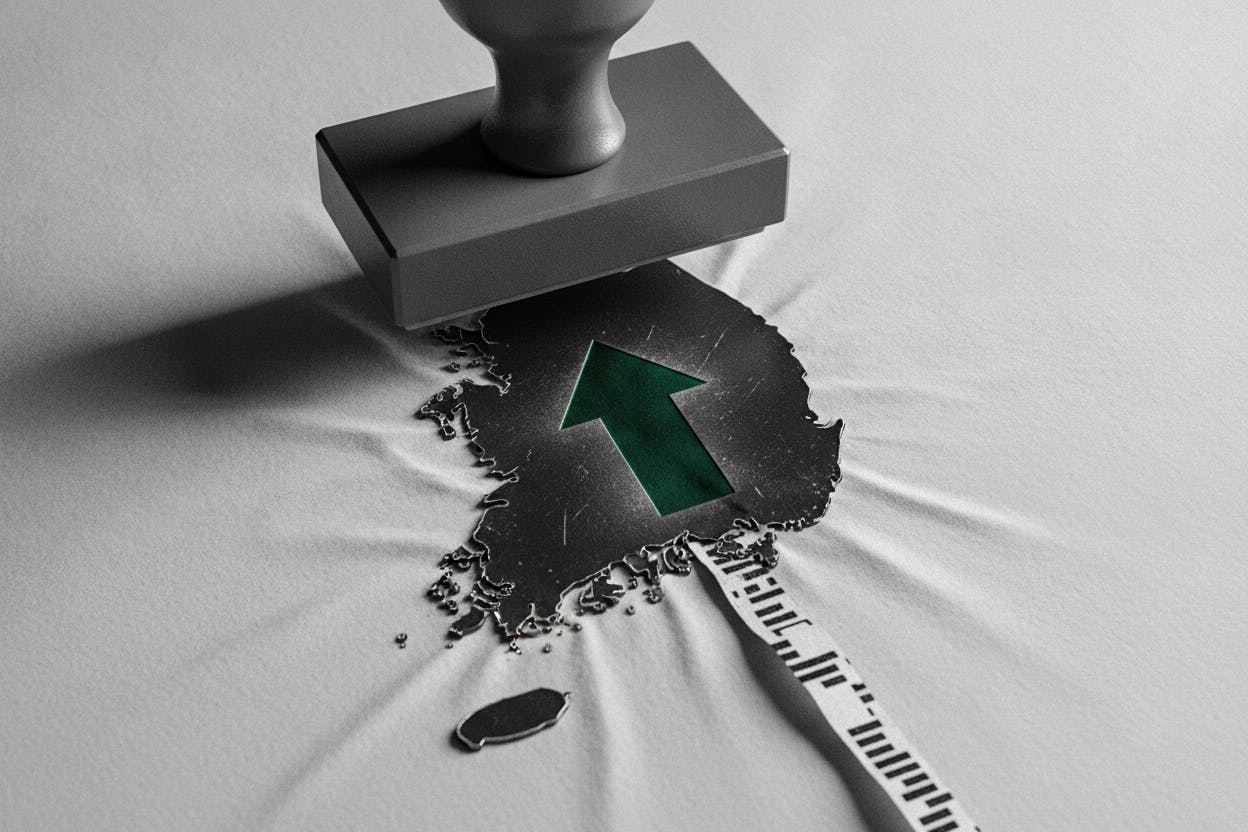
South Korea's central bank has resumed raising interest rates for the first time in three and a half years, lifting its benchmark seven-day repurchase rate by a quarter of a percentage point to 2.75%. The move, announced Thursday, comes as consumer price inflation accelerated to 3.2% in June, well above the bank's 2% target, and officials signaled that additional rate increases remain on the table.
Why the Bank of Korea Acted Now
The Bank of Korea (BOK) had kept its policy rate unchanged since late 2021, when it last raised rates during a previous tightening cycle. The decision to restart hikes reflects growing concern that inflation is proving stickier than expected. June's 3.2% reading was the highest in several months, driven by rising energy costs, food prices, and service-sector inflation.
By raising the seven-day repo rate—the rate at which the BOK lends to commercial banks for short-term liquidity—the central bank aims to cool demand and curb price pressures. A 25-basis-point increase is a standard move for central banks, equivalent to 0.25 percentage points. The repo rate influences borrowing costs across the economy, from mortgages to corporate loans.
The BOK's statement noted that the economy is still growing, albeit at a moderate pace, and that inflation risks remain tilted to the upside. Policymakers left the door open for further hikes, saying they will assess the impact of this move and monitor inflation, growth, and financial stability before deciding on next steps.
What This Means for South Korea's Economy and Markets
Higher interest rates typically slow economic activity by making borrowing more expensive for households and businesses. For South Korea, a major exporter of semiconductors, automobiles, and consumer electronics, tighter monetary policy could weigh on domestic consumption and investment. The country's export-driven economy has already faced headwinds from weak global demand, particularly for chips, which has contributed to volatility in the KOSPI stock index.
The rate hike may also strengthen the South Korean won, as higher yields attract foreign capital. A stronger currency can help reduce import costs, potentially easing inflation, but it can also hurt export competitiveness. The BOK will be watching currency markets closely.
For bond investors, the rate increase pushes yields higher, which can lead to price declines for existing bonds. Short-term government bond yields have already risen in anticipation of the move. The BOK's hawkish stance suggests that the yield curve could steepen if markets expect further tightening.
Investor Implications: What to Watch
For everyday investors, the key takeaway is that South Korea is joining a global trend of central banks maintaining or restarting rate hikes to combat persistent inflation. The U.S. Federal Reserve, European Central Bank, and others have also raised rates in recent years, though some have paused recently as inflation moderates.
Investors with exposure to South Korean assets—whether through KOSPI-linked ETFs, Korean bonds, or currency positions—should expect continued volatility. Sectors sensitive to interest rates, such as real estate, construction, and consumer discretionary, may face headwinds. Conversely, banks and financial institutions often benefit from higher net interest margins when rates rise.
The BOK's next policy meeting is scheduled for August. Markets will be watching for any signs that inflation is easing or that growth is slowing enough to warrant a pause. If inflation remains above 3%, further rate increases are likely. If the economy weakens sharply, the BOK may hold steady.
South Korea's inflation trajectory will also be influenced by global factors, including energy prices, supply chain conditions, and the strength of the Chinese economy, a key trading partner. Recent data showing China's Q2 GDP growth slowing to 4.3% adds to the uncertainty.
Bottom Line
The Bank of Korea's decision to restart rate hikes after a 3.5-year pause underscores the challenge central banks face in taming inflation without derailing growth. For investors, the message is clear: the era of ultra-low rates is over, and higher borrowing costs are here to stay for now. Staying diversified and focusing on quality assets that can withstand higher rates remains a prudent approach.