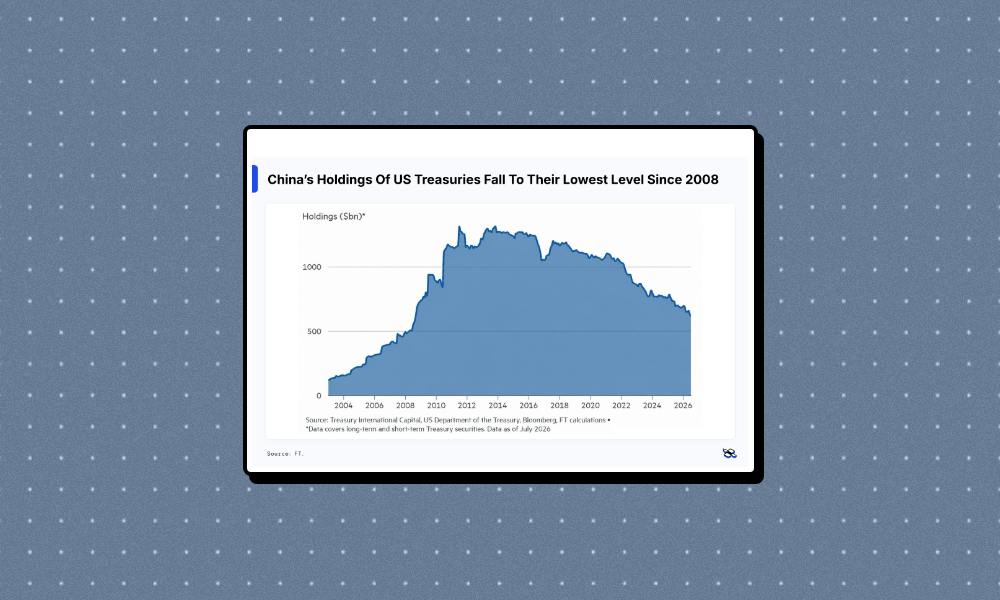
China's once-mighty pile of US government debt is shrinking fast. In July, Beijing's holdings of US Treasuries fell to $618 billion, the lowest level since 2008 and less than half their peak of $1.3 trillion in 2013. That drop has pushed China behind Japan and the UK among America's biggest foreign creditors.
The numbers, released by the US Treasury Department, show a steady decline in China's appetite for US government bonds. At its height, China was the largest foreign holder of US debt, using its massive trade surpluses to buy Treasuries as a safe place to park dollars. Now, it's a different story.
Why is China selling?
Beijing appears to be spreading its money around. Instead of recycling its trade surpluses into Treasuries, China has been diversifying into gold, US agency bonds, and other assets. This shift accelerated after Washington froze Russia's overseas reserves in 2022, a move that raised concerns in Beijing about its own exposure to potential sanctions.
For China, the lesson was clear: holding large amounts of US debt could become a vulnerability if relations with Washington deteriorate. So Beijing has been quietly reducing its reliance on Treasuries, even as it continues to run large trade surpluses with the US.
That said, the official numbers may understate China's actual holdings. Some analysts believe China holds additional Treasuries through custodial accounts in other countries, such as Belgium, which would not show up in the direct data. So the real decline might be less dramatic than it appears.
What it means for US borrowing costs
For everyday investors, the key question is whether China's retreat from Treasuries matters for their own finances. The answer: it could, but it's not a simple cause-and-effect.
Treasuries are the backbone of the global financial system. They're used as collateral for countless transactions, and their yields influence everything from mortgage rates to corporate borrowing costs. When demand for Treasuries falls, the US government has to offer higher yields to attract buyers, which can push up borrowing costs across the economy.
But China is not the only buyer in the market. The US Treasury market is the deepest and most liquid in the world, with a vast array of domestic and international investors. Japan, the UK, and other countries have been increasing their holdings, and US domestic investors—including pension funds, mutual funds, and the Federal Reserve—are far larger players than any foreign government.
So while China's selling is notable, it's not an immediate threat to US borrowing costs. The bigger risk would be if China's selling accelerated sharply or if other major creditors followed suit. For now, the market has absorbed the decline without much disruption.
What investors should watch
For investors, the trend is worth monitoring, but it's not a reason to panic. The US government's ability to borrow is not dependent on any single buyer, and the Treasury market remains highly resilient.
Still, the shift is part of a broader story of geopolitical fragmentation. China's move to diversify away from US assets is a reminder that the global financial system is changing. Countries are increasingly looking for alternatives to the dollar, whether through gold, other currencies, or digital assets.
For those with exposure to bonds, the key is to keep an eye on Treasury yields. If China's selling accelerates, yields could rise, which would affect bond prices and potentially ripple into stocks. But so far, the market has taken the news in stride.
China's actions also come amid broader tensions between Washington and Beijing. Recent headlines have highlighted everything from trade tensions and AI guardrails to slumping auto sales in China. These issues are unlikely to resolve quickly, and investors should expect continued volatility in US-China relations.
For now, the takeaway is simple: China is reducing its exposure to US debt, but the impact on your portfolio is likely to be modest. The Treasury market is big enough to absorb the shift, and other buyers are stepping in. As always, diversification and a long-term perspective are your best defenses against any single market move.