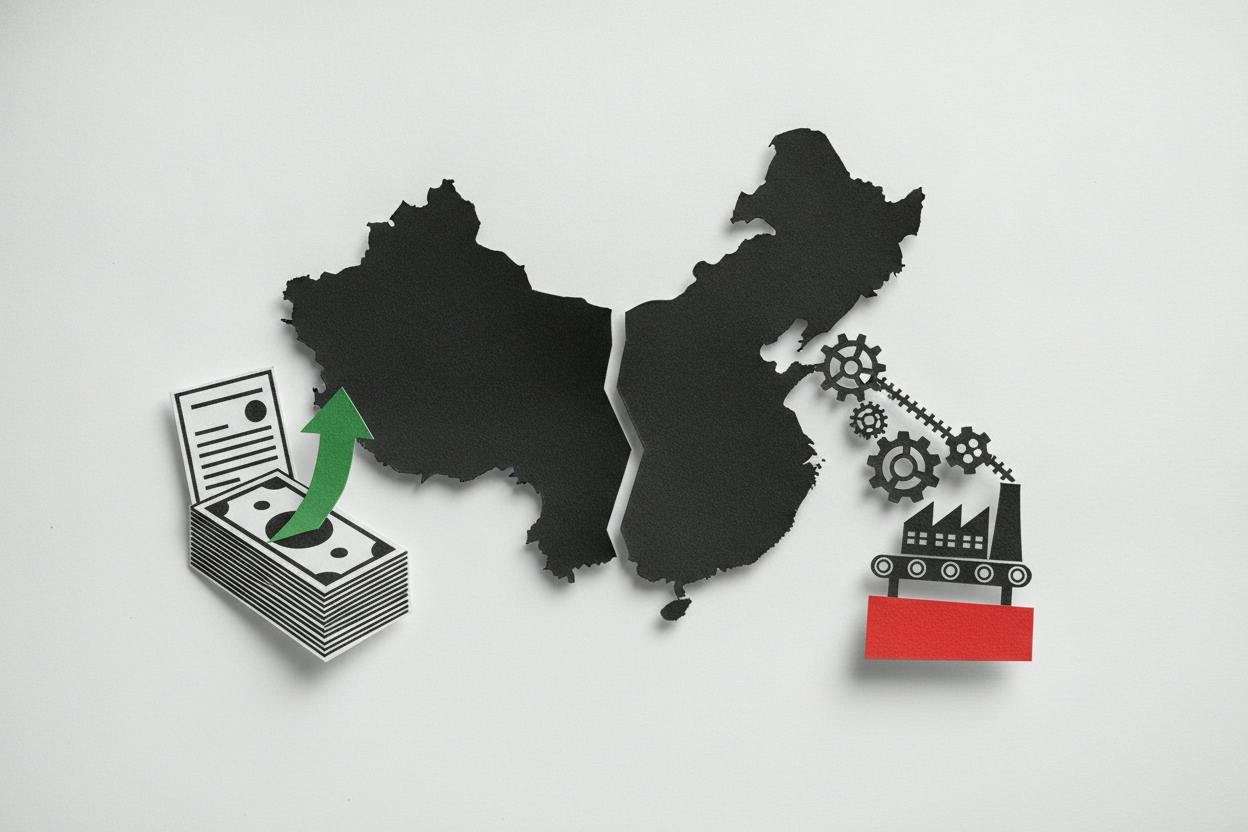
China's stock market ended Friday on a split note, with a strong lending report from the central bank lifting the Shanghai Composite while warnings about automakers' overseas expansion and a sharp drop in a major chipmaker weighed on sentiment elsewhere.
The People's Bank of China (PBoC) said banks extended 1.08 trillion yuan (about $150 billion) in new loans in September, beating the 1.03 trillion yuan forecast tracked by Investing.com. That marked a significant rebound from August's paltry 60 billion yuan, when lending slowed sharply amid weak demand and seasonal factors.
Investors also focused on a broader measure of credit creation known as "total social financing," which captures loans, bonds, and other forms of funding flowing into the economy. A stronger-than-expected reading suggests that policy support is starting to reach businesses and households, which is generally a positive signal for economic growth and corporate earnings.
What's driving the mixed market reaction?
Despite the encouraging credit data, not all sectors shared in the gains. Moody's, the credit rating agency, warned that Chinese automakers' plans to build factories overseas could introduce added risks over the next one to two years. The warning highlights the challenges that come with global expansion, including higher costs, regulatory hurdles, and potential trade barriers.
Meanwhile, Rockchip Electronics, a major chip designer, saw its shares fall sharply. The drop came amid a broader pullback in tech stocks, as investors reassessed valuations after a strong run. The decline in Rockchip, which is often seen as a bellwether for China's semiconductor sector, added to the cautious mood.
The mixed performance underscores a key tension in China's markets right now: improving macroeconomic data is being offset by company-specific and sector-level concerns. Investors are trying to balance the positive signals from policy support with the risks that individual companies face in a challenging global environment.
Why the lending data matters
New loans are a key indicator of credit demand and economic activity. When banks lend more, it typically means businesses are investing and consumers are spending, which supports growth. The September rebound suggests that the PBoC's efforts to encourage lending, including rate cuts and reserve requirement reductions, are having an effect.
However, the August figure was unusually low, so part of the September jump may reflect a catch-up effect rather than a fundamental shift. Still, beating forecasts is a positive sign, and it could give policymakers confidence that their measures are working.
For everyday investors, the lending data is important because it can influence corporate earnings and stock prices. If credit continues to flow, companies may find it easier to fund operations and expansion, which could support profits and share prices over time.
What it means for investors
For investors in Chinese equities, the split market is a reminder that not all stocks move together. While the overall index may be supported by macro data, individual companies can face their own headwinds. The Moody's warning on automakers suggests that even successful domestic players could face challenges as they look to grow internationally.
Similarly, the drop in Rockchip highlights the volatility that can come with tech stocks, especially in sectors like semiconductors that are sensitive to global supply chains and trade tensions. Investors should be prepared for sharp swings in these areas.
Looking ahead, market participants will likely watch for further signs that credit growth is sustainable, as well as any updates on automakers' overseas plans and the tech sector's performance. The broader trend in Chinese stocks will depend on whether the positive macro momentum can outweigh the risks at the company level.
For those with exposure to Chinese markets, the key takeaway is to stay diversified and keep an eye on both the big-picture economic data and the specific challenges facing individual sectors. As always, past performance is not a guarantee of future results, and it's important to consider your own financial situation and risk tolerance.