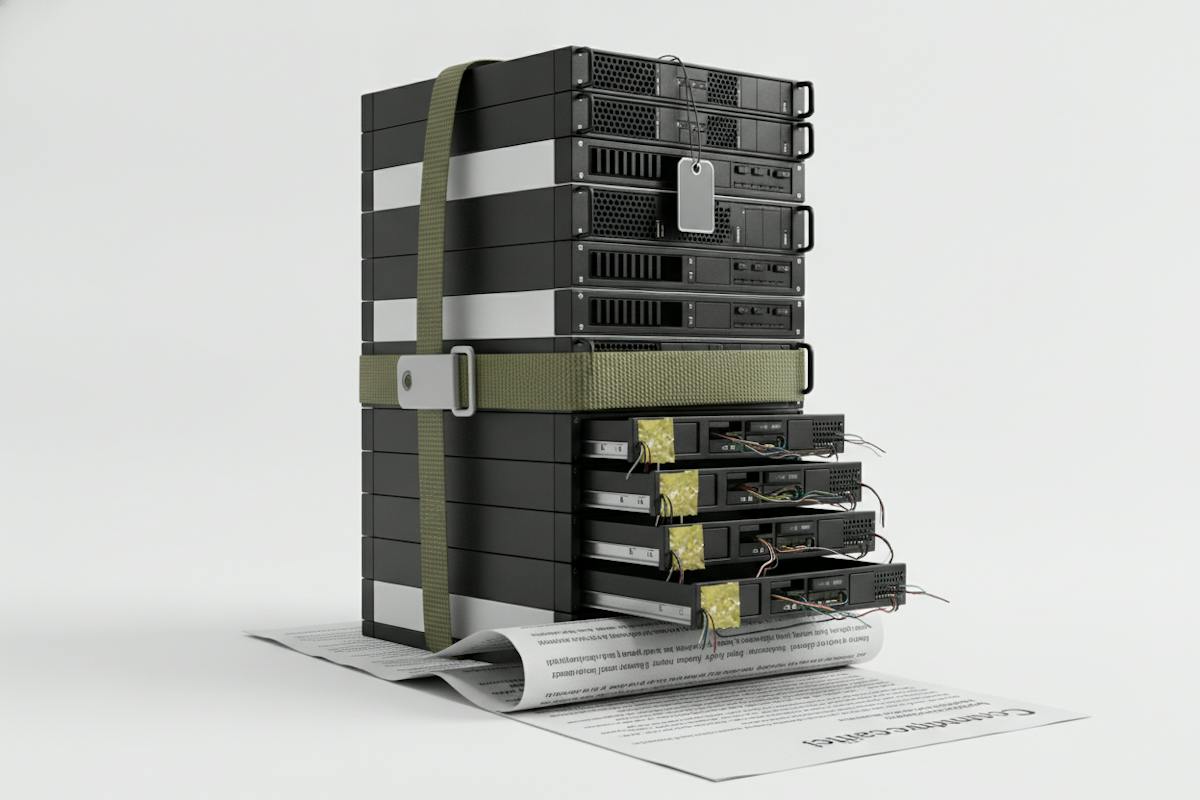
Chinese companies tied to businesswoman Alice Huang are using high-end AI servers as collateral to raise money for data-center projects, according to a Reuters report. Central-bank records show that up to 764 AI servers and computing modules, along with $31 million of networking equipment, were pledged in financing deals. Some of the equipment is linked to a Shanghai data-center site connected to Tencent.
The practice marks a notable shift in how companies finance the build-out of artificial-intelligence infrastructure. Instead of treating expensive computing hardware as a day-to-day operating cost, firms are increasingly using it as an asset that can back loans—much like real estate or machinery in traditional industries.
What's behind the move
Data centers are capital-intensive projects. Building them requires huge upfront spending on land, cooling systems, power infrastructure, and, most critically, the servers that run AI workloads. For Chinese companies racing to expand capacity, securing financing is a major hurdle.
By pledging AI servers as collateral, these firms can unlock loans without having to put up cash or other traditional assets. The Reuters report, citing central-bank records, indicates that lenders are willing to accept this kind of equipment as security. That is a meaningful development because it suggests that high-end compute is now viewed as a durable, resellable asset—not just a rapidly depreciating piece of technology.
The involvement of a Shanghai site connected to Tencent is also notable. Tencent is one of China's largest technology companies and a major player in cloud computing and AI services. While the report does not specify the exact nature of the connection, it highlights how intertwined the financing deals are with the broader Chinese tech ecosystem.
Why it matters for investors
For everyday investors, this story is less about a single company and more about the broader trend of AI infrastructure being treated as a bankable asset class. When servers can be used as collateral, it lowers the cost of borrowing for data-center operators, which could accelerate the pace of AI build-out in China.
That has implications for global supply chains. AI servers rely on advanced chips, many of which are made by companies like Nvidia and AMD. If Chinese firms can finance more data centers, demand for those chips could remain strong, even as the broader AI trade cools. Indeed, recent market moves have shown that AI-related stocks are sensitive to shifts in sentiment, as seen in copper sliding to a March low as the AI trade cools.
At the same time, the use of AI servers as collateral carries risks. If the value of that equipment falls—due to rapid technological obsolescence or a drop in demand—lenders could face losses. That could make banks more cautious about accepting such collateral in the future, potentially tightening credit for data-center projects.
Broader context: China's AI push
China has been aggressively promoting AI development, both as a matter of economic policy and national strategy. The government has encouraged domestic companies to build out computing capacity, and data centers are a key part of that plan. However, Chinese firms also face restrictions on accessing the most advanced foreign chips, which has led to a focus on domestic alternatives and more efficient use of existing hardware.
The financing deals reported by Reuters fit into this picture. By using AI servers as collateral, Chinese companies are finding creative ways to fund their expansion without relying solely on equity markets or government subsidies. This approach could become more common as the demand for AI compute continues to grow.
It also echoes similar trends elsewhere. In other markets, companies are exploring ways to monetize or leverage their AI infrastructure. For example, Korean firms are teaming up to standardize data center construction, which could lower costs and make such projects more financeable.
What to watch next
Investors should keep an eye on how lenders value AI servers and whether this collateral becomes a standard feature of data-center financing. If it does, it could signal that the AI build-out is entering a more mature phase, where infrastructure is treated like any other long-term asset.
Also worth watching is the regulatory angle. Chinese authorities have been tightening oversight of the tech sector, and the use of central-bank records to track these deals suggests a level of official visibility. Any new rules on how AI equipment can be used as collateral could affect the pace of data-center construction.
For now, the Reuters report is a reminder that the AI boom is not just about software and algorithms—it's also about the physical infrastructure that powers it. And in China, that infrastructure is increasingly being used to back loans, a sign that the financial system is adapting to the AI era.