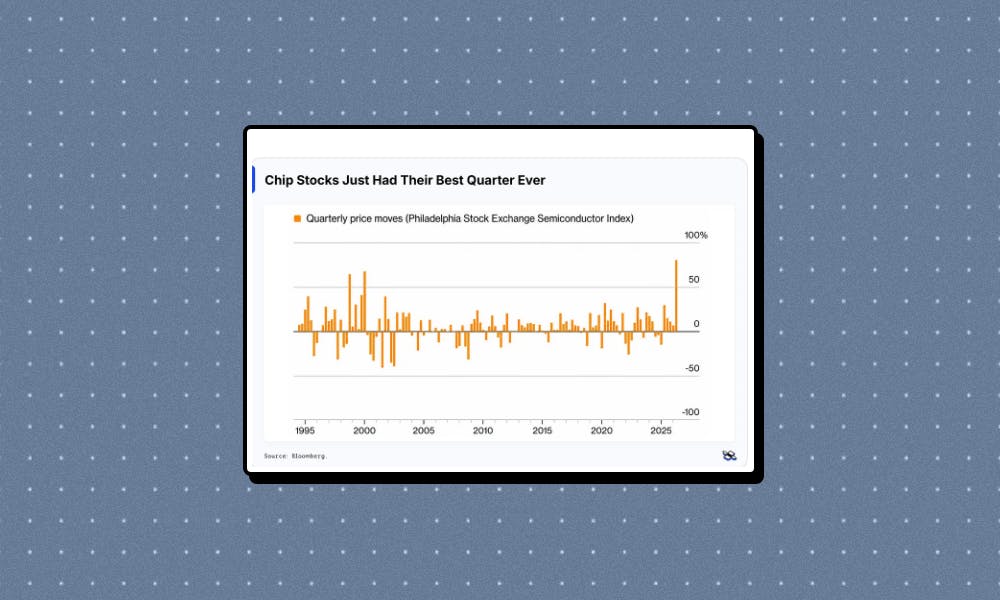
Semiconductor stocks just delivered their best quarterly performance in history, surpassing even the dotcom era's wildest gains. The Philadelphia Semiconductor Index, a benchmark for the chip industry, surged 88% in the second quarter, leaving the broader Nasdaq and S&P 500 far behind.
The rally was fueled by unrelenting optimism around artificial intelligence. Big cloud providers—including Microsoft, Amazon, Alphabet, and Meta—continue to pour billions into AI infrastructure, keeping demand for advanced semiconductors and memory chips elevated. That spending spree has turned chipmakers into the market's darlings, with investors betting that AI will drive a multiyear upgrade cycle for data centers and computing hardware.
Record Gains, but a Bumpy Ride
Despite the historic quarterly performance, the ride was anything but smooth. A sharp selloff in the final week of the quarter and several violent day-to-day swings underscore a growing debate on Wall Street: has the AI trade run too far?
The Philadelphia Semiconductor Index's 88% gain is its strongest three-month performance on record, according to data going back decades. To put that in perspective, even during the dotcom bubble, chip stocks never posted such a concentrated surge in a single quarter. The index's previous record was set in 2002, when it rose 67% during a recovery from the tech bust.
But the recent volatility suggests that some investors are taking profits and questioning whether valuations have become stretched. Chip stocks now trade at elevated price-to-earnings ratios, and any sign of slowing demand or rising competition could trigger further pullbacks.
What's Driving the AI Chip Boom?
At the heart of the rally is the belief that AI will transform industries, from cloud computing to autonomous vehicles to healthcare. Advanced semiconductors—particularly graphics processing units (GPUs) and high-bandwidth memory chips—are essential for training and running large AI models. Companies like Nvidia, AMD, and Intel have seen their stock prices soar as they race to meet demand.
Big cloud providers are leading the charge. Microsoft, Amazon, Alphabet, and Meta have all signaled that they will continue to invest heavily in AI infrastructure, even as they trim spending in other areas. That commitment has provided a strong floor under chip stocks, as investors see a clear, near-term revenue stream for semiconductor companies.
Memory chip makers have also benefited. Companies like Samsung and SK Hynix have reported record sales of high-bandwidth memory chips used in AI servers. The broader semiconductor supply chain—from equipment makers to foundries—has also seen a lift.
What It Means for Investors
For everyday investors, the chip rally highlights both the opportunities and risks of investing in a hot sector. On one hand, the AI boom appears to have genuine, long-term demand drivers. Cloud providers are not just speculating—they are spending real money on infrastructure that will generate revenue for years to come.
On the other hand, the recent volatility is a reminder that even the strongest trends can experience sharp corrections. The Philadelphia Semiconductor Index's 88% gain in a single quarter is extraordinary by any measure, and history suggests that such rapid moves often lead to periods of consolidation or pullbacks.
Investors should also consider the broader market context. The chip rally has been a key driver of the broader stock market's gains this year, but it has also created a concentration risk. If AI-related stocks stumble, the impact could ripple across the entire market.
Geopolitical factors add another layer of uncertainty. Tensions between the US and Iran, for example, have recently weighed on global markets, as seen in the FTSE 100's dip and European stocks slipping. Meanwhile, Asian stocks paused after the AI rally, with the dollar strengthening on the Iran stalemate. These macro headwinds could affect chip stocks if they lead to a broader risk-off sentiment.
What to Watch Next
Investors will be closely watching upcoming earnings reports from major chip companies and cloud providers. Any signs of slowing demand or cautious guidance could trigger further volatility. The next few weeks will also bring key economic data, including inflation readings and jobs reports, which could influence the Federal Reserve's interest rate decisions.
For now, the investment case for chip stocks remains intact, but the easy gains may be behind us. As one analyst put it, the market is now debating whether the AI trade has run too far. The answer will likely depend on whether the spending from cloud providers continues to accelerate—and whether the broader economy can avoid a sharp downturn.