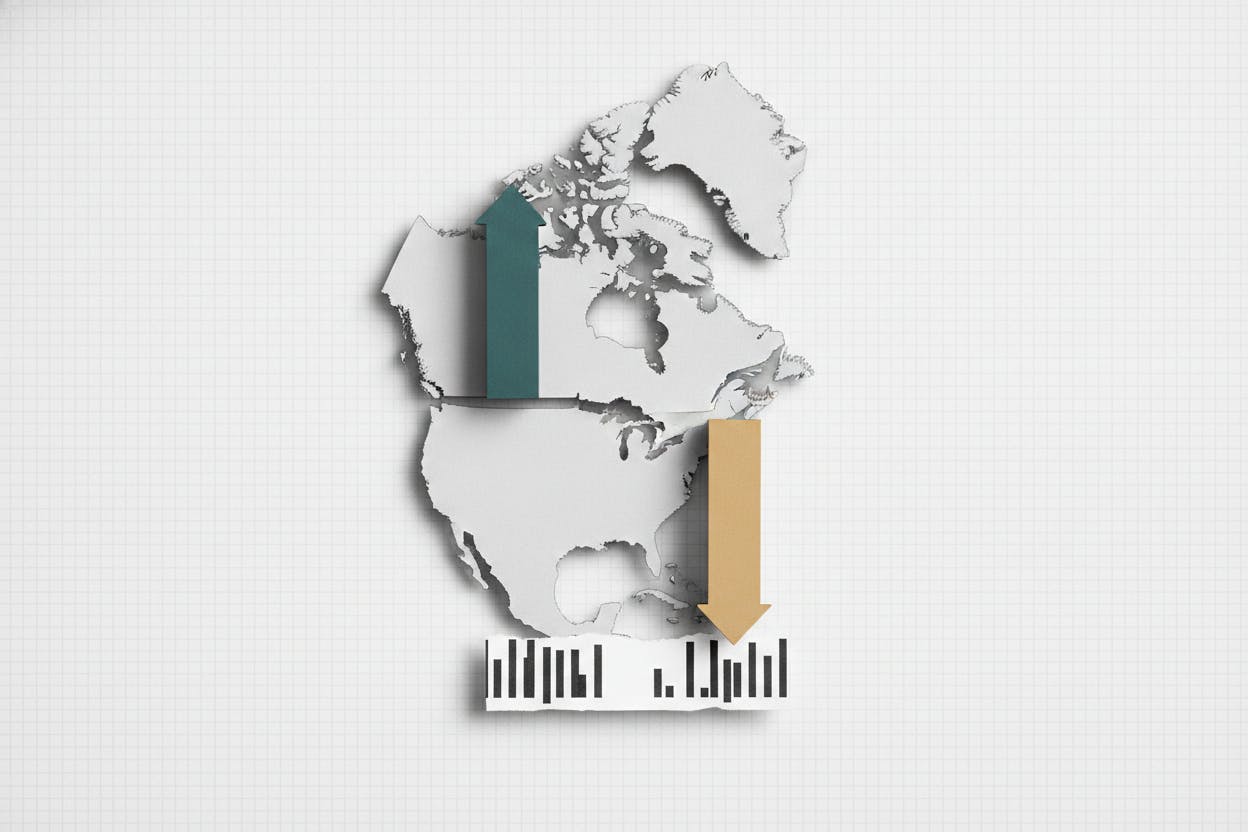
CIBC Capital Markets is projecting that the neutral interest rates of Canada and the United States will drift toward each other by 2028, a shift that could reshape how investors interpret central bank policy over the next few years.
The neutral rate—often called the "cruising speed" for monetary policy—is the level at which interest rates neither stimulate nor restrain economic growth. It's not directly observable, but central banks and markets use estimates of it to gauge how restrictive or accommodative current policy is. When actual rates sit above neutral, policy is cooling the economy; below neutral, it's providing a boost.
What's driving the convergence?
CIBC's chief economist, Avery Shenfeld, argues that the US neutral rate could edge lower as the boom in artificial intelligence-related spending cools and immigration slows. Both factors have been supporting US growth and investment in recent years. A slowdown in AI capital expenditure would remove a key driver of business investment, while reduced immigration could limit the expansion of the labor force and, in turn, the economy's long-run growth potential.
Canada, by contrast, could see its neutral rate creep upward. Shenfeld points to a possible rebound in business investment from currently weak levels, the advancement of major projects, and population trends that continue to support demand for housing. If Canadian companies start spending more on equipment, technology, and infrastructure, the economy could operate at a higher sustainable pace, justifying a higher neutral rate.
The result, according to CIBC, is that the two countries' neutral rates—which have diverged in recent years—will converge by 2028. That convergence would have implications for how traders price interest rate expectations on both sides of the border.
Why neutral rates matter
For everyday investors, the neutral rate is a crucial concept because it influences how central banks set policy. When a central bank like the Federal Reserve or the Bank of Canada raises or lowers its benchmark rate, it's trying to steer the economy toward price stability and full employment. The neutral rate is the anchor for those decisions.
If the US neutral rate is falling, the Fed may not need to keep rates as high as previously thought to cool inflation. Conversely, if Canada's neutral rate is rising, the Bank of Canada might have less room to cut rates without reigniting price pressures.
This matters for bond yields, mortgage rates, and the value of the Canadian dollar. A lower US neutral rate could mean lower long-term Treasury yields, which often pull down yields globally. A higher Canadian neutral rate could support the loonie and affect borrowing costs for Canadian households and businesses.
What it means for investors
For investors, the key takeaway is that the interest rate landscape may look different by the end of the decade than it does today. If CIBC's forecast is correct, the gap between Canadian and US policy rates—which has been a source of currency and bond market volatility—could narrow significantly.
That could affect everything from currency-hedged investments to the relative attractiveness of Canadian versus US equities. A converging neutral rate might also reduce the risk of sharp cross-border capital flows that have sometimes followed rate differentials.
However, forecasts like this are inherently uncertain. Neutral rates are not directly measurable and are subject to revision as new data emerges. Investors should treat CIBC's projection as one plausible scenario, not a certainty.
Related reading: Canada's deficit narrows sharply and factory growth hits a four-year high offer context on the Canadian economy's recent momentum.
For a broader view of how central banks are navigating inflation, see the RBI's latest rate decision and ANZ's outlook for the RBA.
As always, investors should watch for updates from the Fed and the Bank of Canada, as well as economic data on investment, immigration, and productivity, which will ultimately determine whether this convergence plays out as CIBC expects.