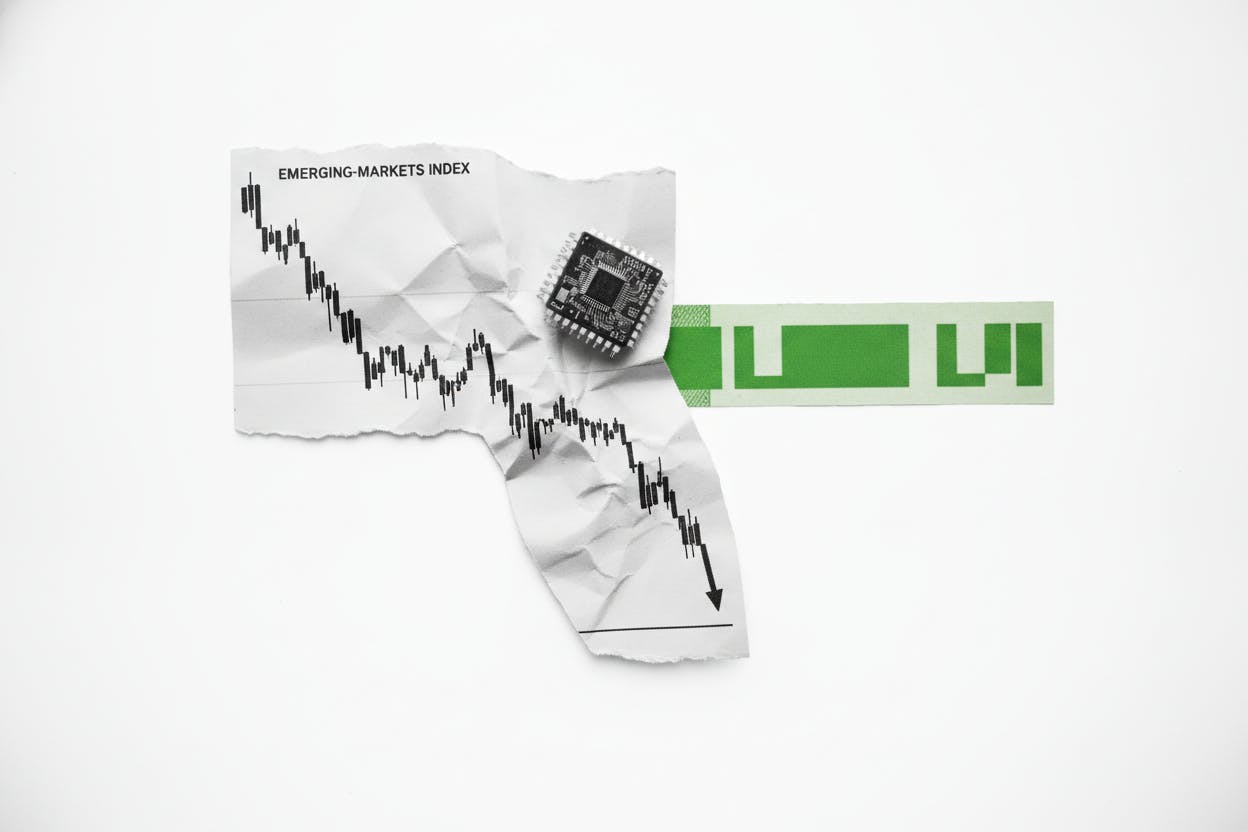
Emerging-market assets showed a clear split on Tuesday, as a renewed selloff in Asian chip stocks dragged equity indexes lower while currencies held steady against a softer US dollar. The divergence underscores how sector-specific risks can hit headline benchmarks even when the broader macro backdrop improves.
What happened
MSCI's emerging-market stocks fell 1.2% on the day, while its currencies index edged 0.1% higher, according to Reuters. The equity weakness was concentrated in tech-heavy Asian markets. South Korea's KOSPI dropped more than 6%, dragged down by heavyweights Samsung and SK Hynix. Taiwan's market was flat despite a strong quarterly report from Taiwan Semiconductor Manufacturing Co (TSMC), the world's largest contract chipmaker.
The contrasting moves highlight a key dynamic: equity indexes can be dominated by a few industries and countries, so a selloff in chip names can drag benchmarks down fast, even if the broader macro environment is improving. Meanwhile, emerging-market currencies benefited from a less threatening dollar, which stayed near a one-month low after softer-than-expected US inflation data.
Why chip stocks are wobbling
Chip stocks have been whipsawing in recent weeks as investors reassess how much of the artificial-intelligence-led rally is already priced in. After a massive run-up in semiconductor shares, any sign of slowing momentum or profit-taking can trigger sharp declines. The selloff in South Korea's Samsung and SK Hynix, two of the world's largest memory-chip makers, reflects that uncertainty, even as TSMC's strong quarter showed continued demand for advanced chips used in AI applications.
For context, the semiconductor sector has been a major driver of emerging-market equity gains this year, particularly in Asia. When that sector stumbles, it can disproportionately affect broad indexes like the KOSPI, which has a heavy weighting in tech stocks. The divergence between South Korea and Taiwan also shows that company-specific factors matter: TSMC's solid results helped cushion Taiwan's market, while South Korea's chipmakers faced more selling pressure.
The dollar factor
On the currency side, the story was different. Softer-than-expected US inflation data released last week led traders to dial back expectations for near-term Federal Reserve interest rate hikes. That kept the dollar index stable but close to a one-month low. A less threatening dollar often supports emerging-market currencies because it eases the penalty of borrowing in dollars and can make higher-yielding local currencies more attractive to global investors.
This dynamic is sometimes called the carry trade: investors borrow in low-yielding currencies like the dollar and invest in higher-yielding emerging-market currencies, pocketing the difference. When the dollar weakens, that trade becomes more profitable, supporting EM currencies even when equity markets are under pressure.
What it means for investors
The split between stocks and currencies is a reminder that "emerging markets" are not a single trade. Equity indexes can be heavily influenced by a few sectors and countries, so a selloff in chip names can drag benchmarks down fast, even if the broader macro backdrop is improving. Meanwhile, cooling US inflation can reduce pressure on the dollar, which tends to help emerging-market currencies through interest-rate differences and the carry trade.
If that dynamic holds, investors may see more days where EM stocks and EM currencies tell different stories, and where risk looks concentrated in specific sectors rather than across the whole asset class. For everyday investors, this means it's worth looking beyond headline indexes to understand what's really driving moves. A drop in an EM stock index might be about chip stocks, not about a broad economic problem, while a steady currency could signal that macro conditions remain supportive.
Related reading: Hong Kong Stocks Rise 1.3% as Cooling US Inflation Overshadows Iran Tensions shows how US inflation data can boost Asian markets. Meanwhile, Nikkei Slides 2.8% as Chip Stocks Tumble Despite TSMC's Record Profit and Raised Outlook highlights the broader chip selloff in Japan. And China Chip Stocks Slide, Hong Kong Tech Jumps on Alibaba-Apple AI Deal shows how sector-specific news can create divergent moves within the same region.
Looking ahead
Investors will be watching for further US economic data that could influence the dollar and Fed policy expectations. Any signs of persistent inflation could reverse the dollar's recent weakness and put pressure on EM currencies again. At the same time, chip stock volatility may continue as earnings season unfolds and investors digest company-specific results against the backdrop of AI demand and global trade tensions.
The key takeaway: emerging markets are not monolithic. A selloff in one sector can hit equity indexes hard, but a supportive macro backdrop—like a softer dollar—can keep currencies stable. Understanding that distinction can help investors avoid overreacting to headline moves and focus on the underlying drivers.



