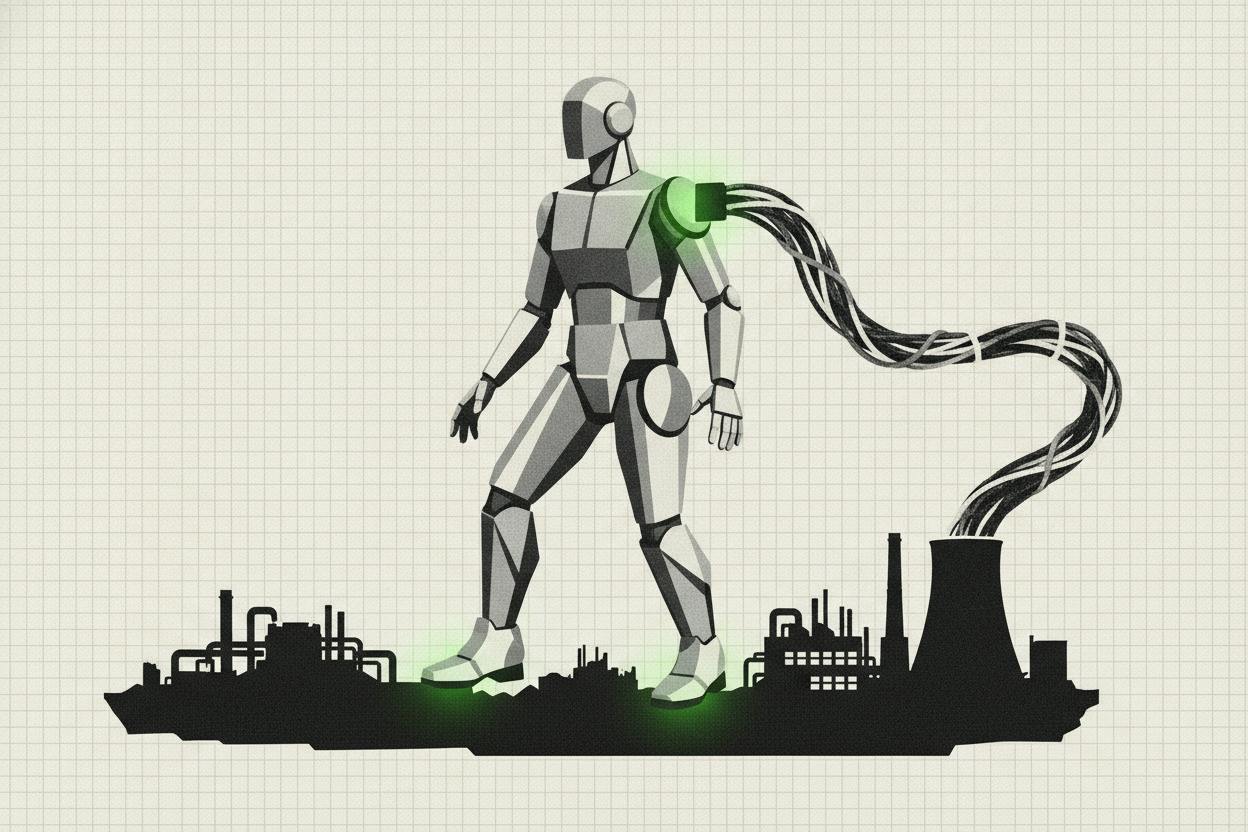
Italian energy giant Eni is stepping into the world of humanoid robotics. The company announced a partnership with Generative Bionics, an Italian deep-tech firm, to test the humanoid robot GENE.01 at Eni's industrial sites. The initial focus will be on inspection, teleoperation, and remote assistance—tasks that are often difficult or dangerous for human workers.
Eni also said it may open up some of its high-performance computing capacity to help train the robot's "Physical AI" software. That would give the startup access to serious computing muscle, which is often a bottleneck for AI development.
Why an energy company cares about robots
Energy facilities—think refineries, pipelines, and offshore platforms—are full of environments that are hard for people to reach and tough on equipment. Robots that can navigate those spaces could help with routine checks, spot problems early, and reduce the need for humans to work in hazardous conditions.
Teleoperation means a human controls the robot from a safe distance, while remote assistance lets the robot act as the operator's eyes and hands in a complex setting. These are early-stage experiments, but they point to a future where humanoid robots become a regular part of industrial maintenance.
Eni is not the only energy company exploring automation. Across the sector, firms are looking for ways to cut costs, improve safety, and deal with a shrinking pool of skilled workers. Robots that can handle repetitive or risky tasks could help on all three fronts.
What this means for investors
For everyday investors, this news is less about Eni's stock and more about a broader trend. Humanoid robots are moving from science fiction to pilot projects, and big industrial players are starting to test them in real-world settings.
That could eventually create opportunities for companies that make robots, sensors, or the software that powers them. But it's early days. Most humanoid robots are still expensive and unproven at scale, and it will take years before they become common in factories or energy sites.
For Eni, the partnership is a way to stay ahead of the curve without making a huge bet. By testing the technology at its own sites, the company can see what works and what doesn't before committing more resources.
Investors should also note the computing angle. Eni's offer to share high-performance computing power for AI training is a sign that energy companies are becoming players in the AI infrastructure space. That could open up new revenue streams, though it's too early to say how much.
What to watch next
Keep an eye on how the pilot goes. If GENE.01 proves useful in inspection or remote support, Eni might expand the program. That would be a signal that humanoid robots are ready for prime time in heavy industry.
Also watch for other energy companies making similar moves. If several big players start testing humanoids, it could accelerate the technology's development and bring down costs.
For now, this is a small but interesting step. It shows that the energy sector is willing to experiment with cutting-edge tech, and that humanoid robots are getting closer to real-world jobs. But as with any new technology, the gap between a pilot and a full rollout can be wide.