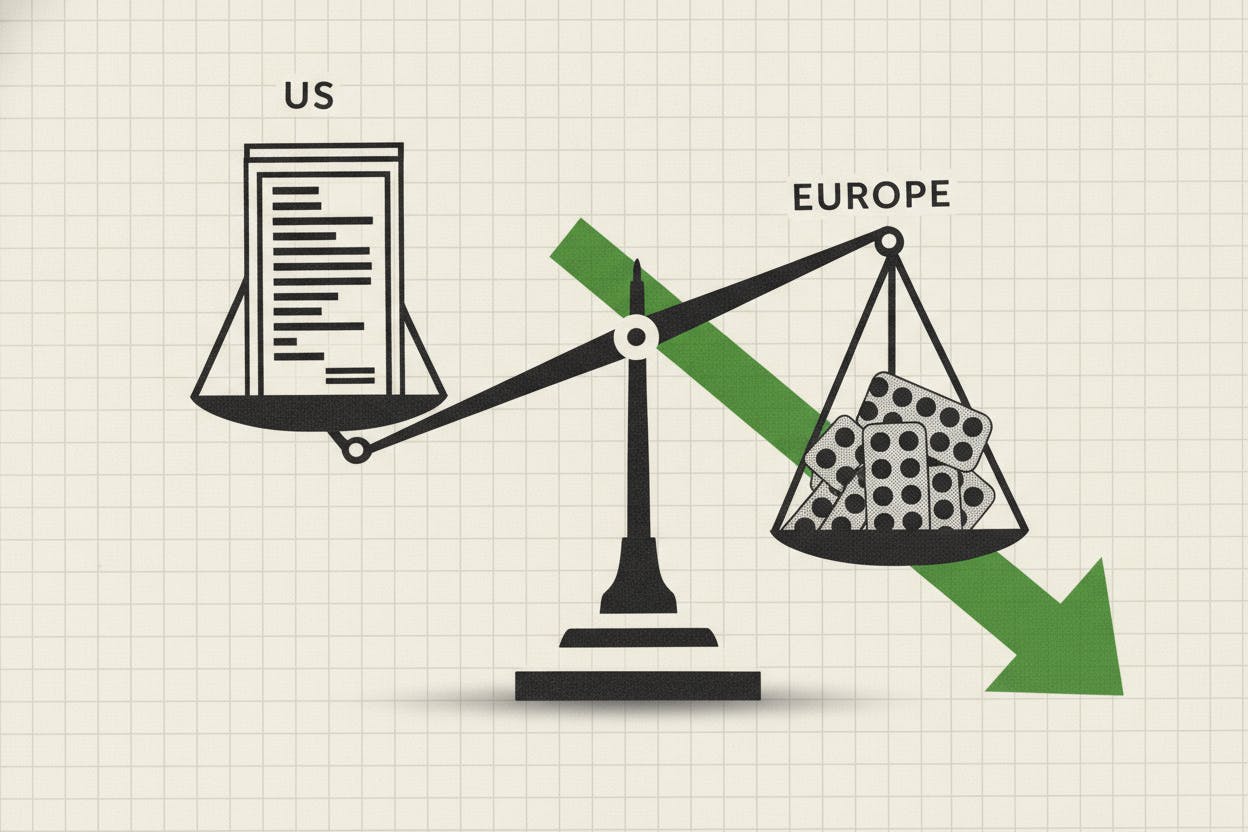
European stocks that trade in the US as American depositary receipts (ADRs) rose late Thursday morning, pushing the S&P Europe Select ADR Index up 1.3% to 1,893.21. But beneath the surface, the move was far from uniform, with a handful of biotech and financial names doing the heavy lifting while energy stocks dragged.
What drove the gains?
The index's rise was powered by a narrow set of winners. Biotech and pharma ADRs led the charge: Silence Therapeutics jumped 8.8%, argenx added 4.2%, and DBV Technologies gained 3.5%. Financial names also contributed, with Lloyds up 2.8%, Barclays rising 2.6%, and Prudential climbing 2.5%.
Meanwhile, several stocks fell even as the index rose. Trinity Biotech dropped 3.5%, Endava slid 3.0%, and Eni fell 1.7%, while Shell edged down 0.4%. That split matters because an ADR's US price is essentially the home-listed share's value translated into dollars (adjusted for the ADR ratio and fees), then nudged around by US-session trading flows.
What are ADRs and why do they matter?
American depositary receipts are certificates issued by US banks that represent shares in foreign companies. They allow US investors to buy and sell international stocks on US exchanges, in US dollars, without dealing with foreign currency or overseas brokers. The S&P Europe Select ADR Index tracks a basket of these instruments, offering a convenient way to gauge European market sentiment during US trading hours.
But as Thursday's action shows, the index can be misleading. When a few outsized movers dominate the tape, the index can climb even if large, steady sectors aren't participating. That's how you can get an upbeat headline print while energy names like Shell and Eni are flat-to-down.
What it means for investors
For anyone using the index as a read-through on European risk appetite, the consequence is tracking error: the basket's move may say more about a narrow set of stocks and US order flow than about Europe as a whole. Those differences often get corrected once the underlying home markets are fully open and arbitrage traders step in.
This pattern is not unusual. In recent weeks, European ADRs have shown similar splits, with energy and tech stocks sometimes moving in opposite directions. For example, European ADRs slipped earlier this month as energy giants dragged down the broader index, while tech stocks got a lift from Micron and Qualcomm forecasts. Such divergences remind investors that ADR indexes are not a pure proxy for European markets.
For everyday investors, the key takeaway is to look beyond the headline index move. If you own ADRs directly, your returns depend on the specific stock and sector, not just the overall index. And if you use ADR ETFs or indexes to gain European exposure, be aware that currency fluctuations and US trading dynamics can add extra volatility.
Broader context
Thursday's ADR move comes amid a mixed backdrop for European markets. European stocks climbed recently as oil rebounded and Rio Tinto eyed a freight deal with Vitol, but energy stocks have been under pressure from falling crude prices. Meanwhile, European stocks split as oil plunged 3.5% and the Dutch urged the US to ease chip export curbs, highlighting the sectoral tensions that can drive ADR performance.
For now, the S&P Europe Select ADR Index's 1.3% gain masks big gaps between winners like Silence Therapeutics and laggards like Eni. Investors watching European markets from the US should keep an eye on the underlying stocks, not just the index.