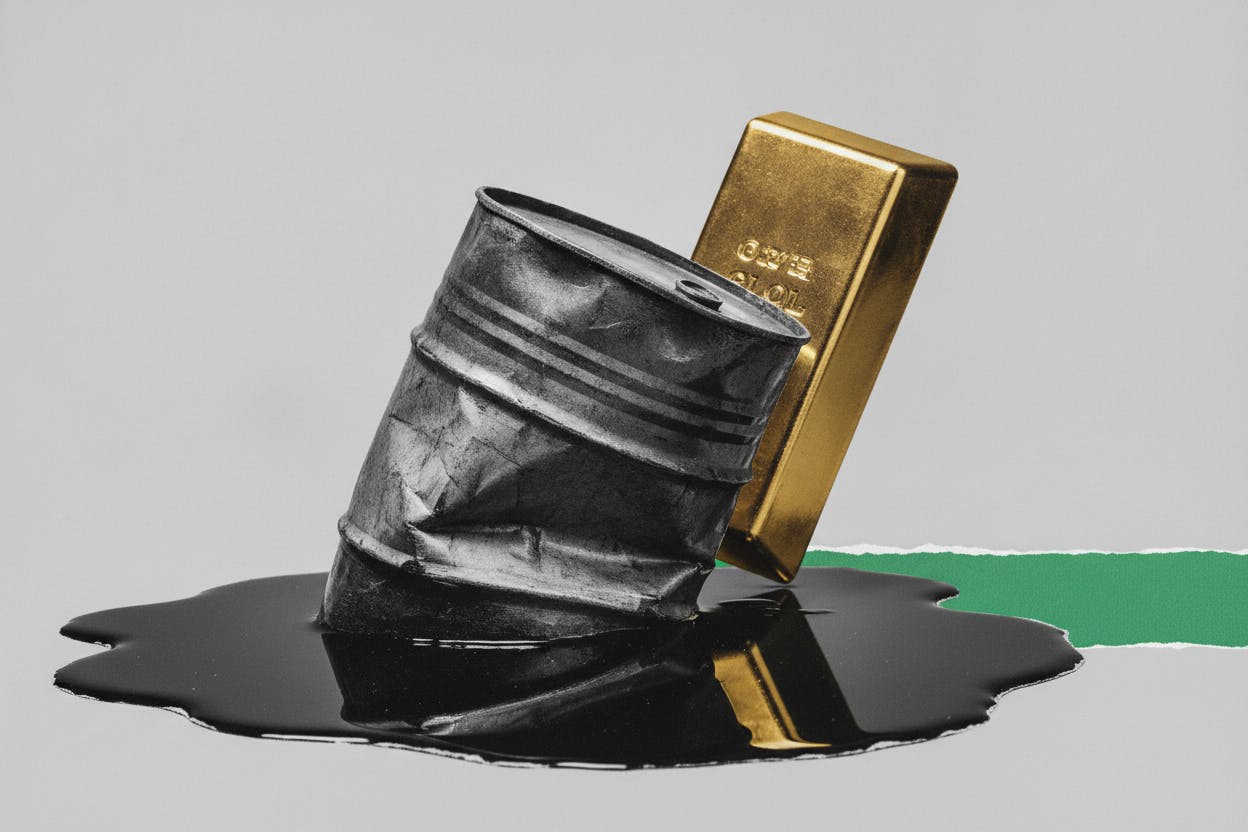
Gold prices edged higher while oil tumbled at the start of the trading week after US President Donald Trump said he would pause any fresh military strike on Iran to allow diplomacy to play out, including talks that could reopen the strategic Strait of Hormuz.
Spot gold climbed 0.7%, while crude oil fell by more than $5 a barrel. On the surface, the moves looked counterintuitive: conflict typically lifts both oil and gold as investors seek safety and worry about supply disruptions. But Monday's divergence told a more nuanced story about how markets are pricing geopolitical risk.
Why oil fell while gold rose
The sharp drop in oil suggested traders quickly marked down the likelihood of a supply shock through the Strait of Hormuz, a narrow waterway that carries roughly a fifth of the world's oil. When Trump signaled a pause in strikes and floated the possibility of talks that could reopen the strait, the so-called "conflict premium" built into crude prices began to unwind.
That premium is the extra amount traders pay for oil when they fear that fighting could disrupt production or shipping. When the risk recedes, prices tend to fall just as quickly as they rose. Monday's move was a textbook example of that dynamic in reverse.
Gold, meanwhile, continued to attract buyers. While it is often seen as a hedge against conflict, it also benefits from broader uncertainty and from expectations that central banks may keep interest rates lower to support growth. Even with a diplomatic opening, investors still see plenty of reasons to hold the metal.
What the Strait of Hormuz means for energy markets
The Strait of Hormuz sits between Iran and Oman, connecting the Persian Gulf to the Gulf of Oman and the open ocean. It is one of the most important chokepoints in global energy trade. A disruption there would not only affect Iranian oil but also shipments from Saudi Arabia, Iraq, the UAE, and other Gulf producers.
In recent weeks, tensions in the region had pushed oil prices higher as traders braced for possible closures or attacks on tankers. Some refiners and shippers had already begun adjusting routes, with some tankers bypassing the strait via the Red Sea, as reported earlier. That kind of rerouting adds time and cost to deliveries, which can show up in fuel prices at the pump.
The latest diplomatic signal does not remove the risk entirely. Talks could fail, and the strait could still become a flashpoint. But for now, the market is betting that the odds of a full closure have fallen.
What it means for investors
For everyday investors, the immediate takeaway is that geopolitical headlines can move markets quickly, but the direction is not always obvious. A pause in strikes is not the same as a resolution, and prices can swing again if talks stall or fighting resumes.
Oil's drop could be good news for consumers, as lower crude prices often translate into cheaper gasoline and heating costs over time. It could also ease pressure on airlines, shipping companies, and other businesses that spend heavily on fuel. On the flip side, energy producers and oil-exporting countries may see their revenues shrink.
Gold's rise, even as tensions eased, suggests that investors are still seeking a safe haven. The metal has been supported by a mix of central bank buying, inflation concerns, and uncertainty about the global economy. For those with gold in their portfolios, the metal continues to serve its traditional role as a diversifier.
Investors should also keep an eye on how the situation affects companies with exposure to the Middle East. Several firms have already flagged the conflict as a headwind, from hotel operators like Accor to chemical makers like Clariant. Even companies that beat expectations have noted the drag from the region.
Refiners, by contrast, can benefit from disruptions. Ampol's Lytton refinery saw margins surge on Hormuz disruptions, a reminder that the same event can have opposite effects on different parts of the energy chain.
The road ahead
Markets will now watch for any concrete steps toward reopening the strait and for signals from Iran and other Gulf nations. Diplomacy is unpredictable, and the situation could change quickly. Traders will also be monitoring oil inventories and shipping data for signs that supply is actually flowing more freely.
For now, the market's reaction suggests a cautious optimism: less fear of an immediate supply shock, but enough lingering uncertainty to keep gold in demand. As always, investors should focus on their long-term goals rather than reacting to every headline.