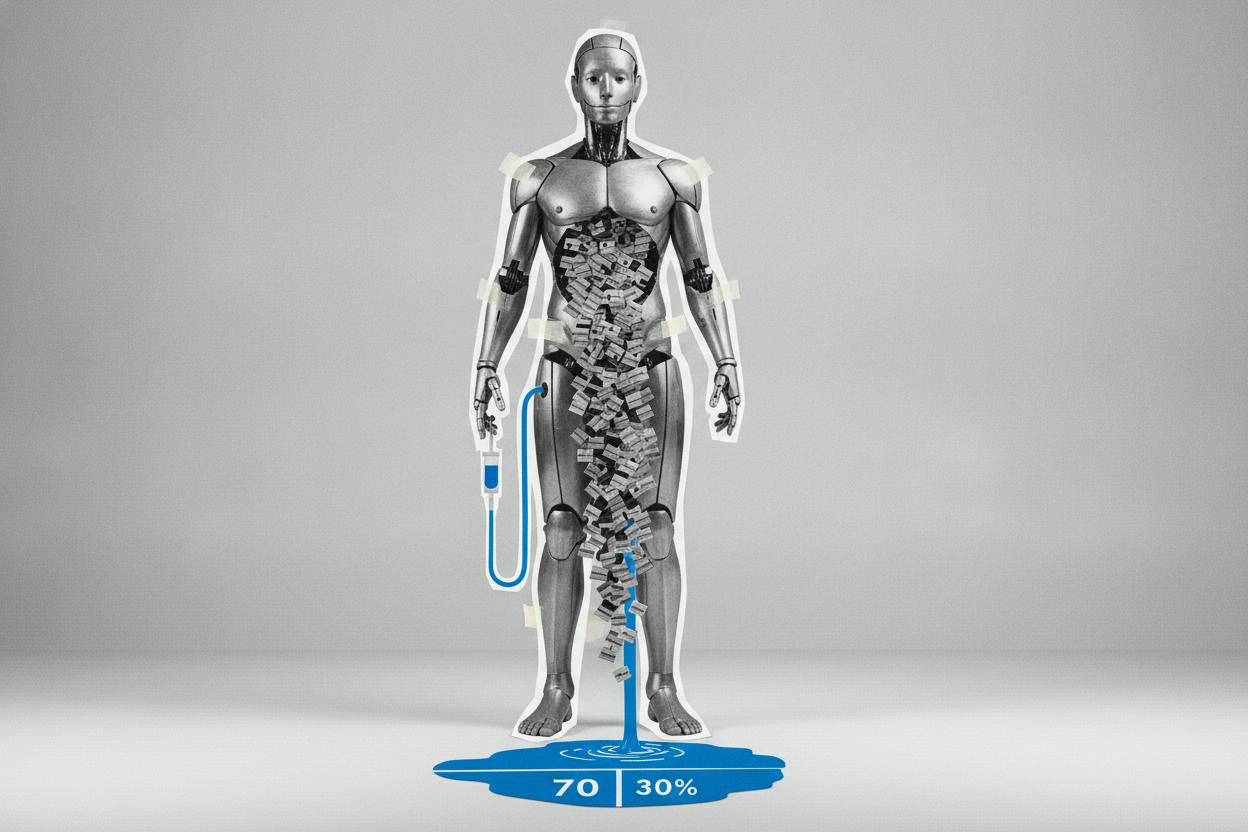
Healthcare Triangle, a small healthcare information technology company, said it has signed a non-binding memorandum of understanding with Malaysia-based AI World to create a joint venture aimed at bringing AI-enabled humanoid "nursing assistant" robots to hospitals in North America. The company's thinly traded stock rose sharply on the announcement.
The proposed venture would be split 70-30, though the brief did not specify which partner holds the larger stake. Because the agreement is a non-binding MOU, it sets out an intention to negotiate rather than a completed transaction — a distinction that matters a great deal for how investors should read the news.
What an MOU actually is
In corporate dealmaking, a memorandum of understanding is an early, usually non-binding document that outlines what two parties hope to build together. It typically covers the broad shape of a partnership — ownership split, scope, and intent — without locking either side into a legally enforceable obligation. Deals at this stage frequently change terms, stall, or disappear entirely before a definitive agreement is signed.
That is why announcements built on MOUs tend to move share prices most in companies with small market capitalisations and light trading volume. When few shares change hands on a normal day, even modest buying interest can produce an outsized percentage move. Investors should treat that kind of pop as a sentiment signal, not a valuation update.
The healthcare robotics space has attracted heavy interest in recent years as hospitals grapple with persistent staffing shortages, rising labour costs, and an ageing population that increases demand for care. Humanoid robots remain an early-stage technology, and deployments in clinical settings are still limited and closely watched for safety and regulatory reasons.
Robotics partnerships are spreading across other industries too. Energy major Eni is testing humanoid robots at its sites, a reminder that automation ambitions are not confined to healthcare.
The hurdles between an MOU and a hospital floor
Bringing a nursing assistant robot into a North American hospital involves far more than engineering. Any device used in patient care faces scrutiny from regulators, must meet strict safety and privacy standards for handling health data, and typically needs buy-in from clinicians who will work alongside it. Hospital procurement cycles are long, and budgets are tight.
There is also the question of what "nursing assistant" means in practice. In most health systems, that role covers tasks such as patient monitoring, moving supplies, and supporting nurses with routine logistics — not replacing clinical judgement. Companies pursuing this market generally position their products as tools that free up staff time rather than substitutes for trained professionals.
For Healthcare Triangle, the strategic logic is that a joint venture could pair its healthcare IT relationships with AI World's technology development. Whether that combination produces a commercially viable product is a question that will only be answered over multiple quarters, if at all.
What it means for investors
The headline is eye-catching, but the substance is thin. A non-binding MOU is the first step in a long process, and there is no guarantee a definitive agreement follows. Investors should watch for concrete milestones: a signed binding agreement, disclosure of capital commitments, pilot programmes with named hospital systems, and any regulatory filings.
It is also worth noting the broader backdrop. Companies across the market are navigating a tougher financing environment as the era of cheap debt fades, with a multi-trillion-dollar refinancing wave looming for Corporate America. For a small-cap firm, funding a capital-intensive robotics venture could require outside capital, which may mean dilution for existing shareholders.
For everyday investors, the practical takeaways are straightforward:
- Distinguish intent from contract. An MOU is a starting gun, not a finish line.
- Watch the volume. Sharp moves in thinly traded stocks can reverse just as quickly as they appear.
- Track the follow-through. Binding agreements, pilot deployments, and revenue disclosures are the signals that matter.
- Consider the sector, not just the story. Healthcare automation has real long-term demand drivers, but timelines are long and execution risk is high.
Healthcare Triangle's announcement puts it in a crowded field of companies betting that AI and robotics can ease pressure on health systems. The idea has merit; the question for investors is whether this particular venture advances beyond a press release. Until binding terms, funding, and clinical partners are disclosed, the news is best treated as an early signal rather than a proven business.