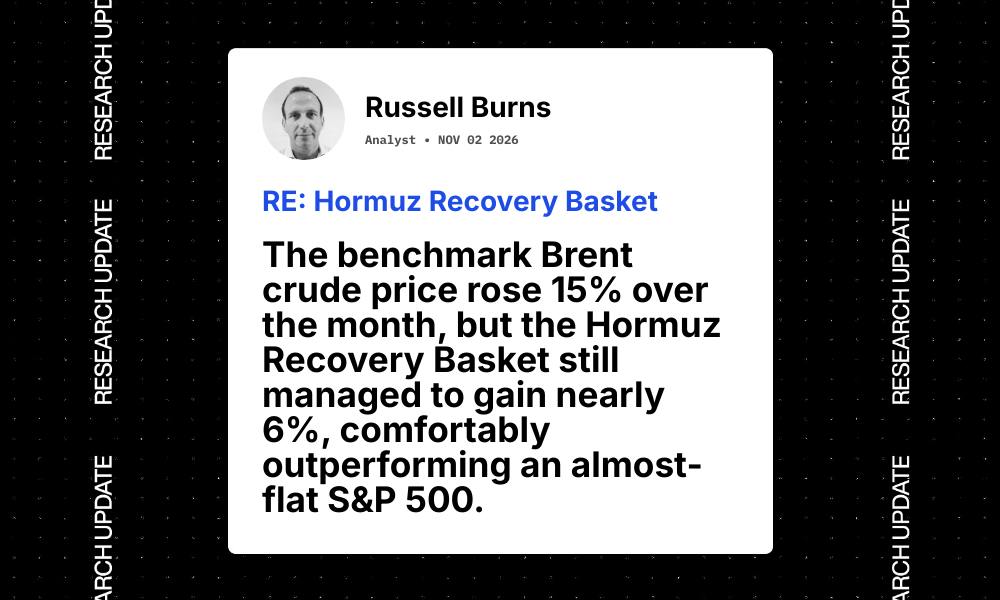
Investors who positioned for a potential reopening of the Strait of Hormuz saw their patience rewarded last month, even as oil prices surged. The Hormuz Recovery Basket—a curated group of stocks expected to benefit from resumed shipping through the critical waterway—gained nearly 6% in the past month, comfortably outpacing the S&P 500, which was roughly flat over the same period.
The resilience is notable because oil prices typically move inversely to stocks that depend on lower energy costs. Brent crude, the global benchmark, jumped 15% during the month, a move that would normally weigh on airlines, cruise operators, and construction firms—all sectors heavily represented in the basket. Yet the basket still managed to post solid gains, suggesting that investors are looking beyond the immediate oil spike to the longer-term recovery story.
What's in the basket and how it performed
The basket is designed to capture companies that would benefit from the reopening of the Strait of Hormuz, a narrow passage between the Persian Gulf and the Gulf of Oman through which roughly 20% of global oil passes. When the strait is disrupted—whether by geopolitical tensions, military conflict, or diplomatic standoffs—shipping costs rise, insurance premiums spike, and supply chains are thrown into disarray. A reopening would ease those pressures, boosting industries that rely on affordable fuel and smooth logistics.
Not every holding pulled its weight last month. The US Global Jets ETF (ticker: JETS), which tracks airline stocks, fell 3% as higher fuel costs ate into profit expectations. Airlines are particularly sensitive to jet fuel prices, so a 15% jump in crude is a direct headwind. The ETF's expense ratio is 0.6%, a detail worth noting for investors considering it as a vehicle for this trade.
But other components more than made up for the drag. Carnival, the cruise line operator, sailed 17% higher after reporting better-than-expected earnings and an upbeat outlook at the end of September. Cruise lines benefit from lower fuel costs and stronger consumer demand, and Carnival's results suggested that the recovery in travel is still on track despite broader economic uncertainty.
Martin Marietta, a major construction materials company, climbed 11% after competitor Vulcan Materials delivered strong results and offered an encouraging pricing outlook for aggregates—the crushed stone, sand, and gravel used in roads, buildings, and infrastructure. When a rival signals that pricing power is holding up, it often bodes well for the whole sector, and investors took that as a positive sign for Martin Marietta's own margins.
Why the basket held up despite oil's surge
The key question is why the basket didn't buckle under the weight of a 15% oil price jump. One explanation is that investors are treating the oil spike as temporary. If the Hormuz situation is resolved, oil prices could fall back quickly, and the stocks in the basket would benefit from both lower input costs and a return to normal shipping flows.
Another factor is that the basket's components are not all equally oil-sensitive. Carnival and Martin Marietta, for example, are more tied to consumer spending and infrastructure demand than to the day-to-day price of crude. Even with higher fuel costs, Carnival's earnings beat showed that demand is strong enough to absorb the hit. Similarly, Martin Marietta's gains were driven by pricing power in aggregates, a market that is more influenced by construction activity than by oil prices.
The broader market context also matters. The S&P 500 was nearly flat, but oil's recent slide has historically lifted stocks, and investors may be positioning for a similar dynamic if the strait reopens. The basket's outperformance suggests that some investors are already looking past the current oil shock to the recovery that could follow.
What it means for everyday investors
For ordinary investors, the Hormuz Recovery Basket offers a way to bet on a specific geopolitical outcome without putting all their eggs in one basket. By holding a diversified mix of airlines, cruise lines, and construction firms, the basket spreads the risk across sectors that would all benefit from a reopening of the strait.
However, it's important to understand the risks. The basket is highly sensitive to oil prices, and if the situation in the Middle East escalates further, oil could keep climbing, dragging these stocks down. The JETS ETF's 3% decline is a reminder that fuel costs can quickly erode profits in travel-related industries.
Investors should also note that the basket's performance is not uniform. As last month showed, some holdings can lag while others surge. Diversification helps, but it doesn't eliminate the risk that a single geopolitical event could move the entire basket in an unexpected direction.
For those considering a similar strategy, it's worth watching a few key indicators: the trajectory of Brent crude, any news about shipping through the strait, and earnings reports from major airlines and cruise operators. Oil price swings can be sharp, and the basket's fortunes are tied closely to them.
Ultimately, the Hormuz Recovery Basket's resilience last month is a testament to the idea that markets often look beyond the headlines. While oil prices surged, investors in this basket were betting on a future where the strait is open, shipping is normal, and the companies in the basket can thrive. Whether that bet pays off depends on events that are notoriously hard to predict, but for now, the basket's performance suggests that some investors see the glass as half full.
As always, it's wise to consider how any thematic investment fits into your broader portfolio. A basket like this can be a useful tool for expressing a view on a specific event, but it should be balanced with other holdings that can weather different scenarios. Safe-haven assets like Treasuries can provide stability when geopolitical tensions rise, and stocks that don't rely on a single catalyst can offer diversification. The key is to understand what you're betting on and why.