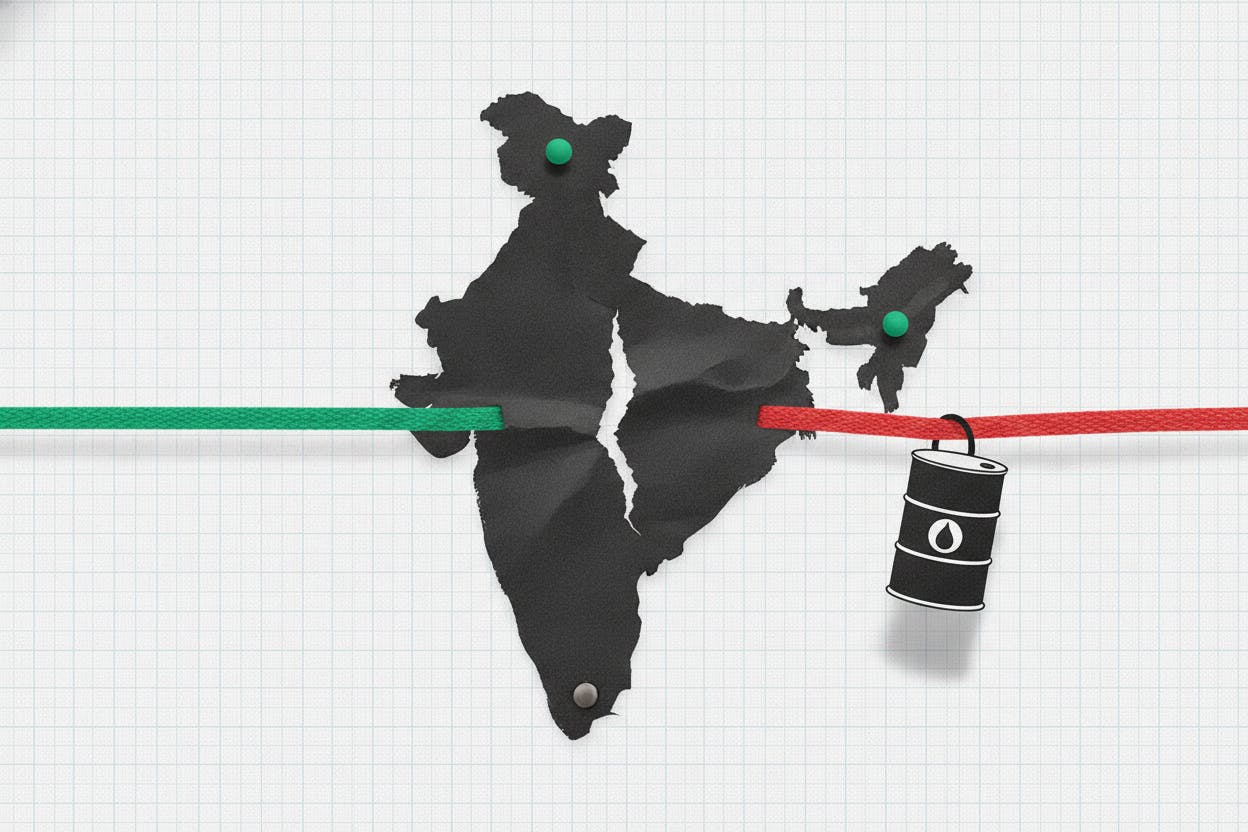
Indian stocks spent Monday swinging between small gains and losses, ultimately closing nearly flat as two powerful forces pulled in opposite directions. On one hand, softer-than-expected US jobs data cooled fears of further interest rate hikes, which tends to support emerging markets like India. On the other, Brent crude oil climbed about 1% to roughly $84.5 a barrel on fresh uncertainty around the Strait of Hormuz, a key shipping chokepoint for global energy supplies.
What's driving the tug-of-war?
The market's indecision reflects a simple but powerful dynamic. When US interest rates look likely to stay lower for longer, the dollar tends to weaken, and global investors become more willing to take on risk in faster-growing economies. That's generally a tailwind for Indian equities, as foreign money often flows into the country's stock market under such conditions. A weak US jobs report can therefore be read as good news for Indian assets.
But oil tells a different story. India imports the vast majority of its crude oil, so when prices rise, the cost of energy feeds into everything from transport and packaging to electricity and manufacturing. That can squeeze corporate margins and add to domestic inflation, which is never welcome for investors. A 1% jump in Brent may not sound dramatic, but when it's tied to potential disruptions in the Strait of Hormuz—through which a large share of the world's oil passes—markets pay attention.
Why the Strait of Hormuz matters
The Strait of Hormuz is a narrow waterway between the Persian Gulf and the Gulf of Oman. Roughly a fifth of global oil consumption moves through it, making it one of the most strategically important shipping lanes on Earth. Any threat of conflict or disruption in the region can quickly push oil prices higher, as traders price in the risk of supply shortages.
Recent regional security worries have already affected other markets. For instance, Dubai stocks edged up while Abu Dhabi slipped on similar concerns, and UAE stocks were split as earnings met Hormuz uncertainty. For India, the stakes are even higher because of its heavy reliance on imported oil.
What it means for investors
For everyday investors, the flat close is a reminder that markets are rarely driven by a single factor. Here, two major forces—US monetary policy and global oil prices—are essentially cancelling each other out. That can make short-term moves look muted, but it doesn't mean nothing is happening underneath.
Investors should watch two things closely in the coming days. First, any further US economic data that could shift expectations about interest rates. A string of weak jobs numbers, like the one that cooled rate-hike bets, could strengthen the case for lower rates and give emerging markets a boost. Second, any headlines out of the Middle East that could push oil higher or lower. A spike in crude would likely weigh on Indian stocks, while a de-escalation could provide relief.
It's also worth noting that Indian markets have been resilient in the face of such crosscurrents. The Nifty and Sensex have shown an ability to absorb shocks, but that doesn't make them immune. For long-term investors, the key is to stay diversified and not overreact to daily swings. As always, it's about the bigger picture, not the noise of a single session.
The broader backdrop
Monday's flat close comes after a period of global volatility driven by US rate expectations. A steady jobless rate of 4.1% in July has helped calm some nerves, but markets remain sensitive to any hint of a slowdown. Meanwhile, oil prices have been a persistent wildcard, with geopolitical tensions adding to supply concerns.
For India, the combination of lower US rates and higher oil prices is a mixed bag. Lower rates can attract foreign capital, but higher oil costs can widen the trade deficit and put pressure on the rupee. That's why the market's hesitation makes sense—investors are weighing these competing forces in real time.
As the week progresses, expect more of the same until a clearer direction emerges. For now, the prudent approach is to keep an eye on both the US economic calendar and headlines from the Gulf, as either could tip the scales.