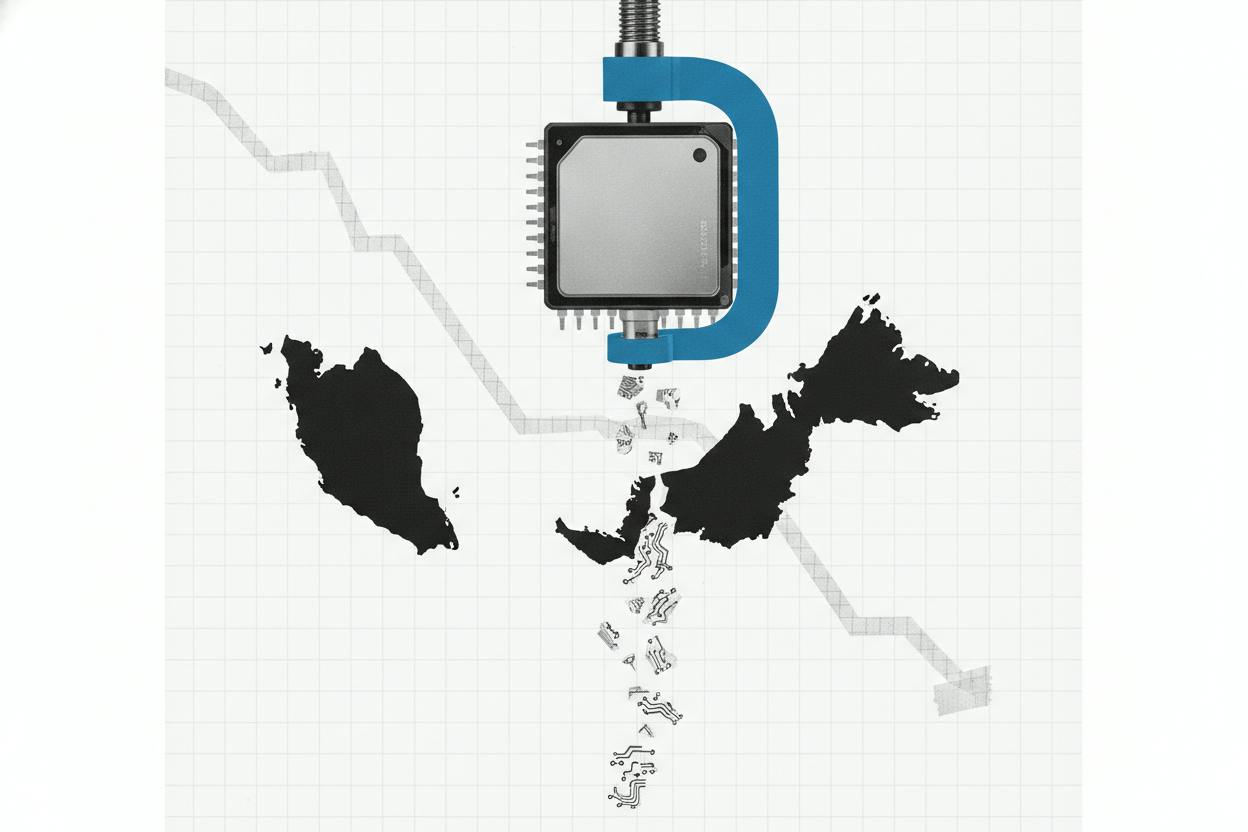
Malaysia's stock market extended its recent slide on Tuesday, with the benchmark FBM KLCI falling 0.5% to 1,566.73. The decline came as investors weighed the impact of tighter US export controls on advanced AI chips destined for Asian data centers—a policy shift that is casting a shadow over the region's tech ambitions even when local companies aren't directly in the crosshairs.
The move reflects a broader caution that has been building across Asian markets, as the US restrictions add a layer of uncertainty to the region's data-center boom. While Malaysia isn't a major chip manufacturer, its economy has been increasingly tied to the AI-driven tech supply chain, and investors are watching how these rules might ripple through the region.
What's behind the slide?
The FBM KLCI's drop is part of a pattern seen in recent sessions, where global tech policy—rather than domestic headlines—has been the main driver of sentiment. The US export curbs, which limit sales of high-end chips to data centers in certain Asian countries, are significant because data centers are among the biggest buyers of these processors. When access to those chips becomes uncertain, the future earnings of companies involved in building and operating data centers feel less dependable.
That uncertainty can spill over into the broader market. Even though most companies in the KLCI don't make chips, the index can still be pressured when investors mark down longer-term growth expectations for anything linked to Asia's AI push. As one market watcher put it, export controls don't just limit sales—they add a "rules might change again" premium that investors apply to the entire sector.
This isn't just a Malaysia story. Similar moves have been seen across the region, with other Asian markets also reacting to the same US policy. The Nikkei's recent rebound and the KOSPI's jump show how sensitive these markets are to AI-related news, both positive and negative.
Growth cools, but stays solid
Adding to the cautious tone, Malaysia's economy expanded 5.5% year-over-year in the third quarter of 2026, down from 6% in the previous quarter. While still a healthy pace, the slowdown suggests the post-pandemic rebound is beginning to moderate. Bank Negara Malaysia also reported that the balance of payments remained in surplus, but the current account surplus narrowed to 5.7 billion ringgit from 10.8 billion ringgit in the prior quarter—a sign that the external sector is losing some momentum.
The GDP figure was in line with expectations, and the country's growth story remains supported by strong domestic demand and a rebound in tourism. However, the cooling pace, combined with the external headwinds from US chip policy, gives investors reason to be more selective.
Mixed company news
On the corporate front, the day's news was mixed rather than uniformly negative. Palm oil producer TSH Resources reported profit attributable to owners of 17.8 million ringgit, down sharply from 56.4 million a year earlier. Despite the drop, its shares rose about 2%, suggesting investors had already priced in the weaker results and were looking ahead to better conditions in the palm oil market.
In capital markets, SCA Solutions said it plans to raise 31.9 million ringgit through an initial public offering on the ACE Market, priced at 0.28 ringgit per share. The ACE Market is Bursa Malaysia's board for smaller, growth-oriented companies, and this IPO is a test of investor appetite for new listings in the current cautious environment.
Elsewhere, OM Holdings completed its move of registration from Bermuda to Singapore and rebranded as OM Materials Holdings. The relocation is part of a broader trend of companies seeking to align their corporate structures with their operational footprints.
What it means for investors
For everyday investors, the key takeaway is that US policy decisions can have a global ripple effect. Even if you don't own chip stocks, the sentiment around AI and data centers can influence the entire market, as seen in the KLCI's slide. This is a reminder that diversification across regions and sectors can help cushion against such external shocks.
The cooling GDP growth and narrowing current account surplus are also worth watching. While 5.5% growth is still respectable, the trend is downward, and investors will be looking to see if this continues in the coming quarters. The central bank's next moves on interest rates will be closely watched, as will any further developments on the US export-control front.
For those considering new listings like SCA Solutions' IPO, the cautious tone suggests that demand may be more selective. Smaller deals could be more sensitive to sentiment, so it's important to assess each opportunity on its own merits rather than assuming the market will greet every new issue with enthusiasm.
In the meantime, the broader regional picture remains tied to the AI trade. As Nvidia's latest earnings showed, demand for AI chips is still booming, but the regulatory environment is becoming a bigger factor. Investors should keep an eye on how these rules evolve, as they could have lasting implications for the entire tech supply chain.