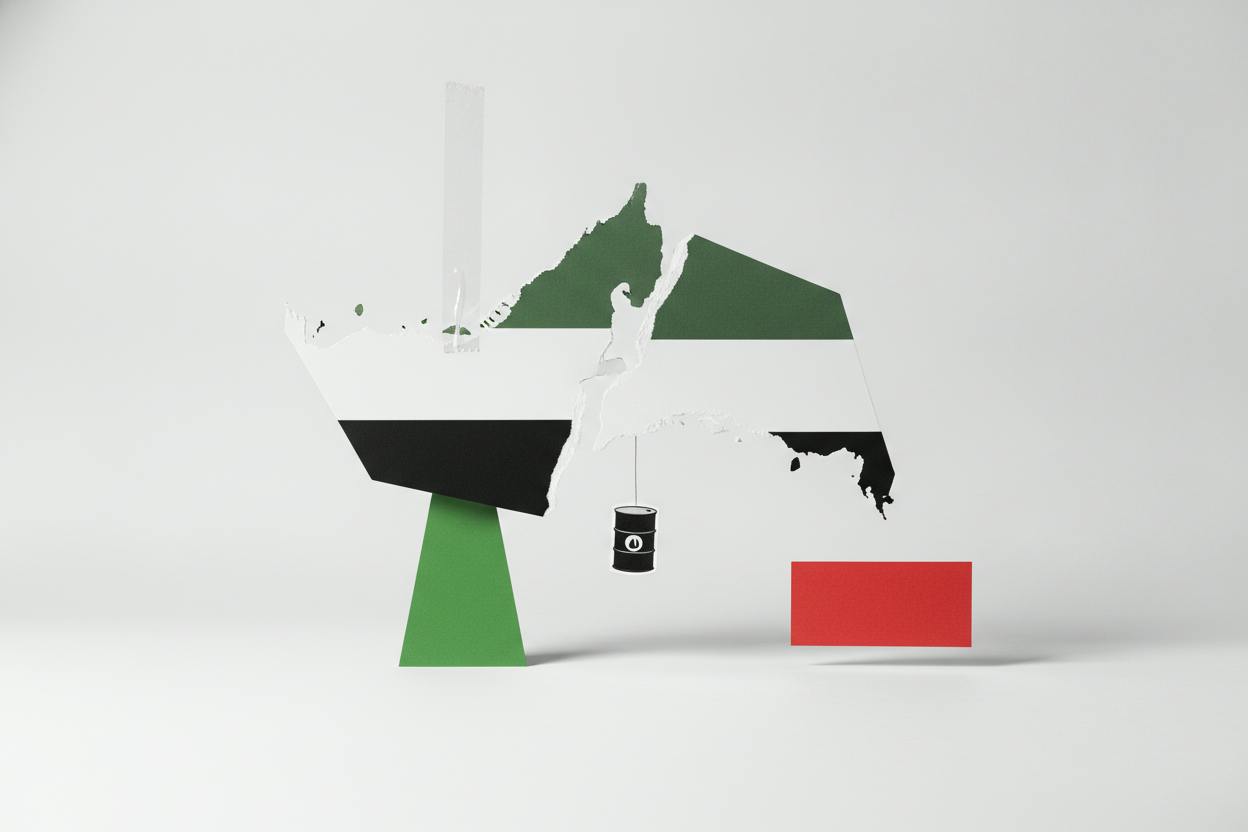
Middle East tensions are splitting the UAE's two main stock markets, with Abu Dhabi's FTSE ADX rising 1.092% while Dubai's DFM fell 0.493% on the day. The divergence reflects how investors are weighing fresh geopolitical risks against a softer oil market.
What's driving the split?
The move comes as traders track headlines about potential US military action against Iran. Reuters, citing Axios, reported that US President Donald Trump said he faced a "big decision" on whether to resume large-scale attacks on Iran. Such headlines typically make investors more cautious, as they raise the risk of supply disruptions in the world's key oil-producing region.
Yet oil prices did not climb in step with the tension. Danske Bank, a Danish lender, noted that Brent crude was slightly above $100 a barrel but on track for its first weekly decline in three weeks, even as tanker transits through the Strait of Hormuz remain a focus. Softer oil can weigh on energy-related stocks, but it can also ease inflation concerns and support broader equities.
The two UAE exchanges often move differently because of their distinct compositions. Abu Dhabi's index is heavily weighted toward energy and large-cap names, which can benefit from geopolitical risk premiums. Dubai's market is more tilted toward financials, real estate, and consumer plays, which may be more sensitive to global risk sentiment and oil price moves.
Why oil and geopolitics are pulling in opposite directions
Geopolitical tensions usually push oil prices higher, as investors price in the chance of supply disruptions. But this time, oil has been softer, partly because of concerns about global demand and the possibility that any conflict could be contained. The result is a market that is trying to price in two competing forces at once.
For investors, this means that a single headline can cause sharp, short-term swings in regional markets. The split between Abu Dhabi and Dubai shows that not all stocks react the same way to the same news. Energy-heavy indices may rally on geopolitical risk, while more cyclical sectors may lag if investors worry about the economic fallout.
This dynamic is not unique to the UAE. Global markets are also grappling with the same crosscurrents. As we noted in our piece on stocks facing a triple test from yields, oil, and AI, oil at $100 a barrel is a key level that can either fuel inflation or, if it falls, ease pressure on central banks.
What it means for everyday investors
For ordinary investors, the key takeaway is that geopolitical events can create volatility, but they don't always move markets in a straight line. The fact that oil prices are not surging despite the tensions suggests that traders may be betting on a de-escalation, or that demand concerns are offsetting supply fears.
If you hold funds or ETFs that track UAE or broader Gulf markets, you should expect continued swings. The split between Abu Dhabi and Dubai is a reminder that diversification within a region matters. An index that is heavy in energy may behave very differently from one that is more focused on financials and real estate.
It's also worth watching how oil prices evolve. If Brent stays above $100, energy stocks could continue to outperform, but that could also reignite inflation worries. The Reserve Bank of Australia recently warned that Middle East conflict and AI data centers are reigniting inflation, a concern that could influence central bank policy globally.
What to watch next
Investors will be closely monitoring any new headlines out of Washington or Tehran. A clear escalation could push oil higher and boost energy-heavy indices like Abu Dhabi's, while a de-escalation could reverse the recent gains. On the other hand, if oil continues to slide, that could ease inflation pressures and support riskier assets, including Dubai's more cyclical stocks.
Also keep an eye on the broader global backdrop. Treasury yields near 5% and the ongoing debate over AI valuations are adding to the uncertainty. As we noted in our analysis of tech stocks leading a rally as yields slide, the direction of yields can have a big impact on equity valuations.
For now, the UAE market's split is a textbook example of how geopolitical risk and commodity prices can pull investors in different directions. The best approach for most investors is to stay diversified and avoid making impulsive moves based on daily headlines.