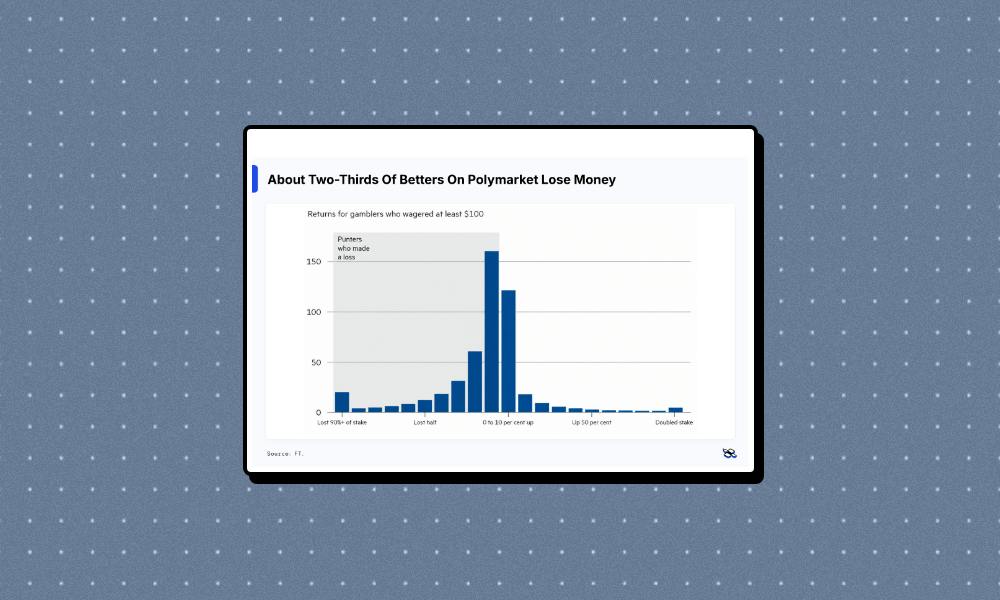
Predicting the future has never been easy, and a new analysis suggests it's not particularly profitable either—at least for most people on the prediction market platform Polymarket. According to a Financial Times examination of 170 million bets placed by 1.2 million accounts since April, a striking 68% of users who wagered more than $100 ended up in the red. Even more sobering, 4% of those losers lost their entire stake.
Who's winning on Polymarket?
The analysis paints a picture of a platform where the vast majority of participants are losing money, but a select few are making substantial gains. The biggest winner, a trader using the handle "swisstony," has reportedly pocketed over $12 million betting on sports. But swisstony's success wasn't about hitting a lucky long shot. Instead, the account made 184,000 trades, exploiting small pricing discrepancies to earn an average return of just under 2% on each trade. That might sound modest, but across $657 million in total wagers, those small edges added up to a fortune.
This approach—high volume, low margin, and a focus on finding mispriced odds—is a far cry from the typical bettor's strategy of wagering on a hunch or a headline. It's a reminder that in prediction markets, as in traditional investing, the people who consistently make money often do so through discipline and scale, not luck.
What are prediction markets?
For those unfamiliar, Polymarket is a decentralized prediction market where users can buy and sell shares in the outcome of future events—from election results to sports games to economic data releases. The prices of these shares reflect the market's collective probability of an event occurring. For example, if a share in "Candidate X wins the election" trades at 60 cents, the market implies a 60% chance of that outcome.
These platforms have grown in popularity as a way to gauge public sentiment and, for some, as a speculative playground. But the FT's analysis highlights a crucial point: the house—or in this case, the platform—isn't the only one taking a cut. The majority of participants are effectively transferring money to a small group of sophisticated traders.
What it means for everyday investors
For the average person, the takeaway from this data is straightforward: prediction markets are not a reliable way to make money. The odds are heavily stacked against the casual bettor. The 68% losing rate among those who wagered more than $100 is a stark statistic, and it's likely even worse for those who bet smaller amounts, as they may not have the capital to overcome transaction costs or the ability to spot the kind of pricing inefficiencies that swisstony exploited.
This isn't to say that prediction markets are worthless. They can be valuable tools for gathering information and understanding market sentiment. For instance, Meta's AI spending warning recently moved Treasury yields, and prediction markets can sometimes offer a real-time read on how such events might unfold. But using them as a primary investment vehicle is a different story.
The dynamics at play here are similar to those in other areas of finance. Just as Europe's biggest banks can beat forecasts through scale and strategy, the winners on Polymarket are often those with the resources to execute complex strategies. The average retail participant, by contrast, is often at a disadvantage.
The bottom line
The FT's analysis is a useful reality check for anyone tempted by the allure of prediction markets. While the platform's biggest winners make for compelling headlines, they are the exception, not the rule. For most, the experience is more likely to end in a loss—sometimes a total one.
For investors, the lesson is to treat prediction markets as entertainment or as a source of information, not as a get-rich-quick scheme. The same principles that apply to traditional investing—diversification, understanding risk, and avoiding putting money at stake that you can't afford to lose—are even more critical in a realm where the odds are so clearly against the average participant.
As with any speculative activity, it's wise to approach with caution. The data suggests that for every swisstony, there are thousands of bettors who are, on average, poorer for their participation.