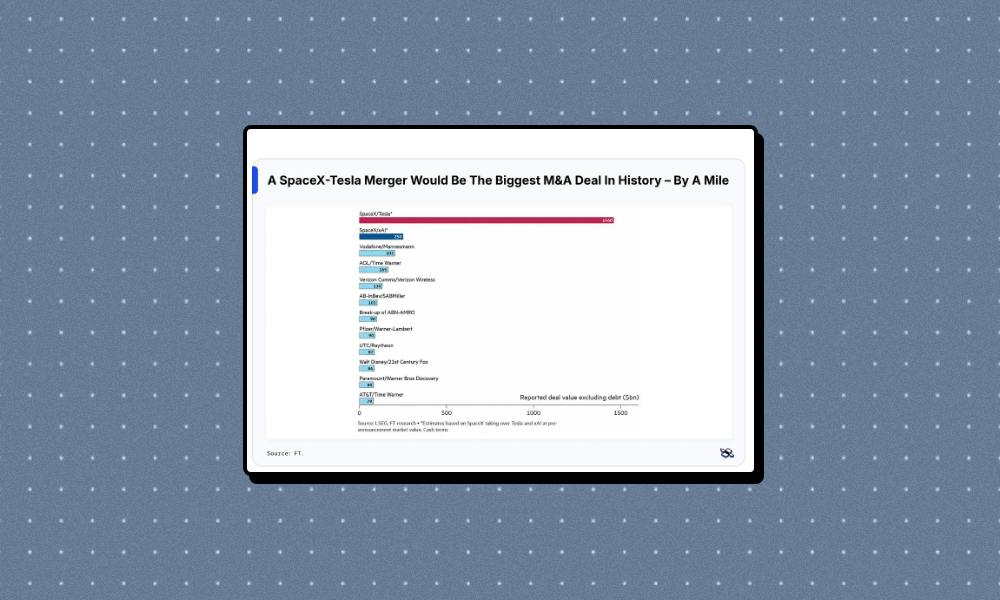
Elon Musk, the world's first trillionaire, is reportedly exploring what could be his most ambitious move yet: merging Tesla and SpaceX into a single company. If completed, the combination would mark the largest merger in corporate history and create the fifth-most-valuable publicly traded company on the planet.
The idea, first floated by Musk himself, is still in its early stages and faces enormous hurdles. But even as a proposal, it has captured the attention of investors who are trying to gauge what a combined Tesla-SpaceX would look like—and what it would mean for their portfolios.
Why combine two giants?
Musk's rationale, according to people familiar with his thinking, centers on accelerating his artificial intelligence ambitions. He believes that merging the two companies could speed up development in areas like self-driving cars, humanoid robots, and even data centers in space. The businesses already collaborate closely, sharing work on advanced chips, batteries, and futuristic vehicles.
Tesla, the electric-vehicle maker, has long positioned itself as an AI company, with its Full Self-Driving software and Optimus robot projects. SpaceX, meanwhile, has been building a satellite internet network called Starlink and developing reusable rockets. A merger could allow the combined entity to pool resources, talent, and technology in ways that Musk argues would be mutually beneficial.
But the deal would also be a massive financial undertaking. The combined market value of Tesla and SpaceX would place the new company behind only a handful of the world's largest firms. The sheer scale of the transaction would test the limits of corporate finance and regulatory approval.
The risks are hefty
For all the potential upside, the risks are substantial. Merging two complex, capital-intensive businesses with different cultures and regulatory environments is never easy. Tesla is a public company with a history of volatile earnings and a heavy reliance on consumer demand for cars. SpaceX, while highly valued in private markets, has its own set of challenges, including the high cost of launches and the need for continuous innovation.
There's also the question of how such a deal would be structured. Would it be a stock swap, a cash buyout, or something else? Musk has not provided details, and any transaction would require approval from shareholders of both companies—and likely from antitrust regulators around the world.
Investors have reason to be cautious. Past mega-mergers in tech and other sectors have often failed to deliver the promised synergies, and integrating two companies of this size would be a monumental task. The potential for disruption to both businesses is real.
What it means for investors
For everyday investors, the news is a reminder of the outsized influence Musk has on the markets. Tesla's stock has been a major driver of the S&P 500's performance in recent years, and any major corporate action involving the company can ripple through the broader market. The bull market's fourth anniversary has been powered in part by tech giants like Tesla, so a major restructuring could shift sentiment.
If the merger goes through, it could create a new kind of conglomerate—one that spans earth and space. But it could also dilute the focus of both companies, and shareholders may end up with a more complex, harder-to-value investment. The risks of data-center investments are a cautionary tale for those betting on Musk's AI-driven vision.
For now, the proposal is just that—a proposal. Musk has a history of making bold statements that don't always come to fruition. But if he does pursue this, it would be the biggest bet of his career, and one that could reshape the investment landscape for years to come.
Investors should watch for more details, including any formal proposal, regulatory filings, or comments from Musk himself. Until then, the idea remains a fascinating but uncertain prospect.