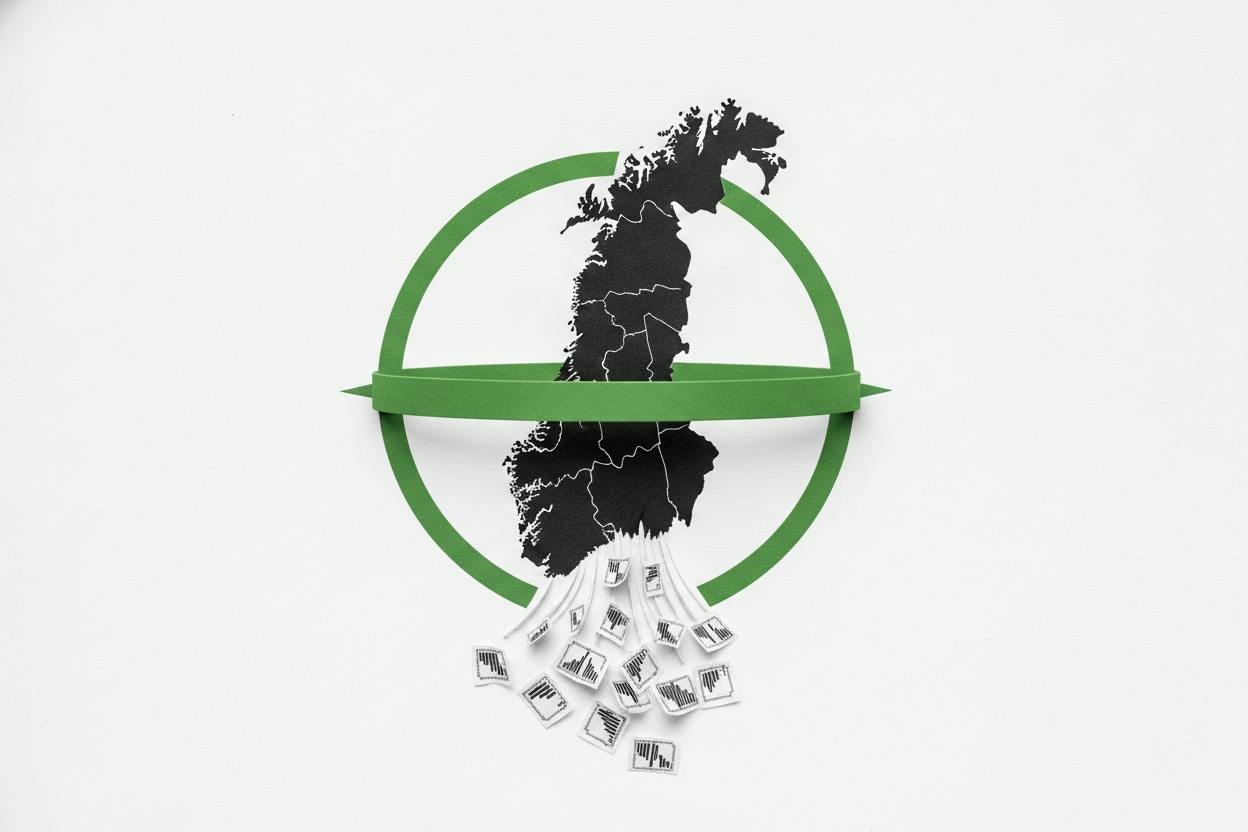
A new alliance backed by two of the Nordic region's most influential business dynasties is making the case for a bigger, more integrated home market for fast-growing companies. Nordic Compass, launched this week at a gathering in Gothenburg, wants to keep the region's scaleups funded and listed locally rather than watching them drift toward deeper US capital pools.
The group, supported by Sweden's Wallenberg family and Finland's Herlin family, is pitching a set of projects across capital markets and strategic industries. Its headline idea is an independently run fund for fast-growing companies, designed to close what it calls a roughly €10 billion growth-capital gap. The alliance estimates Nordic firms may need up to €35 billion in early-stage funding between 2027 and 2031.
Why scaleups leave home
The core problem, as Reuters flagged, is that Europe's capital markets remain chopped up by national borders. That fragmentation can push successful companies toward deeper US pools of money and US listings, as seen with Swedish-founded Spotify and Klarna. Both chose to list or raise capital in the US, where investor depth and liquidity are harder to match at home.
Nordic Compass wants to change that by creating a common public marketplace that links trading in roughly 1,400 listed Nordic companies worth about €2.5 trillion. The plan would leave existing exchanges independent, but connect them so that investors can trade across the region more easily.
Nikolaj Kosakewitsch, an executive at Nasdaq Europe, said the goal is to line up the market's “plumbing” – trading, clearing, settlement, and custody – so cross-border transactions get cheaper. Some of the regulatory work, he acknowledged, could take years.
What a linked market could mean
For investors, the promise is a reduction in the day-to-day friction of trading across borders. Standardizing post-trade steps like clearing and settlement – the behind-the-scenes process of matching, paying, and delivering securities – tends to lower fees and operational risk for big investors. That makes it easier to trade Nordic shares at scale.
Better liquidity typically narrows bid-ask spreads, the gap between what buyers are willing to pay and what sellers want. That can translate into a lower “extra return” investors demand for owning smaller, harder-to-trade stocks. For Nordic small- and mid-caps, cheaper capital markets plumbing can mean a lower cost of raising equity and a stronger case for doing IPOs and follow-on fundraising in the region rather than leaning on US venues.
The idea is not new – European policymakers have long talked about a capital markets union to deepen and integrate the continent's financial markets. But progress has been slow, and the Nordic initiative is a private-sector attempt to move faster within a smaller, more cohesive region.
What it means for investors
For everyday investors, the immediate impact is likely to be modest. The plan is at an early stage, and the regulatory hurdles are significant. But if it succeeds, it could make Nordic stocks more attractive to international investors, potentially supporting valuations for the roughly 1,400 companies that would be part of the linked marketplace.
It could also give Nordic startups and scaleups a more credible alternative to a US listing, which might keep more of the region's future tech champions at home. That would broaden the investment universe for local investors who prefer to keep their money in the region.
Investors should watch for concrete steps, such as the creation of the growth fund or agreements between exchanges on common standards. Until then, the plan is more of a statement of intent than a market-moving event.
For context, other regions have also been working to deepen their capital markets. In Asia, for example, Indonesia's market has shown how local liquidity can diverge from global trends, while Latin American markets have been sensitive to central bank policy. And in the US, treasury moves often reflect the interplay of politics and oil, a reminder that market structure is just one factor in how assets are priced.
Nordic Compass is aiming to make the region's market structure less of a drag. Whether it succeeds will depend on turning a good idea into working infrastructure – and that, as the alliance itself acknowledges, will take time.