Wall Street drifted lower on Wednesday as investors held their breath ahead of Nvidia's fiscal third-quarter earnings, due after the closing bell. The tech-heavy Nasdaq Composite fell 1.1%, while the broader S&P 500 also slipped, as the market's recent AI-driven rally took a pause.
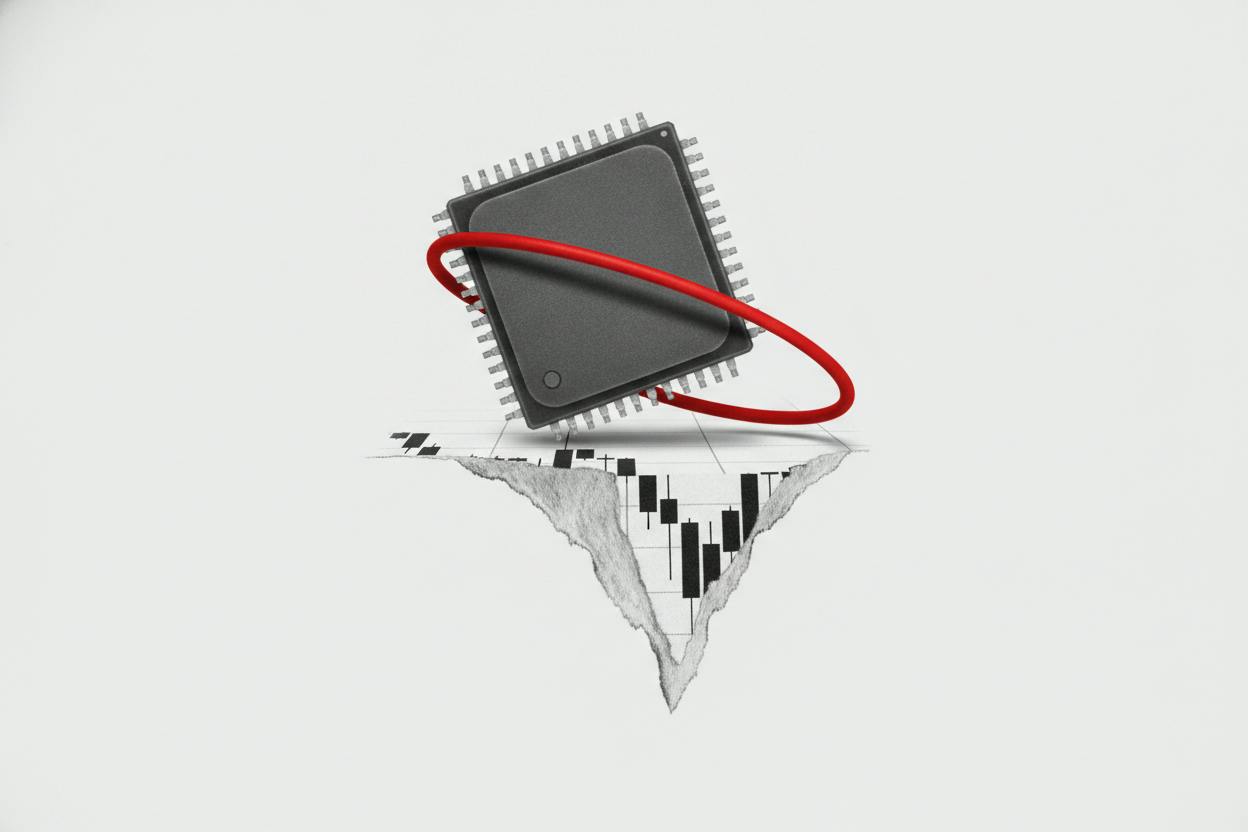
The pullback was most pronounced in technology and semiconductor stocks, where Nvidia has become a bellwether for the artificial intelligence boom. The iShares PHLX Semiconductor ETF, a widely followed chip fund with roughly $43.67 billion in assets, was down 1.4% intraday. That decline came even before any new fundamental information landed, highlighting the nervousness surrounding one of the market's most influential companies.
Why the VIX jumped
The Cboe Volatility Index, commonly known as the VIX, surged 9.7% to 25.13. The VIX measures expected stock-market volatility over the next 30 days, based on options prices. A reading above 20 typically signals heightened investor anxiety, and a jump of this magnitude suggests traders are bracing for a potentially large move in Nvidia's stock—and by extension, the broader market.
This kind of pre-earnings jitter is common when a mega-cap company reports after the bell. Because Nvidia's results can swing the entire tech sector, investors often reposition or hedge ahead of the announcement. The so-called "gap risk"—the chance that a stock opens sharply higher or lower the next day—is especially pronounced for Nvidia, given its outsized weight in major indexes and its role as a proxy for AI sentiment.
Nvidia's outsize influence
Nvidia has become the face of the AI trade, with its graphics processing units (GPUs) powering everything from data centers to large language models. Its earnings are seen as a barometer for AI demand, and any disappointment could ripple through the entire supply chain, from chipmakers to cloud providers.
The company has also been navigating a complex regulatory environment. Earlier this year, Nvidia elevated export controls to a board-level committee amid U.S. scrutiny of its sales to certain countries. That backdrop adds another layer of uncertainty for investors trying to gauge the company's future growth prospects.
For everyday investors, the key takeaway is that Nvidia's results can move markets far beyond its own stock. A strong report could reignite the AI rally, while a miss—or even cautious guidance—could trigger a broader selloff in tech and growth stocks.
What it means for investors
For those with diversified portfolios, a single company's earnings—even one as large as Nvidia—shouldn't dictate long-term strategy. But it's worth understanding that index funds and ETFs with heavy tech weightings will feel the impact of Nvidia's move. The iShares PHLX Semiconductor ETF, for example, is a common holding for investors seeking exposure to the chip sector, and its performance is closely tied to Nvidia's fortunes.
Investors should also keep an eye on the VIX. A sustained spike in volatility can affect everything from options pricing to the attractiveness of risk assets. While a single day's jump isn't alarming, a pattern of rising volatility could signal that the market is entering a more turbulent phase.
Looking ahead, the market will be watching Nvidia's guidance for the coming quarters, as well as any commentary on AI spending trends. Some analysts have questioned whether the massive capital expenditures on AI infrastructure are sustainable, but others argue that the demand for computing power remains robust. For a deeper dive into that debate, see why Wall Street's AI spending fears may be overblown.
In the meantime, the broader market is also digesting a mix of economic data and central bank signals. The U.S. dollar has been under pressure recently, and Treasury yields have eased on softer economic reports. Those dynamics, combined with Nvidia's earnings, are likely to keep markets on edge in the near term.
For investors, the best approach is to stay focused on their own financial goals and risk tolerance, rather than reacting to daily market swings. Nvidia's report is important, but it's just one piece of the puzzle in a complex global economy.