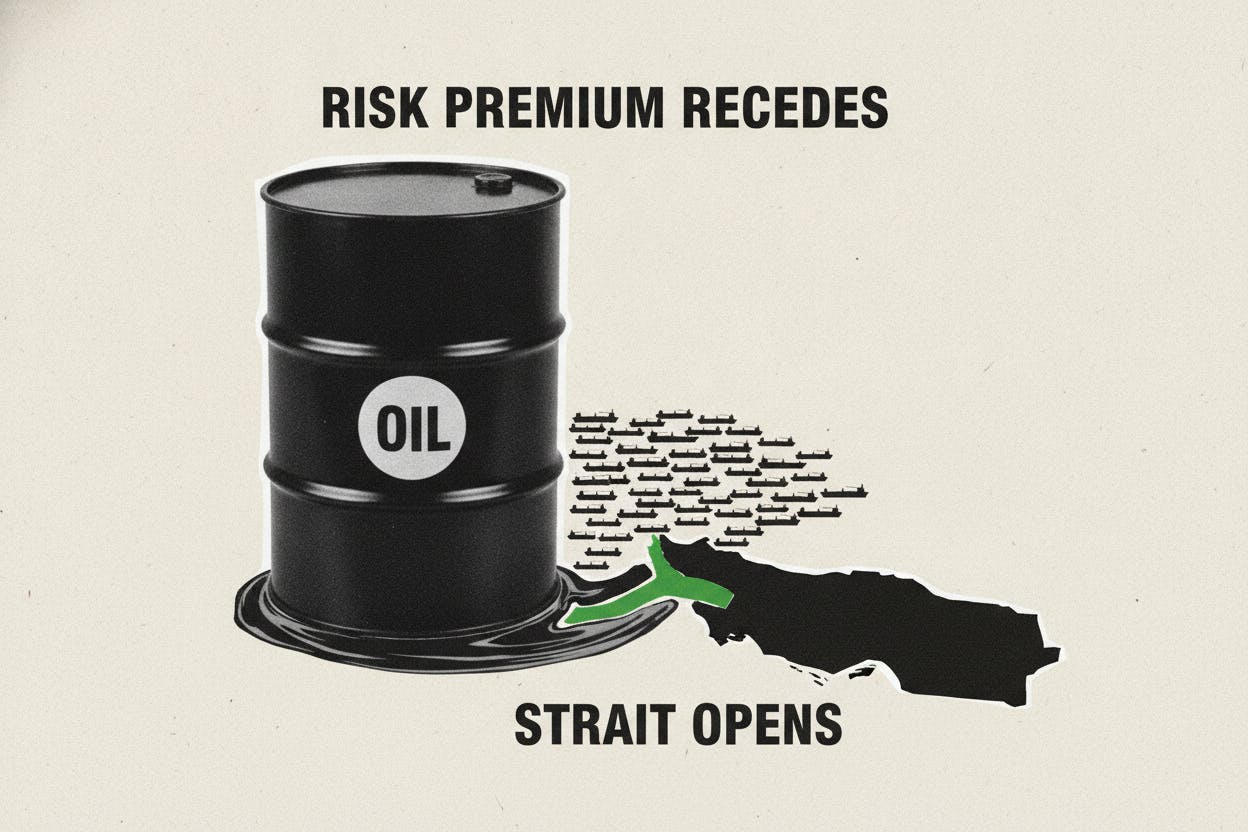
Oil prices tumbled to their lowest levels in four months on Tuesday, as signs of easing tensions between the United States and Iran reduced the so-called risk premium that had been baked into crude prices. Brent crude settled at $71.57 a barrel, down $1.38, while the US benchmark West Texas Intermediate (WTI) fell 92 cents to $68.58.
The move came after President Donald Trump said that US-Iran talks in Qatar had gone well, and as tanker traffic through the critical Strait of Hormuz began to recover. Vice President JD Vance added that flows through the waterway were back near pre-conflict levels, a significant development given that the strait is a narrow chokepoint through which about a fifth of the world's oil passes.
What's behind the price drop?
Until recently, crude prices included a 'risk premium' — an extra cost tied to the chance of supply being interrupted — following the US-Israeli strike on Iran. That premium has now started to fade as diplomatic channels open and shipping activity normalizes. The recovery in tanker traffic through the Strait of Hormuz is a practical signal that the worst-case scenario — a prolonged blockade or military escalation — is becoming less likely.
For context, the Strait of Hormuz connects the Persian Gulf with the Gulf of Oman and the Arabian Sea. Any disruption there can quickly ripple through global oil markets, as it did earlier this year when tensions spiked. The easing of those fears has allowed prices to fall back to levels last seen before the conflict escalated.
Related coverage: Oil Prices Slip as US-Iran Talks and Shipping Recovery Ease Supply Fears
Supply and demand still matter
While geopolitics grabbed the headlines, the fundamental forces of supply and demand haven't disappeared. The Energy Information Administration (EIA), a US government agency, reported that US crude inventories fell by 3.8 million barrels to 408.4 million last week. That drawdown came as refineries ramped up activity ahead of the July 4 holiday weekend, a period of high gasoline demand.
Looking ahead, if OPEC+ adds more production from August as expected, prices may become more sensitive to how much new supply actually shows up now that the geopolitical picture looks calmer. The combination of easing tensions and potential extra supply could keep a lid on prices in the near term.
What it means for investors
For everyday investors, the drop in crude prices is a reminder that geopolitical events can create short-term volatility, but the market eventually refocuses on supply and demand. Lower oil prices can be a tailwind for sectors that rely on energy as an input cost, such as airlines, shipping companies, and manufacturers. Conversely, energy stocks and exchange-traded funds (ETFs) may face headwinds if prices stay low.
However, the pass-through to the pump is not instant. Crude is refineries' main input cost, so lower Brent and WTI typically means cheaper replacement barrels and, with a lag, lower wholesale gasoline and diesel prices. But that pass-through isn't instant: stations sell older inventory first, and much of what you pay reflects taxes, transport, and retailer margins that don't fall just because crude does. Plus, the EIA's inventory draw signals refineries are running harder into a high-demand travel period, and tight refining capacity can keep pump prices firmer than the oil headline suggests until costs filter through.
For those with exposure to commodities or energy-focused investments, the key takeaway is that the risk premium has diminished, but the market is not out of the woods. Any new escalation could quickly reverse the recent decline. Investors should watch for further developments in US-Iran talks and OPEC+ production decisions in the weeks ahead.
Related coverage: UAE Stocks Split as US-Iran Talks in Qatar Raise Hopes for Oil Flow Stability and South Africa's Rand Holds Near 16.37/$ as US-Iran Talks and Factory Sentiment Weigh